What types of aerospace components does Criterion Precision Machining produce?
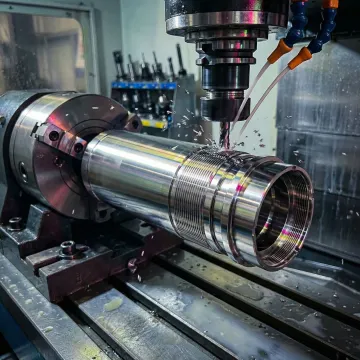
Criterion produces a wide range of aerospace components including structural parts, mounting brackets, shafts, fasteners, rotational components, instrumentation parts, sensor housings, micro-fasteners, and flight control system components. Their CNC milling, CNC turning, and Swiss turning capabilities allow them to handle everything from complex multi-axis geometries to small-diameter, high-precision parts for aircraft, defense systems, and space applications.
What CNC machining capabilities does Criterion's aerospace machine shop offer?
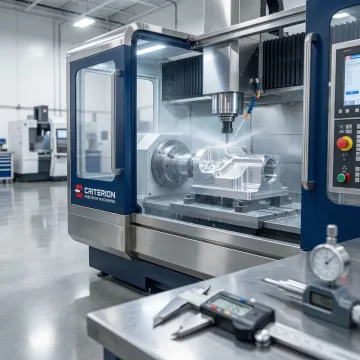
Criterion offers a full suite of CNC machining services including 3-, 4-, and 5-axis CNC milling, 2-axis and 6-axis multi-tasking CNC turning with live tooling, and 8-axis Swiss-style turning for small-diameter components with diameters as small as .010". These advanced capabilities allow the shop to produce complex geometries with consistent precision and repeatability for flight-critical aerospace applications.
What aerospace-grade materials can Criterion machine?
Criterion specializes in machining a broad range of aerospace-grade materials including titanium alloys (Ti-6Al-4V), aluminum alloys (7075-T6 and 6061), stainless steels (300 and 400 series), PEEK, and specialty aerospace composites. Their machinists have extensive experience with the cutting parameters, tooling, and techniques required for each of these challenging materials to ensure optimal surface finishes and dimensional accuracy.
What certifications does Criterion hold for aerospace machining work?
Criterion is ISO 9001 certified and also holds ISO 13485 certification, FDA registration, and ITAR registration. While they do not currently hold AS9100 certification, their quality management system incorporates aerospace best practices, rigorous inspection protocols, and complete traceability documentation. They are also WBENC certified as a woman-owned business enterprise.
What quality inspection systems does Criterion use to verify aerospace parts?
Criterion uses a comprehensive set of quality assurance tools including a Global Advantage CMM (Coordinate Measuring Machine), OASIS optical inspection systems, and Keyence measurement systems. Components are verified at multiple stages throughout production to ensure complete conformance to aerospace blueprints and quality standards before delivery.
What documentation does Criterion provide with completed aerospace components?
Criterion provides a complete documentation package with every aerospace order, including Certificates of Conformance, material certifications with heat lot traceability, first article inspection reports, dimensional inspection data from their CMM systems, and any special testing results required. This documentation supports customers' aerospace quality management systems and regulatory compliance requirements.
Can Criterion handle both prototyping and full production runs for aerospace parts?
Yes. Criterion offers production-intent prototyping using the same CNC equipment and inspection systems as full production runs, which validates a design's manufacturability, fit, and function before committing to volume manufacturing. Once a prototype is approved, the transition to higher-volume production is seamless—no reprogramming or re-qualification is needed—saving time and ensuring consistency.
How long has Criterion been providing aerospace machining services?
Criterion Precision Machining has been providing precision machining services since 1953, giving them decades of experience machining flight-critical components. Their leadership is described as third-generation expertise, reflecting a long legacy of specialization in precision machining for industries where failure is not an option, including aerospace, defense, and space applications.