Meta Title: Aerospace Product Development: Guide & Best Practices
Meta Description: Learn how aerospace product development works, from compliance to design and risk control. Get strategies to avoid delays and build certification-ready systems.
Aerospace development doesn’t give you room to fake competence. A single tolerance slip can freeze certification, bleed cash, and slow a program for years. Type approval alone usually sits in the 5-9 year window, and that timeline dictates every budget, supplier decision, and engineering trade.
What makes this category different is not the tooling or the materials. It’s the scrutiny. Every fastener, software block, and load path must prove it can fly without becoming a headline. Tolerances live in microns. Documentation is evidence, not admin. And certification isn’t a finish line. It’s the frame everything else must fit into.
This guide is not about hype or speed claims. It’s about how you design, verify, and build in a way that keeps auditors off your back, avoids rework spirals, and holds schedule under real regulatory pressure.
Key Takeaways:
The real threat in aerospace isn’t bad engineering. It’s unmanaged decisions that drift the design off-course over the years.
Certification pressure shapes every choice, so teams that bake compliance into day one avoid the rework trap.
The fastest programs aren’t the ones that rush to build. They’re the ones eliminating hidden failure paths early through simulation, modularity, and solid configuration control.
Digital traceability cuts chaos by keeping requirements, tests, and hardware linked, which stops late-stage surprises.
Partners like Criterion matter because precision manufacturing removes variability, which is the one thing certification auditors never tolerate.
What Aerospace Product Development Actually Involves
Aerospace product development is the full engineering cycle of taking flight hardware from concept to certified operation. Systems must perform from -65°F to 160°F, at altitude, under vibration, without mid-flight repair access.
Work spans avionics integration, propulsion mechanics, structural analysis, fatigue-resistant materials selection, fail-safe embedded software, and human factors, where a poor interface becomes a safety incident.
The challenge is to create systems that work consistently, scale in manufacturing, and maintain performance over thousands of flight hours. This requires:
Flight-worthiness and regulatory compliance: designs must demonstrate structural integrity, fail-safe operation, and traceability from requirements to hardware and software.
Seamless cross-domain integration: electrical, mechanical, software, and human interfaces must interoperate flawlessly, with no undocumented assumptions.
Materials durability: components must withstand corrosion, extreme temperatures, and fatigue to ensure decades of safe operation.
Once you understand the integration complexity, the next question becomes how to structure the work so nothing critical gets missed.
Core Phases of Aerospace Product Development
Building an airplane or spacecraft is like solving a giant puzzle where every piece affects the others. Programs fail not because steps are skipped, but because things happen in the wrong order or with missing information. Small mistakes early on can turn into huge problems later.
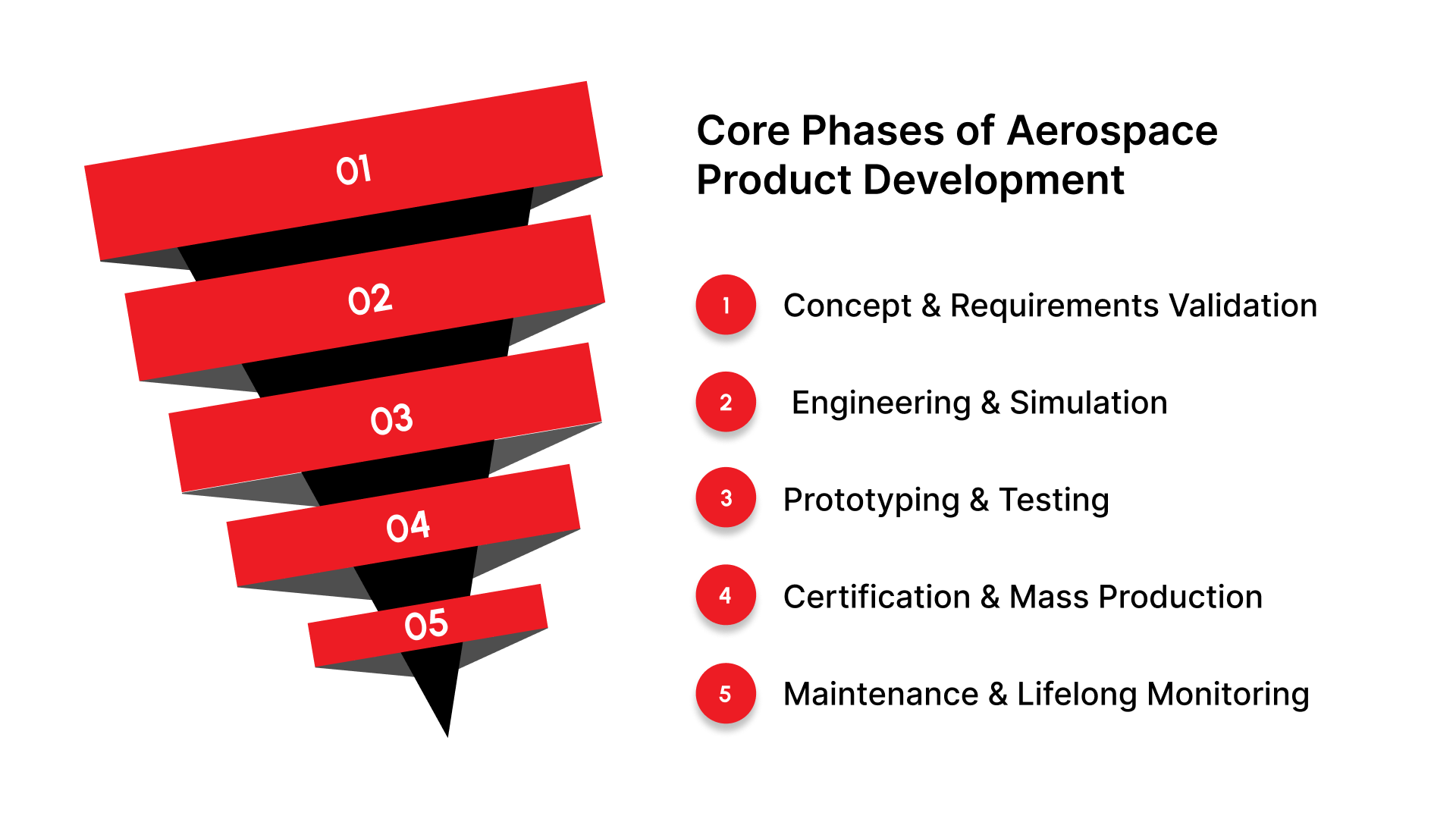
1. Concept and Requirements Validation
Define what the system must do and its constraints: performance, weight, power, operational conditions, and regulatory touchpoints. Validation tests feasibility against physics, cost, and certification pathways, catching impossible designs early.
2. Engineering and Simulation
Use CAD (Computer-Aided Design), CFD (Computational Fluid Dynamics), FEA (Finite Element Analysis), and digital twins to explore the design space, identify stress points, and simulate complete mission profiles.
The goal is to rule out configurations that fail under real loads, thermal gradients, or vibration before physical prototyping.
3. Prototyping and Testing
Build prototypes to expose manufacturing tolerances, assembly challenges, and unmodeled failure modes. Flight testing validates aerodynamic predictions, control responses, and system reliability, feeding anomalies back into the design or manufacturing process for improvement.
4. Certification and Mass Production
Certification shapes every phase. Test data, design rationale, and process controls become the evidentiary package for regulators. Scaling production requires tooling, supplier qualification, and process control to ensure consistent performance across hundreds of units.
5. Maintenance and Lifelong Monitoring
Development continues in service. Flight data informs inspection intervals, service bulletins, and design improvements. The digital thread connecting requirements to hardware extends into field operations, guiding future variants and production lots.
Also Read: Aerospace and Defense Industries: How Precision Machining Plays a Crucial Role
The structure is only half the picture. Execution depends entirely on whether you're designing within the regulatory framework or retrofitting compliance later.
Mandatory Compliance and Safety Certification
Certification drives the entire development approach. Treating it as a final hurdle leads to delays, budget overruns, and costly retrofits. Regulatory frameworks like FAA/EASA Part 25, DO-178C, DO-254, AS9100, and ITAR govern documentation, change management, and performance verification.
Compliance affects design from day one. Single-failure-critical components require redundancy or extremely low failure probability, shaping architecture before CAD work begins.
Key enforcement areas include:
Configuration management: track every design revision, part change, and process update with documented rationale.
Test coverage: verify each hazard with data showing correct system behavior under faults or degraded conditions.
Supplier qualification and traceability: include all material certifications, heat treatments, and inspection records in the certification package.
Independent verification: teams verifying software or hardware must be separate from the development team for objective validation.
The better your traceability infrastructure, the less rework you'll face when certification audits begin, which connects directly to how you engineer the hardware itself.
Engineering Best Practices That Avoid Delays and Recalls
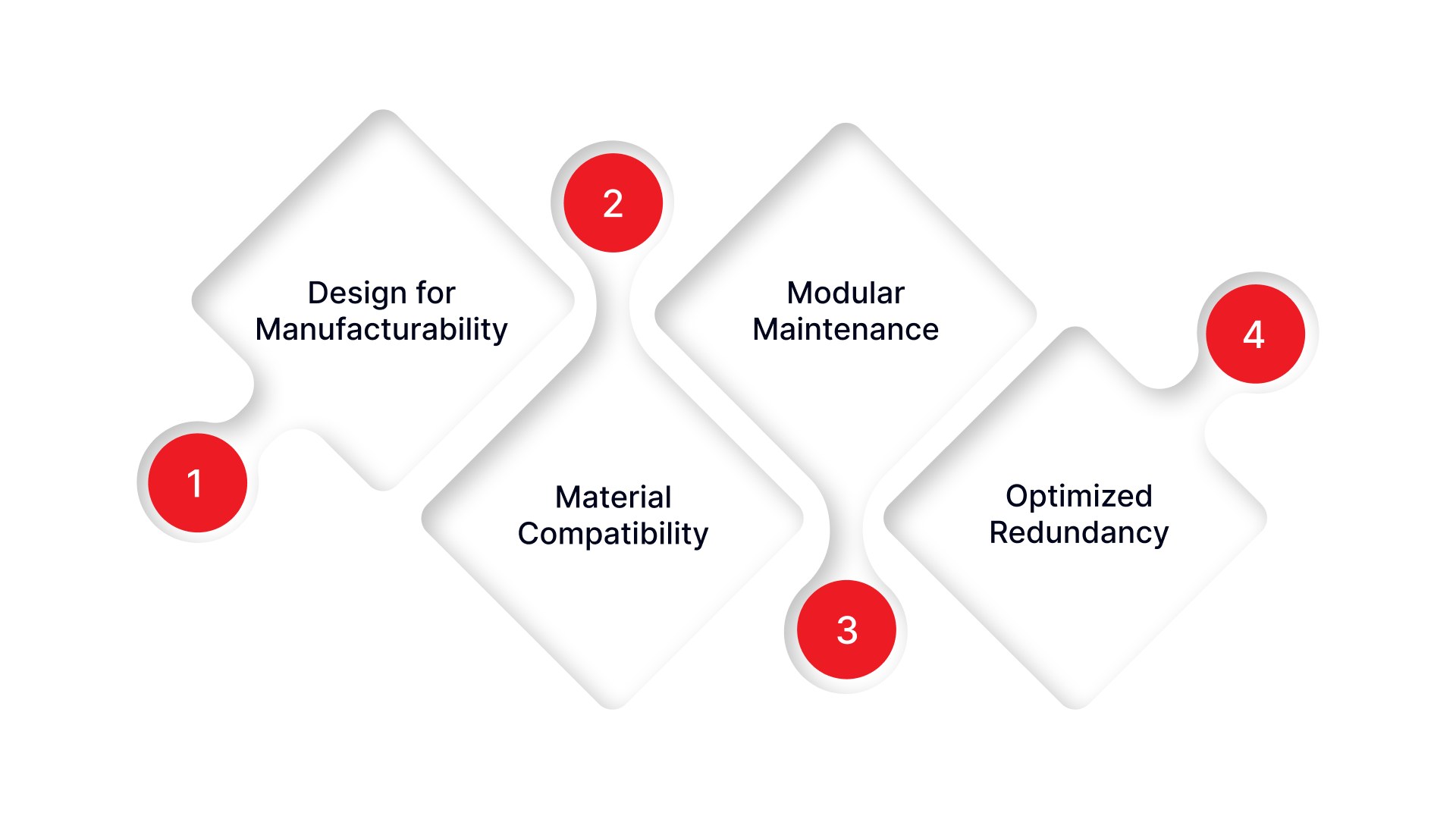
Aerospace programs lose time and money when engineering decisions cause downstream issues in assembly, testing, or certification. Best practices focus on designing with the whole lifecycle in mind, anticipating where real-world conditions diverge from models.
1. Design for Manufacturability
Complex assemblies with tight tolerances and difficult access increase costs and production time. Simplifying designs, like combining parts into a single component, reduces steps, eliminates tolerance issues, and improves manufacturability. Also, ensure tooling accessibility to avoid failure on the factory floor.
2. Material Compatibility
Materials must meet more than strength requirements; they need to withstand temperature changes, corrosion, and fatigue. Catch material incompatibilities early to avoid costly changes later.
For example, aluminum alloys may lose toughness in cryogenic environments, and titanium requires specific machining to prevent issues.
3. Modular Maintenance
Line-replaceable units allow field maintenance without disassembling half the aircraft. If a sensor fails in service, the operator swaps a module and returns the failed unit to the depot. This requires designing connectors, mounting interfaces, and access panels upfront. It also means considering failure isolation.
A modular avionics bay prevents cascading system failures, ensuring high dispatch reliability. It also streamlines certification, as replacing components doesn't require re-verification, speeding up service bulletins and upgrades.
4. Optimized Redundancy
Redundancy prevents single-point failures, but poorly implemented redundancy adds weight, complexity, and new failure modes. Dual hydraulic systems provide backup if one fails, but they require isolation valves, additional routing, and cross-bleed logic that must also be verified.
The goal is to ensure sufficient redundancy to meet safety targets without overcomplicating the system. Dissimilar redundancy, such as using an electric backup for a hydraulic primary, can offer better fault tolerance than duplicating the same system.
Also Read: How Precision Machining Drives Innovation in Manufacturing
Once an engineering discipline is in place, the tools used to model, verify, and document work impact iteration speed and the quality of your certification package.
Digital Tools Driving Faster Product Development
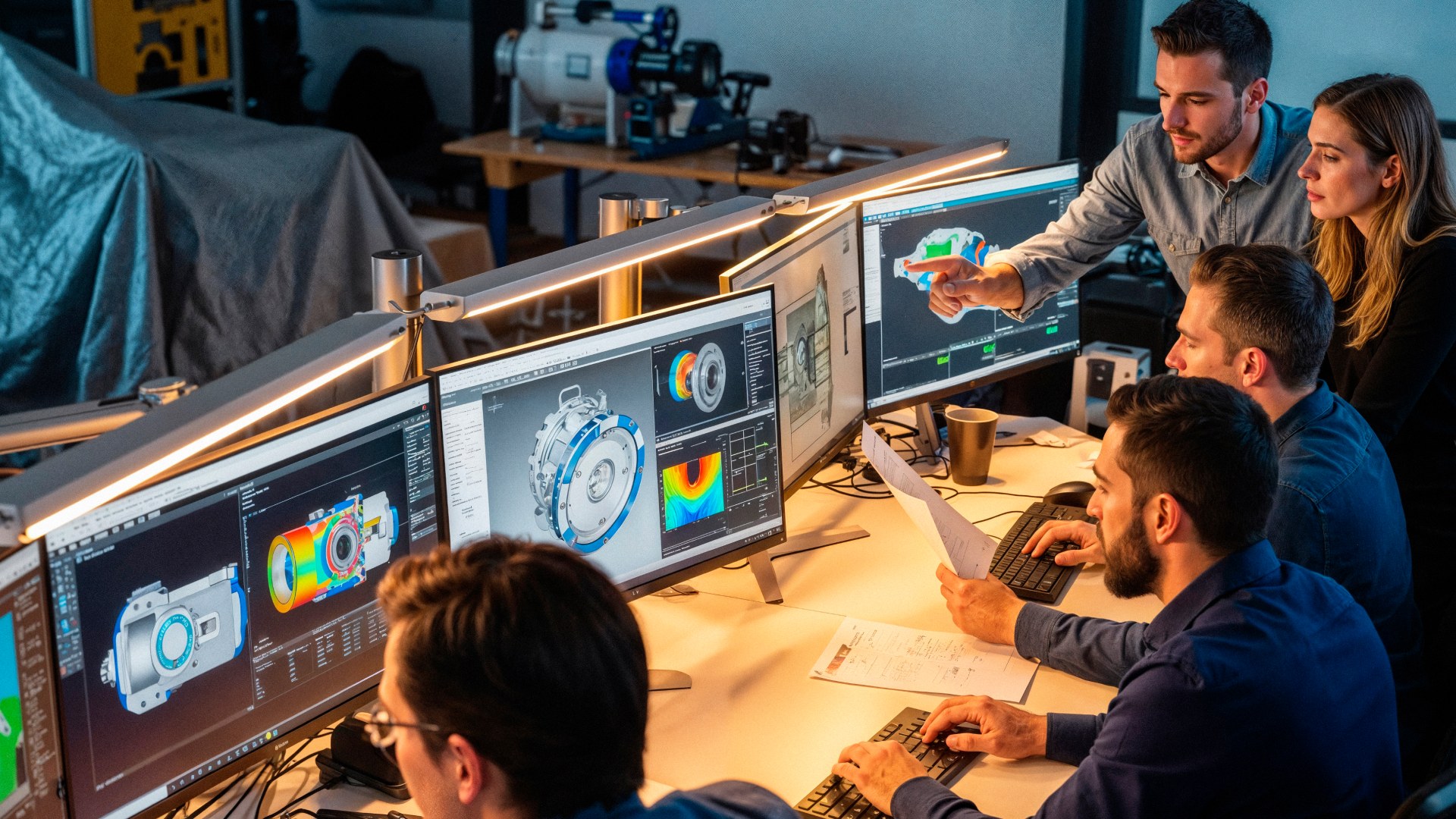
Digital tools replace physical iteration with validated simulations and automate certification documentation. Model-Based Systems Engineering (MBSE) keeps design requirements, models, and verification in sync.
CFD and digital twins simulate performance before prototypes, test multiple design variations, and predict operational and maintenance needs. Real-time savings appear in:
Automated EBOM to MBOM transformation: Automated tools cut the months-long manual process down to weeks, aligning manufacturing with design intent.
Real-time system integration: PLM, ERP, and MPM systems update automatically with design changes, ensuring smooth coordination and preventing errors.
Traceability from requirements to as-built configuration: Digital threads link all components, tests, and processes to requirements, enabling fast access to critical data for certification.
Even with perfect tools and disciplined engineering, risk is embedded in every aerospace program.
Risk Mitigation: Preventing Costly Program Failures
Programs fail when risks aren’t identified or tracked early, like unreliable suppliers, software failures, or weak designs. Failure Mode and Effects Analysis (FMEA) helps spot these risks by asking what can fail, how, and why. It’s a continuous process that adapts as designs evolve.
Here's where the major failure points actually occur:
Risk Category | Why It Kills Programs | Mitigation Approach |
Single-Point Failures | Critical function loss due to lack of backup | Redundancy, dissimilar backups, fault detection, graceful degradation |
Supplier Process Drift | Production failure from uncontrolled variation | Capability studies, statistical process control, volume inspections |
Cybersecurity Vulnerabilities | Exploitation or breaches due to network exposure | Secure development, penetration testing, isolated critical systems |
ITAR Non-Compliance | Unauthorized data sharing, restricted manufacturing | Controlled access, jurisdictional reviews, export licenses |
Inadequate Testing Coverage | Unverified failure modes discovered post-release | Fault injection, stress screening, accelerated life testing |
Also Read: Why Precision Machining is Critical in Aerospace Manufacturing
When it comes to mitigating these risks, precision and compliance are essential. This is where partners like Criterion Precision Machining become invaluable.
Criterion’s Role in High-Stakes Aerospace Programs
Aerospace components operate in environments where failure isn’t an option, and Criterion Precision Machining is built for that standard. The company manufactures custom, tight-tolerance CNC-milled, CNC-turned, and Swiss-turned components engineered to customer specifications, never off-the-shelf parts.
Aerospace teams rely on Criterion for:
CNC Turning & Multi-Axis Milling: Precision machining for complex geometries and tight-tolerance features used in sensor housings, structural brackets, and actuation system components.
Swiss Turning: Small-diameter, high-precision parts with micro-features, tight concentricity, and repeatable accuracy, supported by high-speed, multi-axis Swiss equipment.
Material Capability: Experience machining titanium, stainless steels, specialty alloys, aluminum, and engineered plastics suited for aerospace applications.
Certified Quality & Compliance: ISO 13485, ISO 9001:2015, FDA registration, ITAR registration, DFARS compliance, and WBENC certification, all supporting traceability, documentation, and audit-ready manufacturing for regulated aerospace programs.
By working with Criterion, aerospace teams get a partner capable of handling both early prototypes and full production runs with the same quality framework.
Conclusion
Aerospace programs don’t fail because teams lack skill. They fail when no one governs the constant stream of decisions that shape a design over the years. Without that control, intent drifts, interfaces misalign, and the program ends up chasing its own mistakes.
The teams that reach certification keep their direction tight. They enforce clarity through every revision, every supplier change, and every test cycle so the system stays true to its original purpose.
That’s where the right partners matter. Criterion Precision Machining helps teams hold that line by delivering hardware that stays faithful to the design intent from prototype to production, giving programs stability where it counts most.
Need trusted hardware for flawless certification? Connect with Criterion Precision Machining today!
FAQs
1. What normally triggers redesigns late in aerospace development?
Redesigns usually come from overlooked interface dependencies, missing load cases, or supplier-specific limits that weren’t accounted for during early requirements work.
2. How do aerospace teams validate usability without compromising safety?
They run structured human-factors testing using task-based simulations to measure workload, reaction time, and error rates before locking cockpit or control-system layouts.
3. What makes tooling strategy critical in aerospace programs?
Tooling has its own qualification path, so a poor strategy can block production. Teams plan jigs, fixtures, and inspection tooling early to avoid delays during ramp-up.
4. How do teams prove reliability for components with no practical full-life test window?
They use accelerated life-testing with thermal cycling, vibration profiles, and stress-screening designed to recreate decades of field conditions in compressed time.
5. Why do some programs adopt mixed manufacturing sources for a single component?
Dual-sourcing reduces supply risk, but only works when both suppliers can match tolerances, inspection methods, and process signatures so parts integrate without variation.