You may have seen this happen before. A prototype performs well during testing, stakeholders sign off, and expectations are set. Then production begins, and problems appear, such as variation between parts, missed tolerances, longer lead times, or inspection failures. The issue often isn’t the design. It’s the environment used to build it.
Many early-stage parts are produced inside what can be described as a prototyping bubble. These setups are fast and flexible, but they are not built for consistency or scale. As requirements change, the same approach may no longer hold up.
This guide explains how prototyping and full-scale production environments differ, and how to assess suitability at each stage. And how to recognize when it’s time to move beyond the prototype bubble to protect quality, delivery, and downstream risk.
Key Takeaways
Prototype success does not equal production readiness. What works once can fail when consistency and volume are required.
Manufacturing environments have limits. Prototyping setups are optimized for learning, not repeatability.
Scale exposes process gaps, not design intent. Variation appears when informal adjustments are no longer sustainable.
Readiness depends on systems, not speed. Defined setups, inspection discipline, and documentation determine suitability.
What “Bubble Suitability” Means in Manufacturing
In manufacturing, a bubble describes an environment that works well under a narrow set of conditions. It supports a specific goal, such as fast iteration or design validation, but it does not account for what happens when volume, oversight, or risk increases.
Bubble suitability refers to how well that environment continues to perform as expectations change.
A setup that produces one or two acceptable parts may struggle when asked to deliver consistent results across dozens or hundreds of units. The limitation is rarely visible at the start.
Inside a prototyping bubble, many decisions are handled manually.
Adjustments are made at the machine. Inspection may be informal.
Documentation often exists only to confirm function, not repeatability. This works during early development, when speed matters more than control.
Production environments operate under different conditions. Processes must repeat the same result across time, operators, and machines. Inspection must confirm consistency, not just success. Documentation must support traceability and audits.
Understanding bubble suitability helps you judge whether a part, process, or supplier can meet current needs and remain stable as requirements increase.
The Prototyping Bubble: Strengths and Built-In Limits
Prototyping environments are designed to move quickly. They allow teams to test ideas, adjust designs, and validate function without committing to rigid processes.
Where prototyping works well
Fast turnaround for early design validation
Flexible setups that adapt to frequent design changes
Direct communication between engineering and machining
Lower upfront cost for small quantities
These strengths make prototyping essential during development. Problems arise when the same environment is expected to support production demands.
Where suitability breaks down
Processes rely on operator judgment rather than defined controls
Setups change between parts with limited documentation
Inspection focuses on pass or fail, not trend or variation
Material sourcing and handling may vary between runs
As volume increases, small differences become visible. Features that were adjusted manually during prototyping may drift in production. Surface finishes that looked acceptable on a single part may vary across batches.
The risk is subtle. Early success can create confidence that the process is ready, even though it has never been tested for repeatability. Recognizing these built-in limits helps you avoid carrying prototype assumptions into environments that require consistency and control.
The Production Environment: What Changes at Scale
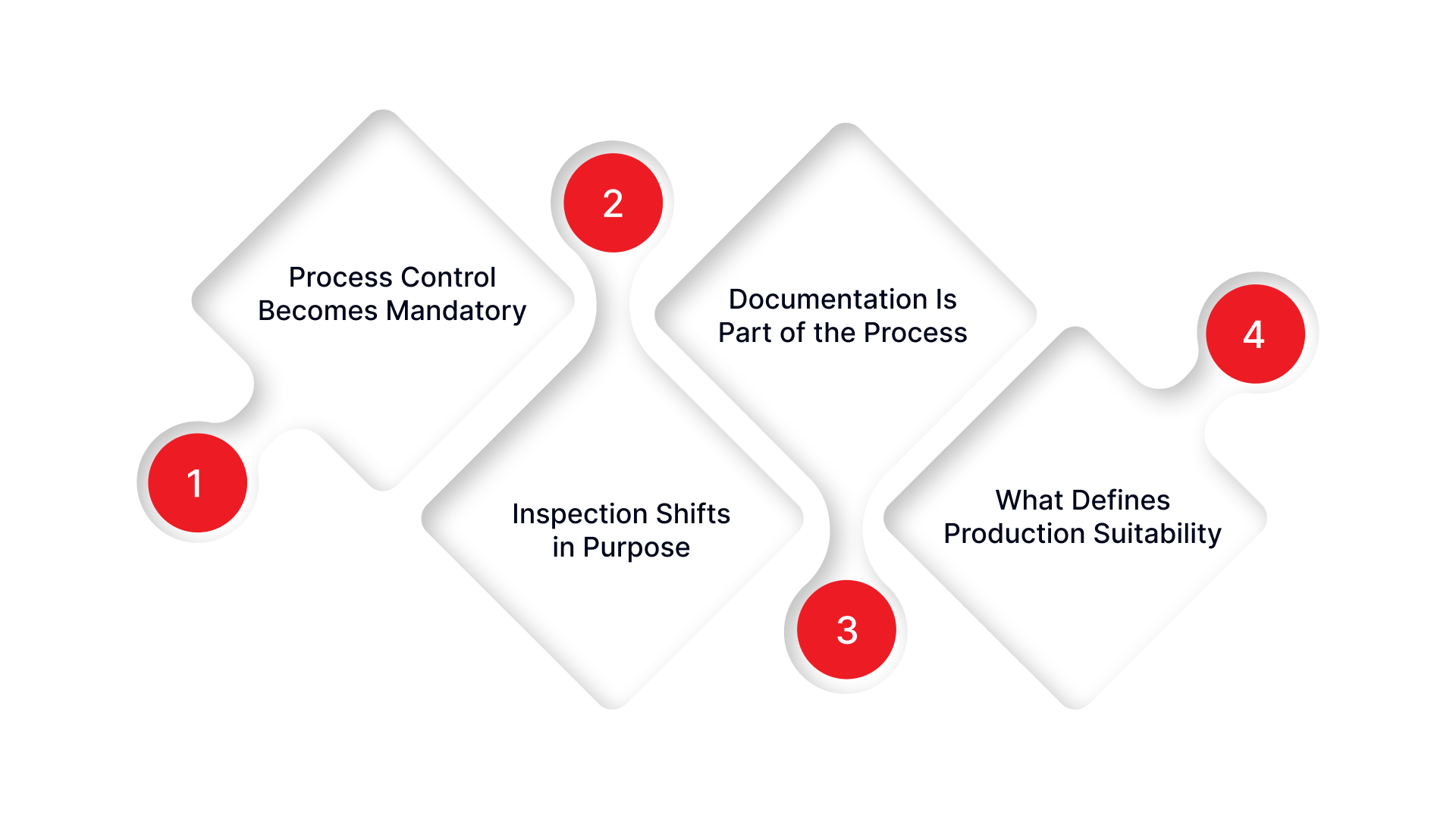
When a part enters production, expectations change. Speed and flexibility matter less than control, repeatability, and predictability. The environment must support consistent output across time, volume, and people.
Process Control Becomes Mandatory
In production, machining decisions are no longer informal.
Setups are defined and documented
Tooling and fixtures return parts to the same reference points
Any change follows a review and approval process
This reduces variation between runs and protects downstream assemblies.
Inspection Shifts in Purpose
Inspection no longer answers, “Does this part work?”
It answers:
Does it match previous parts?
Is variation trending within limits?
Are results repeatable across batches?
Production inspection relies on recorded data, not spot checks.
Documentation Is Part of the Process
Production environments require documentation to support:
Revision control
Lot traceability
Inspection records
Customer and regulatory audits
Without this structure, scaling volume increases risk rather than efficiency.
What Defines Production Suitability
A production-ready environment can:
Produce the same result across multiple runs
Absorb volume without added variation
Maintain consistency across operators and machines
If these conditions are not met, scaling exposes weaknesses that were not visible during prototyping. Production suitability depends on systems, not individual adjustments.
Key Differences: Prototyping vs Full-Scale Production
The gap between prototyping and production is often underestimated because both produce physical parts. The difference lies in how risk, variation, and accountability are managed.
Area | Prototyping Environment | Production Environment |
Primary objective | Validate design and function | Maintain consistency at scale |
Volume expectation | One-off or small batches | Repeatable, ongoing runs |
Process definition | Informal and adaptable | Defined and controlled |
Setup approach | Adjusted as needed | Fixed and documented |
Inspection focus | Feature confirmation | Trend monitoring and control |
Documentation | Minimal, task-specific | Complete and traceable |
Risk exposure | Low short-term impact | High downstream impact |
Problems occur when a part moves forward without addressing these differences. The environment that supported early success may lack the structure needed for stability.
Evaluating suitability means asking whether controls, documentation, and repeatability exist today, not whether the part worked once. This comparison helps you decide when a transition is necessary before issues surface in production.
When Prototypes Fail in Production: Common Scenarios
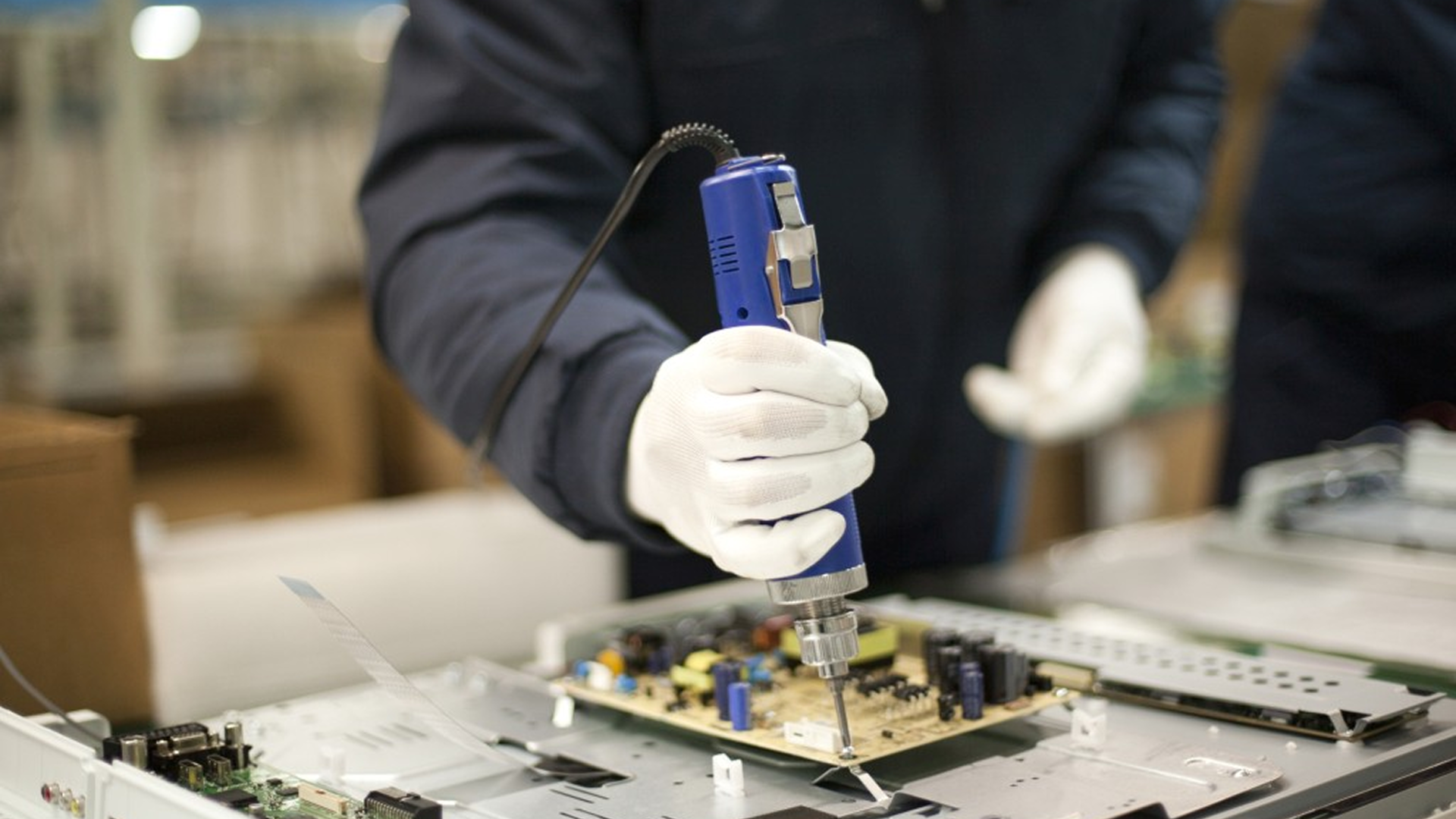
Many production issues trace back to assumptions formed during prototyping. The part worked once, so the process was assumed to be stable. Problems appear only after the volume increases.
Common Failure Patterns
Manual adjustments during prototyping: Features were tuned at the machine but never locked into a defined process.
Setups that do not scale: Fixturing works for one or two parts, but cannot repeat alignment consistently.
Tolerance stack-up across operations: Multiple setups introduce small shifts that compound over time.
Surface finish variation: Results depend on tool condition or operator technique rather than controlled parameters.
Inspection gaps: Early checks confirm fit, but do not monitor variation across batches.
Why These Failures Are Missed Early
Prototype volumes are too low to expose variation.
Rework hides underlying instability.
Success is measured by function, not consistency.
Production Impact
Once production starts, these gaps lead to:
Higher scrap and rework
Missed delivery schedules
Inspection delays and nonconformances
Identifying these patterns early helps you decide when a process must mature before scaling further.
Bridging the Gap: Moving Out of the Prototyping Bubble
Transitioning to production requires more than increasing quantity. It requires turning informal success into controlled, repeatable output.
What Must Change
Process definition: Each operation needs documented steps, tooling, and references.
Setup repeatability: Fixtures must locate parts the same way every time.
Inspection planning: Measurement methods should confirm consistency, not just fit.
Change control: Design or process updates must be reviewed and tracked.
Signs You’re Ready to Scale
Parts meet requirements without manual adjustment.
Results remain consistent across multiple runs.
Inspection data support stability, not correction.
Reducing Transition Risk
A single partner supporting both prototyping and production reduces handoff risk. Process knowledge carries forward, and early decisions can be validated under production conditions.
Criterion Precision Machining supports this transition by applying production-level controls during later-stage prototyping. This approach helps your team validate not only the design, but also the manufacturing path needed for reliable scale.
Supplier Suitability: How to Evaluate Readiness
Not every supplier that performs well during prototyping is suitable for production. Readiness depends on whether the supplier can deliver consistent results under tighter controls and higher accountability.
Questions to Ask When Evaluating Suitability
Are machining processes defined and documented, or adjusted per job?
Can setups be repeated without relying on individual operator judgment?
Is inspection standardized and recorded across runs?
Are revisions tracked with clear version control?
Can the supplier support volume without changing the process?
Warning Signs of a Prototype-Only Supplier
Quality depends heavily on a specific machinist
Documentation is created only when requested
Inspection focuses on individual features, not trends
Lead times vary widely between similar jobs
These signals indicate a setup that works in isolation but may struggle under production demands.
What Production-Ready Suppliers Provide
Stable setups and controlled workflows
Defined inspection plans tied to part risk
Traceability for materials, revisions, and lots
Predictable output across batches
Criterion Precision Machining operates with these controls in place, allowing engineering teams to move beyond prototype validation and into repeatable, audit-ready production without changing suppliers midstream.
Regulated Industries: Why Bubble Risk Is Higher
In regulated industries, the cost of instability is higher. Parts must meet technical requirements and support documentation, traceability, and audit expectations.
Why Prototyping Bubbles Break Faster
Informal processes cannot support audits
Manual adjustments are difficult to justify or reproduce
Inconsistent inspection creates compliance gaps
Industry-Specific Pressures
Medical devices: traceability and process validation are required before scale.
Aerospace: geometric consistency affects system performance and certification.
Defense: documentation accuracy and controlled workflows are mandatory.
In these environments, early success does not reduce risk. It can hide it.
What Reduces Exposure
Production environments that apply controls early reduce downstream disruption. Defined processes, recorded inspection data, and revision control protect both delivery schedules and compliance outcomes.
This is why regulated manufacturers often select partners like Criterion Precision Machining, where certified quality systems and controlled multi-axis processes support both development and full-scale production without introducing new risk at scale.
Decision Framework: Is Your Part Ready for Full-Scale Production?
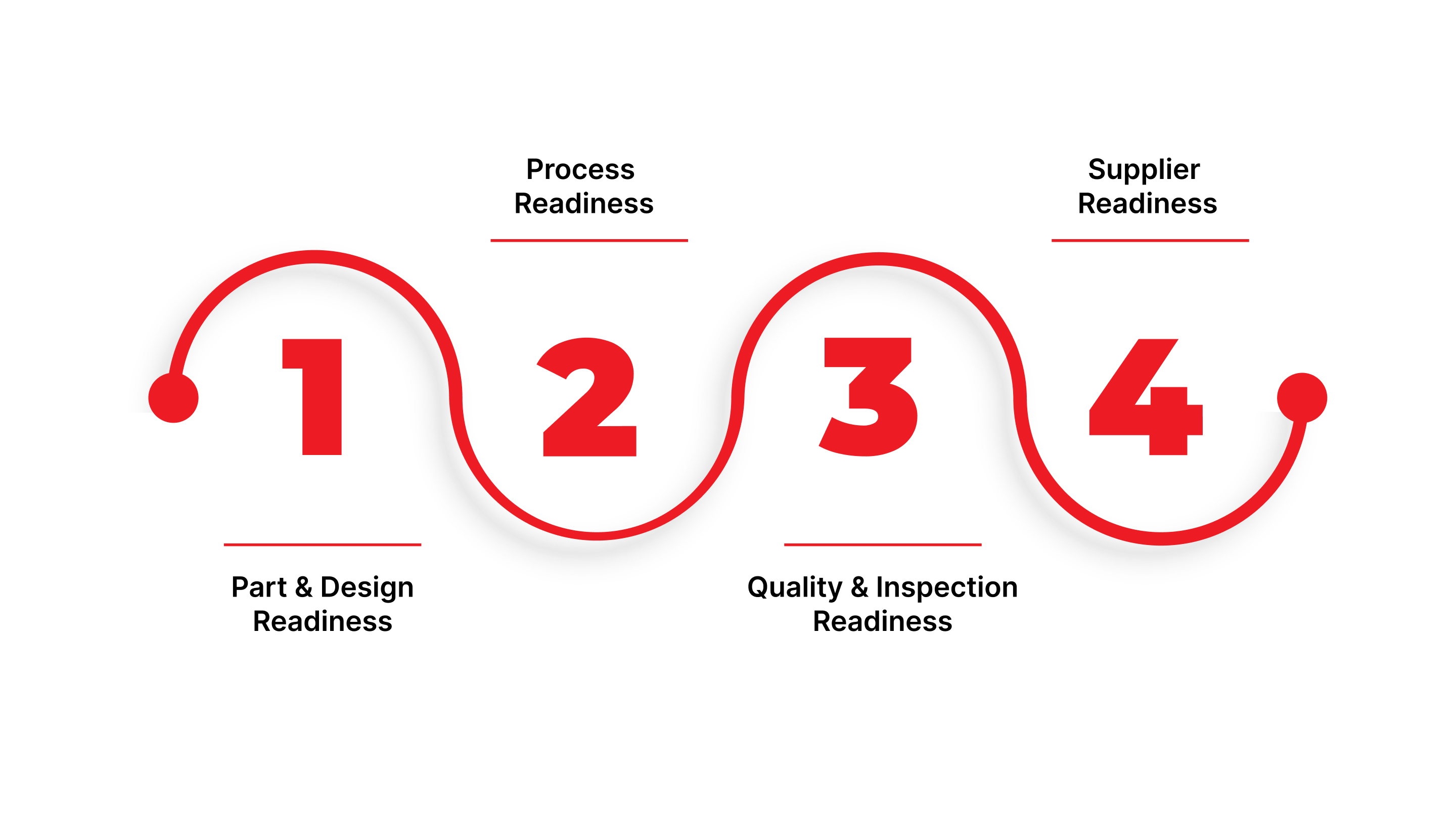
Before moving out of a prototyping environment, it helps to assess readiness against clear, practical criteria. This framework is designed to support engineering, sourcing, and quality decisions.
Part and Design Readiness
Geometry is stable with no frequent design changes
Critical features can be machined without manual adjustment
Tolerances are achievable with repeatable setups
Process Readiness
Machining steps are defined and documented
Fixtures locate parts consistently across runs
Tooling and inspection methods are standardized
Quality and Inspection Readiness
Inspection verifies consistency, not just fit
Measurement results are recorded and reviewed
Nonconformances trigger corrective action
Supplier Readiness
Lead times remain stable at higher volumes
Revisions are controlled and traceable
Quality systems support customer or regulatory audits
Decision Guide
If this is true… | Then… |
Parts require frequent rework | Remain in prototyping |
Output varies between runs | Mature the process |
Results repeat without adjustment | Prepare for production |
Documentation supports audits | Production-ready |
Using this framework helps you reduce risk before volume increases, protecting both delivery schedules and quality expectations.
How Criterion Precision Machining Supports the Transition from Prototype to Production
Moving beyond the prototyping bubble requires an environment that can maintain control as volume, oversight, and risk increase. Many teams struggle at this stage because their early suppliers are not structured for repeatable production.
Criterion Precision Machining is built to support this transition without introducing handoff risk.
Relevant Services Supporting Scale
CNC milling, including multi-axis and 5-axis machining
CNC turning and Swiss turning for high-precision components
Prototype machining using production-level processes
Low- to high-volume production under controlled workflows
In-house inspection and secondary operations
Complete quality documentation and traceability support
Why This Matters During Scale-Up
Prototypes are validated using the same setup discipline applied in production
Process knowledge carries forward as quantities increase
Inspection and documentation remain consistent across stages
Operating within certified quality systems, Criterion supports regulated manufacturing programs where stability, repeatability, and audit readiness are required as parts move from development into full-scale production.
Final Takeaways: Choosing the Right Environment at the Right Time
Prototyping environments play a critical role during development. They allow speed, flexibility, and design learning. Problems begin when those same conditions are expected to support scale.
Full-scale production demands repeatability, defined processes, and documented control. Suitability depends on systems, not individual effort. When volume increases, weak controls become visible quickly.
Evaluating bubble suitability helps you decide when to shift expectations and strengthen your manufacturing approach. This transition reduces rework, stabilizes lead times, and supports inspection and compliance requirements.
Manufacturers that plan this shift early avoid late-stage surprises. Working with a partner that supports both development and production under a single quality framework—such as Criterion Precision Machining, helps ensure the path from prototype to production remains controlled, predictable, and aligned with long-term program goals.
FAQs
1. What does “bubble suitability” mean in manufacturing?
It describes how well a prototyping or production environment continues to perform as volume, control, and risk increase.
2. Why do parts that work in prototyping fail in production?
Because early success often relies on manual adjustments and informal processes that do not repeat at scale.
3. When should a project move out of the prototyping bubble?
When geometry is stable, setups repeat without intervention, and inspection confirms consistency across runs.
4. Can the same supplier handle both prototyping and production?
Yes, if the supplier uses production-level controls, documentation, and inspection during later-stage prototyping.
5. Is prototyping always cheaper than production machining?
Not always. Rework, delays, and scrap during scale-up can outweigh early cost savings.
6. Why is bubble risk higher in regulated industries?
Medical, aerospace, and defense programs require traceability, process control, and audit-ready documentation.
7. Does volume alone define production readiness?
No. Readiness depends on repeatability, documentation, and risk control, not just quantity.
8. How can teams reduce transition risk?
By validating processes, inspection methods, and supplier systems before increasing volume.