A single out-of-spec batch can stop your assembly line and turn a scheduled ship date into an emergency program. When parts slip out of tolerance, the impact isn’t limited to scrap; it extends into engineering rework, inspection bottlenecks, and added compliance scrutiny.
Choosing the lowest bidder often trades short-term savings for hidden operational costs. What you’re really buying is proof: reproducible process controls, traceable first-article records, and evidence that a shop can maintain precision as volume scales.
In this article, we’ll lay out a practical path to vetting CNC partners. You will get an evaluation framework, the exact evidence to demand, red flags that signal program collapse, and how to price parts at the process level.
At a Glance:
True precision is consistency across prototypes and production, not one-off tolerances.
Systems, expertise, and engineering insight matter more than machines or certificates.
Digital traceability prevents silent errors and protects compliance.
Process-level cost review reveals hidden risks in tooling, rework, and yield.
The right partner cuts oversight, stabilizes schedules, and frees your team to focus on design.
The Real Driver Behind Choosing a Machining Partner
Production rarely fails all at once. It slowly moves off target when a shop’s systems aren’t disciplined. A team that holds ±0.0005" on a prototype can ease toward ±0.0015" over successive runs if fixturing, tooling cycles, and inspections aren’t tightly controlled.
That gradual shift inflates costs, disrupts schedules, and creates compliance headaches. So when you evaluate a machining partner, focus on indicators of proper process consistency:
Stable SPC data across multiple runs, not single-run hero numbers
Rigid setup repeatability supported by fixture maintenance logs
Predictable tooling-lifecycle planning instead of reactive replacements
Proof they monitor, and correct, trend movement, not just outliers
Also Read: The Role of Precision Machining in Medical Device Manufacturing
Understanding what creates that stability starts with knowing how to assess it.
Core Evaluation Framework for CNC Partner Selection

CNC vendor failures typically trace back to a single root cause: buyers evaluate quotes, machines, and promises rather than the system that actually produces the part.
A shop’s stability comes from its controls, not its brochures, and this framework breaks down how to verify that stability before you lock into a production partner.
1. Define Your Production Reality
Document what your program truly requires: tolerances, surface finish, material, and the ramp from prototype to full volume. If your part holds ±0.0002" on a 0.125" bore with Ra 16 in 17-4 PH, that’s the baseline.
And if you’re moving from 50 prototypes to 5,000 parts a month, your partner must show they can scale without tolerance creep.
Verification comes from historical metrology, not claims. Prototype accuracy is irrelevant if it cannot keep pace with production speed; the question is whether part 4,872 matches part 12. Here’s what to review to confirm stability:
Metrology records tied to actual volume increases
Evidence that dimensional stability held as throughput scaled
Data showing consistency across runs, not one-off precision
Proof they can maintain tolerance under production tempo
2. Capability Depth Beyond Equipment
Machine inventories don’t reveal a shop’s true capability. A team can have five new 5-axis mills and still deliver poor parts if their GD&T execution is weak, their CAM strategy kills tool life, or their fixturing introduces uncorrected deflection.
A common failure mode is that positional tolerances pass in prototyping, then drift out of spec in production when fixture deflection isn’t modeled.
Here’s what actually defines meaningful capability depth:
Proven expertise within your industry’s tolerance and compliance demands
Fixture strategy aligned with your part’s failure modes
CAM and tool-path approaches optimized for your material and geometry
Inspection protocols calibrated to your sector’s acceptance criteria
3. Proof of Quality Control (Not Printed Certificates)
ISO certificates show a shop has passed an audit. They don’t guarantee consistent execution under production pressure. True quality relies on real-time verification, active SPC, and traceable FAI packages. If a shop can’t produce this on request, their quality system is reactive.
Here’s what to look for to confirm embedded quality discipline:
In-process metrology that catches deviations in real time
SPC charts tied to critical dimensions
Deviation logs with documented corrective actions
Complete FAI packages with traceable material, process, and dimensional records
4. Engineering Intelligence vs Order Taking
Not all shops approach part production the same way. Some execute designs as-is, often driving hidden costs, tool wear, or production delays.
Engineering-savvy partners go further. They review tolerances, optimize toolpaths, and suggest secondary operations or fixturing strategies to prevent costly mistakes across the production run.
Comparison at a Glance:
Aspect | Transactional Shops | Engineering-Backed Partners |
Approach | Execute prints as-is | Review and optimize designs |
Tolerances | Accept without question | Rationalize for manufacturability |
Feature Handling | Follow the spec blindly | Identify secondary ops & critical features |
Tooling/Fixturing | No input | Suggest toolpath & fixturing strategies |
Cost Impact | Lower per part, higher risk | Prevent expensive production mistakes |
Pre-Production Conversations | Minimal insight | Engineering-driven guidance before production |
The difference isn’t just technical; it shows in smoother launches, predictable production, and fewer costly surprises across your full production run.
5. Digital Communication and Change Traceability
Production changes are only as reliable as the systems that manage them. Revision control, ERP/MRP integration, and deviation alert protocols determine whether updates to drawings, tolerances, or materials propagate correctly, or silently compromise dimensional integrity.
A drawing moving from Rev B to Rev C can lead to a lot being machined to the old spec; when this happens, it’s a process failure, not an operator error.
Digital discipline ensures partners scale reliably as complexity rises, including:
Version-controlled CAD/CAM and inspection plans synced automatically with revisions
ERP/MRP integration that propagates changes without manual gaps
Deviation alerts and traceability logs for every change
Secure file transfer and NDA compliance to protect IP and regulatory posture
6. Cost Structure at Process-Level
Transparent cost structures expose how well a shop understands its process. Quotes that omit fixturing amortization, tool wear, secondary operations, or rework buffers may indicate a lack of tracking or reliance on optimistic yields.
Similarly, unusually low unit costs (30% below market, for example) often reflect underestimated setup complexity, tool life, or scrap rates rather than unmatched efficiency.
A detailed cost breakdown shows where margin truly exists and demonstrates process awareness, including:
Multi-part fixturing that reduces setup frequency
Tooling strategies that extend cutter life across runs
In-line finishing processes instead of outsourcing steps
Realistic buffers for rework, scrap, and yield assumptions
7. Red Flags That Collapse Programs
Programs rarely fail due to a single mistake. Instead, subtle issues like lapses in discipline, limited visibility, and insufficient technical depth can accumulate over production cycles. Without oversight, every run risks becoming experimental, process consistency erodes, and troubleshooting or optimization becomes nearly impossible.
Here are the key red flags to watch for:
Documentation gaps: Absence of structured verification or approval processes.
Process variability: Inconsistent outputs from one lot to another.
Untracked supply chain activities: Critical tasks outsourced without proper oversight.
Limited engineering involvement: Operations without technical guidance on tolerances, cycle optimization, or design updates.
Catching these warning signs early prevents program disruption and ensures reliable, consistent production quality.
Also Read: How Precision Machining Drives Innovation in Manufacturing
When precision, consistency, and traceability matter, Criterion Precision is the partner that meets every criterion.
Why Criterion Precision Excels as a CNC Partner
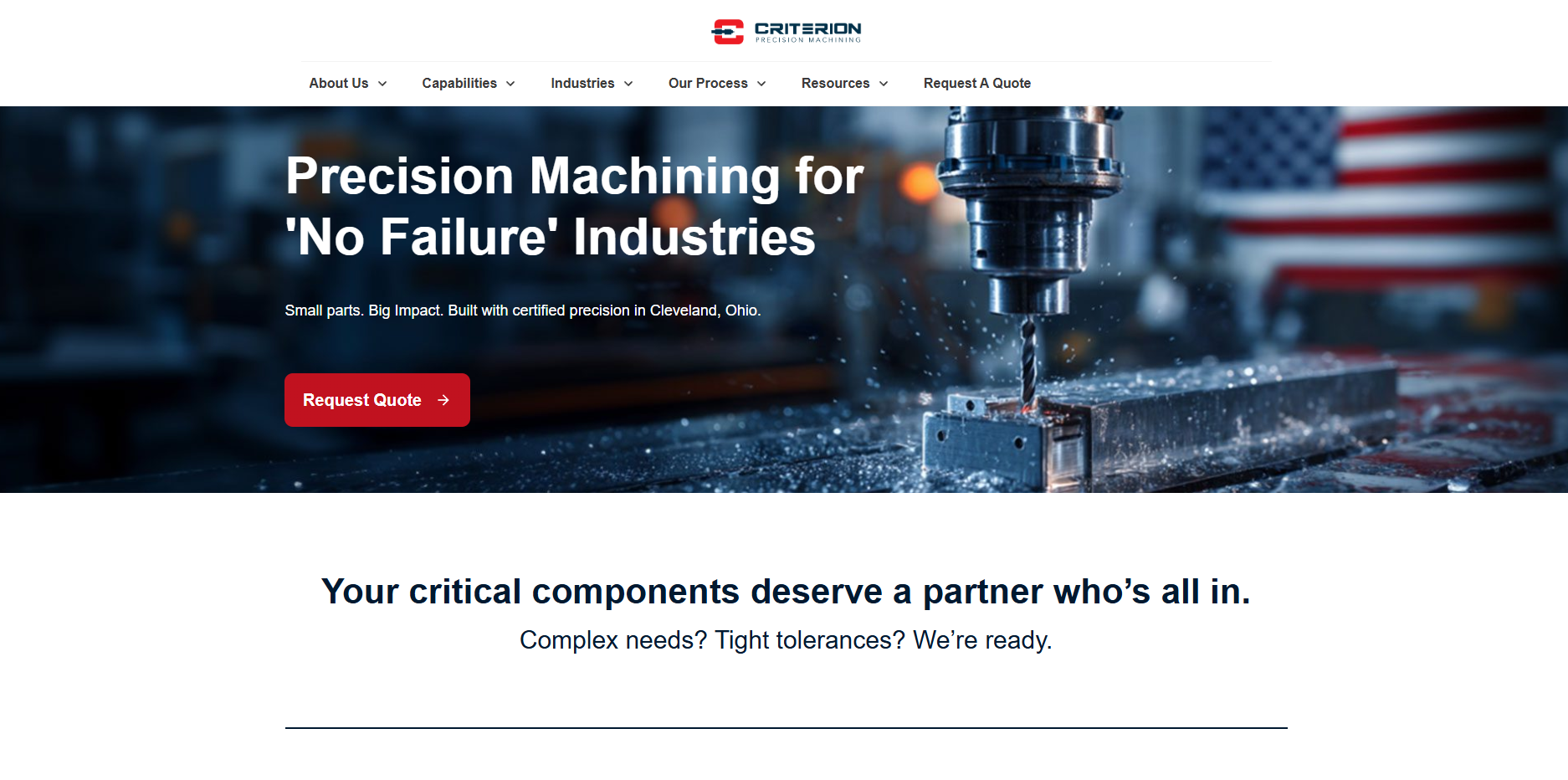
Choosing a machining partner isn’t optional; precision, reliability, and compliance are non-negotiable. Criterion Precision delivers custom, high-tolerance CNC components across medical, aerospace, defense, and photonics industries, turning designs into production-ready parts with predictable quality.
Here’s how Criterion supports precision manufacturing:
Swiss Turning & CNC Milling/Turning: Swiss turning enables small, intricate parts. Multi-axis milling and CNC turning handle complex geometries, all with tolerances down to ±0.0002".
Prototyping to Production: Rapid prototypes closely replicate production parts, allowing seamless scaling to full production runs.
Materials Expertise: Precision machining accommodates aluminum, titanium, stainless steel, specialty alloys, and engineered plastics.
Compliance & Certifications: ISO 13485, ISO 9001:2015, FDA-registered, ITAR- and DFARS-compliant, WBENC-certified, with inspection reports and traceability included by default.
Mission-Critical Industries: Components meet stringent performance and audit requirements for medical devices, AS9100-certified aerospace, defense, and photonics applications.
Integrated Workflows: CAD/CAM, ERP, and QC processes maintain accuracy, repeatability, and audit-readiness for every part.
With Criterion Precision, your designs become reliable, compliant, and production-ready parts every time.
Conclusion
A machining partner doesn’t just influence the parts you receive. It affects how much internal oversight your team needs to spend, how predictable your planning cycles become, and how much confidence you can place in delivery promises.
The real value lies in reducing your team’s cognitive load, allowing engineers and planners to focus on design rather than production policing. A relationship like that is rare, and it’s why many teams gravitate toward shops with proven operational maturity.
Criterion Precision doesn’t just supply components; it reduces noise, stabilizes schedules, and gives teams the breathing room they need to push programs forward without constant monitoring.
Looking for a certified, compliant partner that keeps your production predictable? Connect with Criterion to explore a smoother path from design to delivery.
FAQs
1. How early should a company involve a machining partner in its product lifecycle?
Involvement can begin as soon as the concept lock occurs, well before drawings exist, so manufacturability risks, material availability constraints, and regulatory pathway timing can be anticipated before engineering freezes the design.
2. What supply-chain factors affect CNC machining reliability outside the shop floor?
Logistics lead times, alloy mill allocation cycles, plating/anodizing queue congestion, and regional transportation volatility can all reshape production timing even when machining capacity is stable.
3. How does geopolitical or trade-policy change influence CNC part sourcing?
Trade policies, tariffs, and export controls can disrupt sourcing. Criterion mitigates risk by maintaining compliant sourcing strategies and contingency plans, ensuring minimal disruption and avoiding requalification delays.
4. What cybersecurity risks exist when sharing CAD models with machining vendors?
Risks include IP theft, ransomware, and unsecured transfers. Partners with controlled access, encryption, and strict retention protect IP and regulatory compliance.
5. How can companies benchmark machining partners across regions?
Energy reliability, workforce depth, post-processing access, and local regulations affect consistency beyond the shop floor. These factors directly impact delivery, quality, and scalability when selecting a partner.