In sectors where failure is not an option, such as medical devices, aerospace, defense, and photonics, prototype manufacturing is more than an engineering checkpoint. It is a risk reduction strategy, a compliance requirement, and a critical phase that ensures every component performs flawlessly once it reaches the field.
Prototype manufacturing is the creation of early, test-ready versions of a component before full-scale production. In precision-driven industries, prototypes must do more than resemble the final product. They must perform like it. From medical implants and surgical tools to aerospace housings and optical fixtures, prototypes validate safety, support regulatory compliance, reduce risk, and speed up development.
Modern CNC turning, Swiss machining, and multi-axis milling allow engineers to produce prototypes with exceptional accuracy and complete traceability. This guide explains how prototype manufacturing works, why it matters, and how engineering teams can select the right partner for mission-critical environments.
Key Takeaways
Prototype manufacturing in high-reliability industries is a risk-reduction tool that validates performance, safety, and compliance long before qualification testing or production begins.
Functional, engineering, and pre-production prototypes must match production-level tolerances, materials, and documentation to ensure meaningful testing and regulatory readiness.
CNC machining, especially multi-axis, Swiss, and turning processes, is essential for creating prototypes that behave exactly like final parts in critical applications.
High-reliability sectors require prototypes with full traceability, tight tolerances, controlled finishes, and advanced metrology to guarantee stability and performance.
Selecting the right prototype partner demands certifications, strong QA systems, ITAR compliance, and the ability to scale seamlessly from early builds to full production.
What Is Prototype Manufacturing?
Prototype manufacturing involves producing early versions of a component to evaluate function, manufacturability, and regulatory requirements before production. In regulated industries, prototypes must meet the same tolerance expectations, material requirements, and documentation standards as the final part.
Types of prototypes include:
Concept Prototypes for Design Exploration
Concept prototypes are the earliest physical or visual representations of a design. Their purpose is to help engineers, designers, and stakeholders explore ideas before investing in detailed engineering work.
They typically focus on form, ergonomics, or general layout rather than precision. In many cases, concept prototypes may be 3D printed or simplified models used to confirm that the basic design direction is feasible.
Primary goal: Understand the idea, visualize the concept, and decide whether the design direction is worth pursuing.
Functional Prototypes for Performance Checks
Functional prototypes are created to evaluate how the part or assembly behaves under real or simulated conditions. These prototypes test performance, mechanical interactions, usability, and, sometimes, environmental behavior.
Unlike concept prototypes, functional prototypes often use materials and geometries closer to the final design. They help engineers determine whether the design performs as intended before committing to tighter tolerances or complex machining.
Primary goal: Validate how the component functions in real-world or test conditions.
Engineering Prototypes for Dimensional and Manufacturability Analysis
Engineering prototypes are precision-built to evaluate critical dimensions, tolerances, and manufacturability. They are typically produced using the same methods planned for production, such as CNC turning, Swiss machining, or multi-axis milling.
These prototypes help identify potential production challenges, assess geometric stability, analyze tolerance stack-ups, and confirm that the design can be manufactured consistently and cost-effectively.
Primary goal: Ensure the design can be manufactured to spec and behaves like a production part.
Pre-Production Prototypes for Compliance and Final Validation
Pre-production prototypes are the closest representation of the final product before full-scale manufacturing. They follow the intended production process, materials, and quality controls. These prototypes are often tied to regulatory or customer qualification steps such as FAI, PPAP, DHR creation, or aerospace audits.
In industries like medical, aerospace, and defense, pre-production prototypes may be required for certification, safety validation, and supply chain approval.
Primary goal: Final verification that the part meets all technical, regulatory, and production requirements before mass manufacturing.
Also Read: How Precision Machining Drives Innovation in Manufacturing
Why Prototype Manufacturing Matters for High-Reliability Industries?
In industries such as medical devices, aerospace, defense, and photonics, even minor design errors can lead to significant risks, including patient harm, mission failure, or equipment malfunction. Because of these high stakes, prototypes serve as the first line of defense against uncertainty.
They allow engineering teams to verify performance, confirm manufacturability, and ensure that every detail aligns with regulatory expectations before moving into production. Validated prototypes are essential for protecting end users, supporting compliance, and maintaining the integrity of mission-critical systems.
Benefits include:
Prototypes reduce risk by identifying design flaws before costly qualification testing or tooling commitments.
They prevent failures by exposing issues in strength, tolerances, thermal behavior, or assembly fit early.
In medical and aerospace programs, prototypes accelerate development through rapid iteration and early validation.
They improve cost efficiency by revealing manufacturability challenges and avoiding unnecessary operations or materials.
Prototypes support ISO, AS9100, and ITAR compliance by providing traceability, validated processes, and audit-ready documentation for smooth production transitions.
Common Prototype Manufacturing Methods
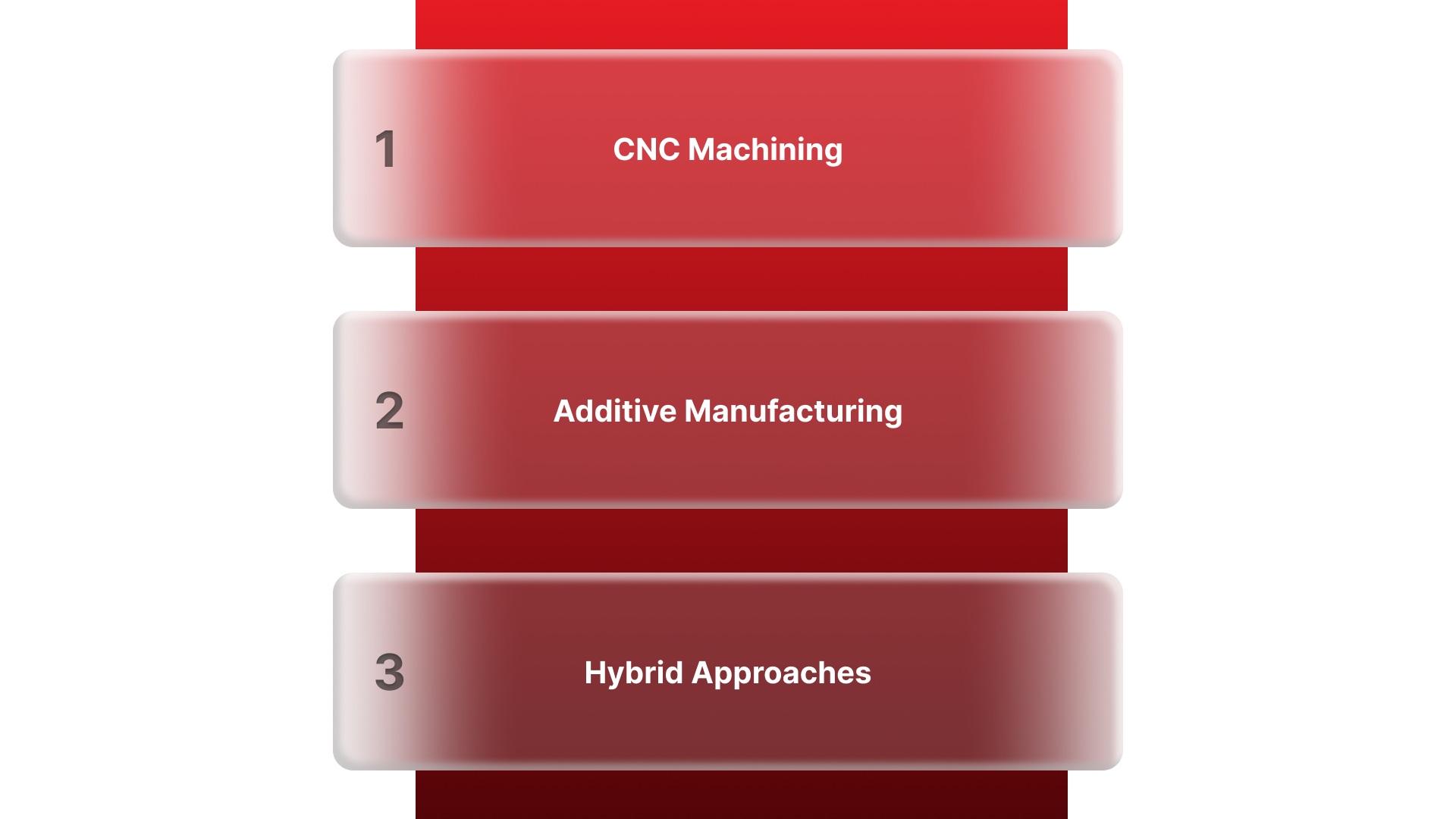
Prototype manufacturing uses various methods to evaluate design feasibility, performance, and manufacturability before production. Method selection depends on precision, materials, and tolerances, especially in high-reliability industries where prototypes must replicate geometry, ensure traceability, support documentation, and match real-world performance conditions.
The following methods represent the most widely used and most effective approaches for producing prototypes that behave like production parts.
CNC Machining
CNC turning, Swiss turning, and multi-axis milling are ideal for prototypes that need production-level accuracy.
Key advantages include high precision, repeatability, material compatibility, and full documentation.
Additive Manufacturing
Useful for early-stage models or quick form checks, but not ideal for final engineering prototypes in regulated industries due to limitations in tolerance and material validation.
Hybrid Approaches
A common workflow uses additive methods for early iterations and CNC machining for functional prototypes that behave like production parts. This is popular in photonics, medical development, and defense R&D
Industries That Depend on Precision Prototype Manufacturing
High-reliability industries operate in environments where accuracy, consistency, and full traceability are essential. These sectors cannot afford design errors or performance uncertainty, making validated prototypes a critical part of their development process.
Prototypes in these industries must meet strict tolerance requirements, use certified materials, and follow documented workflows that mirror production conditions. By validating performance early, engineering teams reduce risk, streamline regulatory approval, and ensure that final components will perform safely and reliably in the field.
High-reliability sectors depend on traceable, validated prototypes, including:
Medical Devices: Prototypes verify ISO 13485 compliance and ensure implants, surgical tools, and diagnostic housings meet requirements for fit, ergonomics, mechanical strength, biocompatibility, dimensional accuracy, and assembly alignment. They also support documentation for FDA submissions and audits.
Aerospace Components: Prototypes validate structural integrity, weight optimization, vibration resistance, thermal performance, and precision alignment. They support AS9100 requirements and prepare teams for demanding qualification testing.
Defense & Military: ITAR-compliant prototypes protect sensitive data and undergo ruggedness, durability, and reliability testing for targeting systems, sensors, and mechanical assemblies, ensuring components meet military standards.
Photonics & Optics: Prototypes confirm extreme precision by validating surface quality, parallelism, concentricity, and material compatibility. They refine laser housings, mounts, and alignment fixtures to ensure optical accuracy and stability before production.
Also Read: The Role of Precision Machining in Medical Device Manufacturing
Typical Customers and Their Needs
OEMs and engineering teams working in regulated industries operate under strict performance, quality, and compliance requirements. Their prototype suppliers must not only deliver precision parts but also support documented workflows, material traceability, and responsive engineering collaboration.
These customers rely on partners who can bridge early-stage design exploration with production-level rigor, ensuring that each prototype accurately reflects final manufacturing outcomes, meets regulatory expectations, and accelerates qualification processes.
OEMs and engineering teams in regulated sectors typically require:
Tight Tolerance Prototypes Matching Final Production Behavior
Customers in regulated sectors require prototypes that function exactly like production parts so that testing is meaningful. This includes holding micron-level tolerances, replicating surface finishes, and using production-grade materials or equivalents. These prototypes allow engineering teams to validate performance, assembly fit, and reliability before scaling into manufacturing.
Traceability and Documentation for FDA, ISO, and Aerospace Audits
Medical, aerospace, and defense OEMs need full traceability to support quality systems and audit requirements. This includes material certifications, lot traceability, device history records (DHR), FAIR documentation, and controlled revisions. Proper documentation ensures that prototypes can be used in verification, validation, and regulatory submissions without risk.
Fast Iteration Without Sacrificing Accuracy
While development timelines are compressed, customers cannot compromise on precision. They need rapid prototype turnaround with the same dimensional control and process stability expected in production. This allows teams to iterate quickly, compare design revisions, and shorten development cycles without losing reliability.
ITAR-Compliant Manufacturing for Defense Projects
Defense contractors must ensure all prototype work complies with ITAR regulations, including secure handling of technical data and controlled access for qualified personnel. Customers expect their suppliers to follow compliant workflows, maintain data security, and manage documentation in a way that aligns with defense program requirements.
Experience Across Titanium, Stainless Steel, Aluminum, and Engineered Plastics
Different sectors rely on demanding materials that require specialized machining, finishing, and inspection expertise. Customers expect their suppliers to work confidently with titanium for implants and aerospace structures, stainless steel for surgical tools, aluminum for lightweight housings, and engineering plastics for diagnostic systems. Material competence ensures that prototypes reflect real-world performance.
Key Requirements for High-Quality Prototype Manufacturing
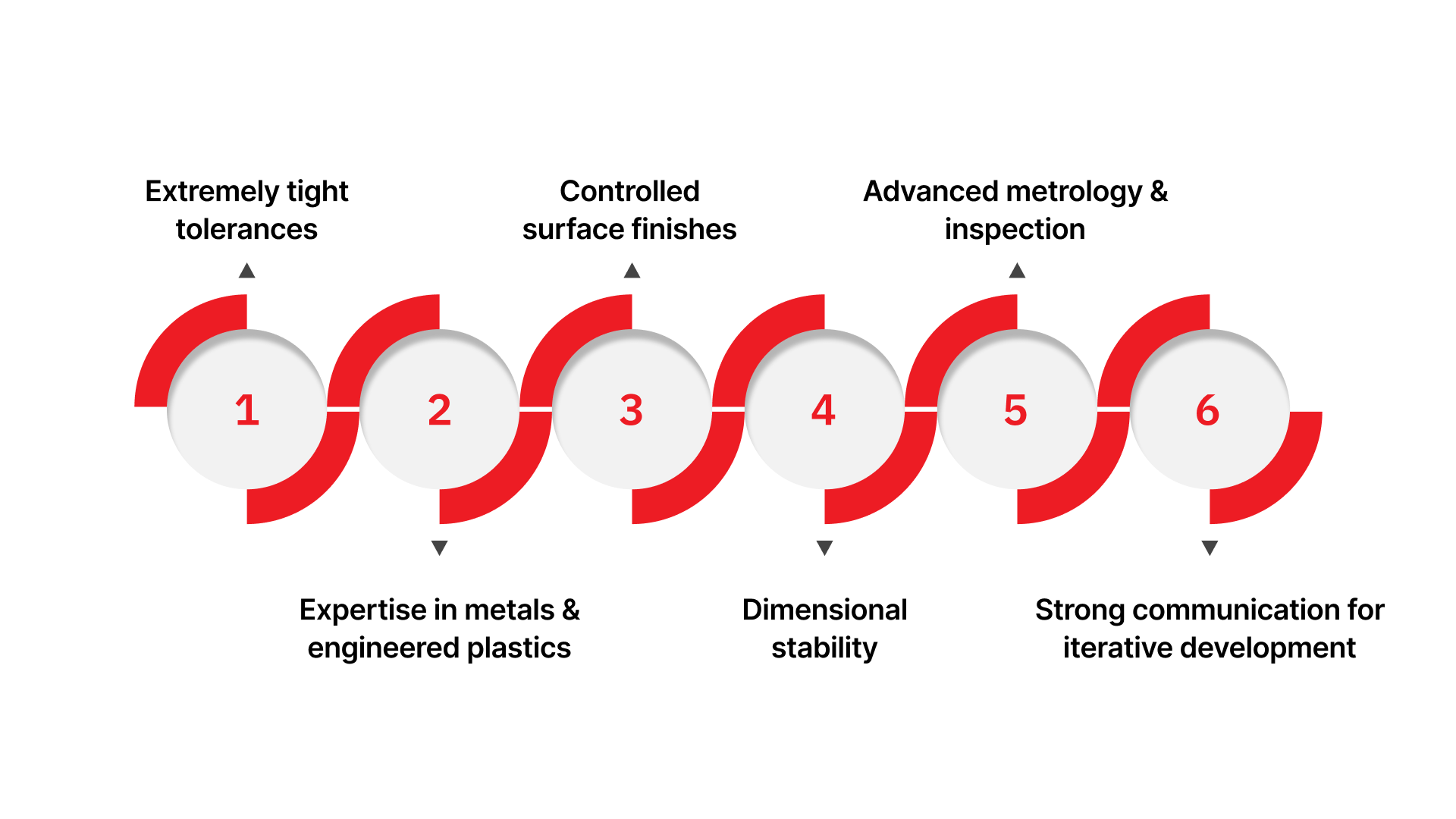
High-reliability sectors demand prototypes that behave exactly like final production parts. This requires not only advanced machining or fabrication capabilities, but also disciplined quality control, material expertise, and close engineering collaboration.
A successful prototype program minimizes risk, accelerates development, and produces data that engineering teams can trust when moving into verification, validation, and eventual production.
Below are the essential requirements that ensure prototypes perform with true production-level accuracy:
Extremely Tight Tolerances
Prototypes must precisely match the final design intent, often with tolerances in the microns. This ensures accurate performance testing, proper assembly fit, and confidence that the part will behave consistently when scaled to production. Tight control also helps prevent redesigns and unexpected failures later in the process.
Expertise in Metals and Engineered Plastics
Regulated sectors rely on materials such as titanium, stainless steel, aerospace-grade aluminum, PEEK, Ultem, and other high-performance polymers. Skilled machinists and engineers understand how these materials behave, how they respond to heat and cutting forces, and how to select the right tooling and parameters to maintain dimensional accuracy.
Controlled Surface Finishes
Surface quality affects everything from biocompatibility and sterilization in medical devices to thermal performance in aerospace components. Controlled finishes ensure parts meet functional requirements, pass inspection, and integrate properly with mating components or assemblies.
Dimensional Stability
Precision components must maintain geometry through machining, handling, and inspection. Dimensional stability is critical for prototypes made from temperature-sensitive plastics, thin-walled metals, or parts requiring multi-operation machining. Stable parts prevent false failures during testing and maintain consistency across iterations.
Advanced Metrology and Inspection
High-quality prototype suppliers rely on CMMs, optical inspection, profilometry, and other advanced metrology systems. These tools provide detailed dimensional data, verify tolerances, and ensure prototype performance matches engineering requirements. Reliable inspection enables data-driven design decisions.
Strong Communication for Iterative Development
Prototyping is inherently collaborative. Engineering teams need transparent communication on manufacturability, design risks, timing, and material considerations. A responsive partner helps refine designs faster and reduces the likelihood of costly rework.
Choosing the Right Prototype Manufacturing Partner
Selecting the right prototype supplier directly impacts development timelines, regulatory readiness, and long-term product reliability.OEMs in regulated sectors need partners with strong machining capabilities, solid compliance systems, secure data handling, and the ability to scale from prototypes to full production.
The ideal partner combines technical capability with disciplined quality management.
Certifications: ISO 13485, ISO 9001, and ITAR Registration
Industry certifications demonstrate that the manufacturer follows controlled processes and meets regulatory expectations. ISO 13485 is essential for medical device work, ISO 9001 supports general quality management, and ITAR registration is required for defense projects. These certifications ensure that prototypes are produced in a compliant environment.
Capability to Support Prototypes and Full-Scale Production
A partner who can seamlessly transition from prototype to production reduces risk and eliminates the need to requalify suppliers. This supports smoother scale-up, consistent quality, and faster market entry. Teams benefit from a unified workflow with a shared understanding of design intent throughout the product lifecycle.
Mature QA and Inspection Processes
Robust quality systems, documented workflows, calibration programs, and traceability ensure that each prototype is built to spec and suitable for verification or regulatory submissions. Mature QA processes reduce variation, catch issues early, and provide confidence during audits.
Experience in Complex, Regulated Environments
Suppliers familiar with FDA-regulated products, aerospace qualification standards, and defense compliance understand the level of discipline required. Their experience reduces onboarding time, minimizes mistakes, and ensures prototypes meet the technical and documentation expectations of high-reliability sectors.
Secure U.S.-Based Manufacturing for IP Protection and Compliance
Domestic manufacturing protects sensitive data, supports ITAR requirements, and ensures alignment with U.S. regulatory frameworks. This is essential for defense, aerospace, and advanced medical device programs where confidentiality and compliance are critical.
Also Read: 5 Reasons to Partner with a Precision Machining Expert Like Criterion
Criterion Precision Machining for Swiss-Turned Components
In medical, aerospace, defense, and photonics, prototypes aren’t just “early parts.” They’re qualification tools that prove manufacturability, reduce validation risk, and establish process controls before production ramps. Criterion Precision supports prototype manufacturing with the same high-tolerance discipline, documentation, and compliance infrastructure required in audit-heavy environments.
Here’s what Criterion brings to prototype manufacturing programs:
Swiss Turning & CNC Milling/Turning: Swiss turning supports the production of small, intricate prototype components with excellent repeatability. Multi-axis milling and CNC turning handle complex geometries, with tolerances down to ±0.0002"±0.0002" for designs that can’t drift.
Prototyping with Production Intent: Prototype builds are approached with production realities in mind, helping teams validate DFM considerations, lock critical dimensions, and move into low- or high-volume runs without changing suppliers or re-qualifying processes.
Material & Application Fit: Criterion machines a wide range of prototype materials used in regulated builds, including aluminum, titanium, stainless steel, specialty alloys, and engineered plastics supporting performance targets across mechanical, thermal, and corrosion-driven requirements.
Compliance & Certifications: ISO 13485 and ISO 9001:2015 quality systems, FDA registration, ITAR registration, DFARS compliance, and WBENC certification help prototype programs stay aligned with downstream qualification expectations.
Quality Inspection & Documentation: Inspection reports, certificates of conformity, and traceability are provided as standard deliverables, reducing handoffs between engineering and quality while strengthening audit-readiness from the first build.
Support for Mission-Critical Sectors: Criterion’s machining and quality workflows are built to meet the demands of medical device programs, aerospace supply chains, defense manufacturing, and photonics assemblies, where part failure or documentation gaps create outsized risk.
With Criterion Precision, prototype manufacturing becomes a controlled, traceable step toward qualification, not a one-off shop exercise, so your team can validate designs faster and scale with fewer surprises.
Conclusion
Prototype manufacturing is vital in sectors where accuracy, compliance, and safety cannot be compromised. In medical devices, aerospace, defense, and photonics, prototypes do more than prove a design; they validate performance, expose risks, and support regulatory pathways.
Criterion Precision Machining uses advanced CNC turning, Swiss turning, and multi-axis milling with a quality system tailored to regulated industries, so prototypes behave like production parts, dimensionally stable, fully traceable, and built with full-scale rigor. With deep technical expertise, strong documentation, and over 70 years of experience, Criterion is a dependable partner for mission-critical development.
Ready to move from concept to production-ready prototypes?
Talk to Criterion Precision Machining about your next high-reliability project.
FAQs
1: Why is prototype manufacturing important in regulated industries?
Prototype manufacturing ensures designs meet strict safety, performance, and compliance standards before production. It reduces risk, validates functionality, supports regulatory documentation, and prevents costly redesigns later in the development cycle.
2: What makes a prototype suitable for medical or aerospace applications?
A suitable prototype must deliver tight tolerances, material accuracy, surface quality, and complete traceability. It should behave like a production part so engineers can rely on it for testing, qualification, and regulatory approval.
3: How does Criterion ensure prototype precision and repeatability?
Criterion relies on advanced CNC, Swiss turning, controlled processes, and rigorous inspection, including CMM validation. Every prototype is produced using production-grade workflows, ensuring consistent accuracy, dimensional stability, and documentation for audits.
4: Can prototypes transition easily into production with Criterion?
Yes. Criterion’s workflow includes DFM support, qualification builds, and scalable machining processes. Prototypes are engineered with production in mind, enabling a smoother transition into volume manufacturing with fewer engineering changes.
5: What information should teams provide when requesting a prototype quote?
Engineering teams should supply CAD models, technical drawings, materials, tolerances, quantities, and any inspection or documentation requirements. Clear requirements help accelerate quoting, improve manufacturability analysis, and ensure compliant, production-ready prototypes.