Introduction: The Critical Role of ITAR Compliance in Defense Manufacturing
Defense OEMs face severe financial and operational consequences when partnering with non-compliant suppliers. Civil penalties reach up to $1,271,078 per violation, criminal fines can hit $1 million, and imprisonment extends to 20 years for willful violations. Beyond monetary penalties, debarment from defense contracts ends a supplier's ability to serve the defense industrial base.
ITAR is more than a registration checkbox — it's a national security framework that governs how sensitive military technology is handled, shared, and controlled. For precision machining companies, that means managing access to CAD files, process specifications, and engineering drawings with the same rigor applied to physical hardware.
DDTC enforcement makes clear the stakes are real: RTX Corporation paid $200 million in 2024 for unauthorized data exports, while Precision Castparts Corp. settled for $115,000 after foreign national employees accessed controlled tool and die technical data.
What follows is a practical guide for defense OEMs to evaluate machining partners' ITAR compliance — and to understand exactly what the regulations require at every point in the supply chain.
TLDR: Key Takeaways About ITAR Compliance in Precision Machining
- ITAR controls defense articles, services, and technical data under 21 USML categories—machined components for aircraft and fire control systems are frequently controlled
- DDTC registration runs $3,000/year (Tier 1 rate: $2,500), with mandatory annual renewal
- Violations trigger civil penalties up to $1.27 million per incident, criminal fines to $1 million, and potential 20-year imprisonment
- Defense OEMs must vet supplier DDTC registration, Technology Control Plans, and employee screening before awarding contracts
What is ITAR and Why It Exists
The International Traffic in Arms Regulations (ITAR) (22 CFR Parts 120-130) implement the Arms Export Control Act, controlling the manufacture, export, and transfer of defense-related articles and services. The Directorate of Defense Trade Controls (DDTC) within the U.S. Department of State enforces these regulations, managing registration, licensing, and compliance actions.
The United States Munitions List (USML)
The USML (22 CFR Part 121) organizes controlled items into 21 categories. Precision machining companies most frequently encounter:
Category VIII (Aircraft and Related Articles):
- Military aircraft components, accessories, and attachments
- Forgings, castings, and machined bodies identifiable by mechanical properties or geometry
- Parts "specially designed" for specific military aircraft (F-35, B-21, etc.)
Category XII (Fire Control, Laser, Imaging, and Guidance Equipment):
- Optical sensors and guidance systems
- Specially designed housings, gimbals, and infrared focal plane arrays
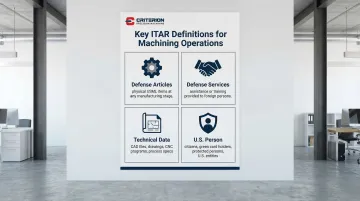
Critical Definitions for Machining Operations
Four definitions shape how ITAR applies to day-to-day machining operations:
- Defense Articles: Physical items on the USML, including forgings, castings, and machined bodies at any manufacturing stage where they're identifiable as defense components
- Defense Services: Assistance or training provided to foreign persons covering design, manufacture, assembly, testing, or repair of defense articles — teaching a foreign national to machine a USML part qualifies
- Technical Data: Any information required to design, produce, or modify a defense article, including blueprints, CAD files, CNC programs, photographs, and process documentation
- U.S. Person: U.S. citizens, lawful permanent residents (Green Card holders), protected persons (refugees/asylees), and U.S.-incorporated entities — only U.S. persons may access ITAR-controlled items without specific export authorization
These definitions carry real consequences. In 2024, RTX Corporation reached a $200 million settlement after DDTC found unauthorized exports of both classified and unclassified defense data — evidence that enforcement reaches every tier of the supply chain, not just prime contractors.
Key ITAR Compliance Requirements for Precision Machining
Registration and Annual Renewal
Any U.S. person manufacturing or exporting defense articles must register with DDTC, even if they never export. Registration requires:
- Completing Form DS-2032 (Statement of Registration) via the DECCS portal
- Paying the annual registration fee: $3,000 for Tier 1 (discounted to $2,500 for first-time registrants and manufacturers with no license applications)
- Renewing annually, submitting renewal requests 30-60 days before expiration
Technical Data Controls
In machining contexts, "technical data" includes engineering drawings, CAD files, CNC programs, process specifications, and inspection reports. ITAR restricts access to U.S. persons only unless specific export authorization is obtained.
Best practices for securing technical data:
- Implement end-to-end encryption using FIPS 140-2 compliant cryptographic modules (or AES-128 equivalent)
- Restrict cloud storage to providers that cannot access decryption keys and do not store data in proscribed countries (China, Russia, etc.)
- Use secure file transfer protocols with access logging
- Implement role-based access controls limiting technical data to authorized personnel
Export Control and Licensing
Export licenses are required for both physical shipments and electronic transfers of controlled data. Sharing technical drawings with foreign nationals on U.S. soil constitutes a "deemed export" requiring prior authorization (typically a DSP-5 license).
Under ITAR, a "release" of technical data can happen in more ways than most shops expect:
- Visual inspection of defense articles by a foreign national
- Oral exchanges of controlled technical information
- Providing access credentials (passwords, decryption keys) that allow foreign persons to view controlled data
U.S. Person Requirements
Controlling who accesses technical data is just as critical as controlling how it's stored. Companies must verify employee citizenship or permanent residency status before granting access to ITAR-controlled information. Employment verification procedures should include:
- I-9 documentation review
- Citizenship/residency verification for all employees accessing technical data
- Visitor screening and escort procedures for facility access
- Immediate reporting of status changes (e.g., employee naturalization or visa expiration)
Technology Control Plans (TCP)
A strong Technology Control Plan (TCP) should document each of these core areas:
- Senior leadership endorsement of the compliance program
- Segregated ITAR work areas with badge access and locked storage
- IT controls preventing unauthorized electronic access to controlled data
- Citizenship/residency verification procedures for all personnel
- Regular ITAR awareness training for every staff member
- Periodic compliance reviews and record verification audits
Recordkeeping and Audit Requirements
Registrants must maintain records for five years from license expiration or transaction date. Required documentation includes:
- Manufacturing, acquisition, and disposition records for defense articles
- Export licenses and exemption documentation
- Technical data transfer logs (including electronic access records)
- Employee training documentation
- Brokering activities and political contributions
The ITAR Registration Process: What Machining Companies Must Do
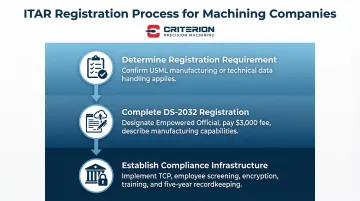
ITAR registration follows a defined sequence. Here's what machining companies need to complete, in order.
Step 1: Determine Registration Requirement Registration applies the moment you manufacture defense articles or handle USML technical data. If you produce "specially designed" components for defense applications—even without any export activity—registration is mandatory, not optional. Once you've confirmed this applies to your shop, the next step is formal submission.
Step 2: Complete DS-2032 Registration Submit your Statement of Registration online through the DDTC portal, including:
- Designation of an Empowered Official (EO) (a U.S. person authorized to sign license applications and refuse exports)
- Payment of the $3,000 Tier 1 registration fee
- Detailed description of manufacturing capabilities and defense articles produced
Step 3: Establish Compliance Infrastructure Registration approval doesn't end your obligations—it's the starting line. During registration, implement:
- Written Technology Control Plan documenting security procedures
- Employee screening protocols verifying U.S. person status
- Physical and digital security measures (access controls, encryption, secure storage)
- Training programs covering ITAR requirements and technical data handling
- Recordkeeping systems maintaining five-year documentation retention
Why ITAR Compliance Matters for Defense OEMs
National Security Protection
ITAR prevents sensitive military technology from reaching adversaries or unauthorized entities. Compromised technical data—such as material specifications, dimensional tolerances, or manufacturing processes for fire control systems—could enable adversaries to reverse-engineer U.S. defense capabilities, undermining military advantage and endangering personnel.
Supply Chain Integrity
ITAR compliance ensures the entire defense supply chain maintains consistent security standards. The cascading risk of a single non-compliant supplier is significant: if a tier-2 machining subcontractor allows unauthorized data access, the breach affects the tier-1 supplier, the prime contractor, and ultimately the Department of Defense program. That chain-of-exposure is exactly why OEMs vet supplier compliance before awarding contracts.
Contract Eligibility and Competitive Advantage
Most defense contracts require or strongly prefer ITAR-registered suppliers. Registration demonstrates:
- Commitment to national security
- Established compliance infrastructure
- Capability to handle controlled technical data
- Eligibility for classified and sensitive programs
Without registration, even technically capable shops are disqualified at the sourcing stage — before any evaluation of quality or capacity.
Risk Mitigation and Penalty Avoidance
The financial and operational consequences of violations are severe:
Civil Penalties: Up to $1,271,078 per violation or twice the transaction value, whichever is greater
Criminal Penalties: Up to $1 million in fines and 20 years imprisonment for willful violations
Debarment: Mandatory prohibition from defense trade following conviction, with administrative debarment lasting typically three years (reinstatement requires DDTC approval)
Recent enforcement actions demonstrate active prosecution: Precision Castparts Corp. paid $115,000 in 2024 after foreign national employees from Mexico and Peru accessed controlled technical data regarding tools, dies, and wax patterns for turbine blades.
Quality and Compliance Synergy
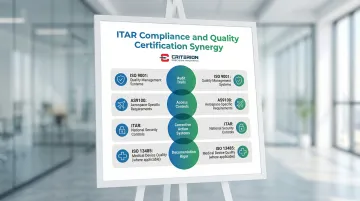
ITAR compliance pairs naturally with AS9100 and ISO certifications — each standard reinforces the documentation rigor and process controls the others require. For defense OEMs evaluating suppliers, multiple certifications indicate a single source of accountability across quality, security, and regulatory domains:
- Quality management (ISO 9001)
- Aerospace-specific requirements (AS9100)
- National security (ITAR)
- Medical device quality (ISO 13485, where applicable)
Shops holding this combination have already built the audit trails, access controls, and corrective action systems that ITAR demands — making them lower-risk partners from day one.
Choosing an ITAR-Compliant Precision Machining Partner
Verification Checklist
Confirm Active DDTC Registration:
- Request a copy of the current DDTC Registration Letter (valid for 12 months)
- Verify the registration includes the specific manufacturing activities you require
- Check that registration is current and not expired
Review Technology Control Plan:
- Request evidence of a written TCP covering physical security, IT security, and personnel screening
- Verify the plan includes specific procedures for technical data handling
- Confirm regular updates and management review
Verify Empowered Official:
- Confirm identity and authority of the designated EO
- Ensure the EO is a direct employee (not a consultant) and a U.S. person
- Verify the EO has independent authority to refuse exports
Audit Employee Screening:
- Review procedures for verifying citizenship/residency status
- Confirm I-9 documentation practices
- Verify visitor screening and escort protocols
Red Flags
- Expired or missing DDTC registration documentation
- Reluctance to discuss compliance procedures or provide registration letters
- No written TCP, or vague responses about security measures
- Foreign nationals working in ITAR zones without export licenses
- Mixed defense/non-defense operations without proper segregation or access controls
- Inadequate facility security (no badge access, unlocked storage, unsecured networks)
- Disorganized recordkeeping or inability to retrieve past documentation

Questions to Ask Potential Partners
Data Security:
- How do you control access to technical data (encryption, access controls, secure file transfer)?
- Where is technical data stored, and who can access it?
- What IT security measures prevent unauthorized electronic access?
Personnel Screening:
- What employee screening processes verify U.S. person status?
- How do you handle foreign national requests for facility access or technical information?
- What training do employees receive on ITAR requirements?
Compliance History:
- What is your audit history with DDTC?
- Have you experienced any violations or consent agreements?
- How do you monitor ongoing compliance?
Facility Security:
- How do you segregate ITAR-controlled work from non-defense operations?
- What physical security measures protect defense articles and technical data?
- Who has badge access to ITAR work areas?
ITAR-Registered Precision Machining with Comprehensive Compliance
If you're applying this checklist to a specific search, Criterion Precision Machining offers a concrete reference point. ITAR-registered with the U.S. Department of State, Criterion manufactures components for defense and military applications under strict protocols for controlled technical data and defense articles. Based in Brook Park, Ohio, the company holds ISO 9001:2015 and ISO 13485:2016 certifications alongside its ITAR registration — covering both quality management and national security requirements within a single compliance framework.
Criterion's documented procedures for technical data handling and supply chain security directly address the verification areas outlined above. For defense OEMs in aerospace, weapons systems, and photonics, the company produces tight-tolerance components (±0.0002") with the traceability and access controls that classified programs require.
Frequently Asked Questions
Who must register with the DDTC under ITAR?
Any company manufacturing, exporting, brokering, or providing defense services for USML items must register with DDTC. This includes precision machining facilities producing defense components, even if they never export products.
What are ITAR compliance requirements for precision machining?
Core requirements cover registration, access controls, recordkeeping, and licensing. Specifically:
- DDTC registration ($3,000 annually)
- Technical data access restricted to U.S. persons
- Documented Technology Control Plan
- Employee citizenship verification
- Five-year recordkeeping
- Export licensing for shipments and electronic data transfers
What products and activities in precision machining fall under ITAR?
ITAR controls aerospace components for military aircraft (Category VIII), weapons parts, fire control systems (Category XII), defense electronics housings, optical components for guidance systems, and all associated technical data including CAD files, engineering drawings, CNC programs, and manufacturing process specifications.
How much does it cost to register with DDTC for ITAR compliance?
The annual fee is $3,000 (Tier 1), reduced to $2,500 for first-time registrants with no pending license applications. Beyond registration, budget for Technology Control Plan development, employee training, physical and IT security upgrades, and legal consultation.
What is DoD compliance and how does it relate to ITAR and precision machining?
DoD compliance spans three overlapping frameworks: ITAR governs defense articles and technical data, DFARS covers procurement requirements, and CMMC sets cybersecurity standards. Together, they protect the defense supply chain from unauthorized access and data breaches.
How can defense OEMs verify a machining supplier's ITAR compliance?
Start by requesting documentation, then verify on-site. Key steps include:
- Confirm a current DDTC registration letter (valid for 12 months)
- Review the written Technology Control Plan for physical and IT security procedures
- Conduct a facility assessment to confirm ITAR work area segregation
- Audit employee screening and citizenship verification protocols