Introduction
Aerospace buyers face a critical challenge: selecting machining partners who can consistently deliver flight-critical components without failure. A single defective part can ground an aircraft, trigger a multi-million dollar recall, or—at worst—contribute to a safety incident with consequences that last far longer than the repair.
AS9100D is the aerospace industry's quality management standard — the benchmark for supplier reliability and risk control on mission-critical components. The problem is that a certificate on the wall tells you very little. According to the IAQG OASIS database, approximately 24,781 sites worldwide hold aerospace quality certifications, yet compliance depth varies widely across that group.
This article gives you a buyer-focused framework for assessing AS9100D compliance where it actually matters. You'll learn:
- Which specific standard requirements to verify with your supplier
- What documentation to request before awarding a contract
- How to spot red flags that signal surface-level compliance versus a genuine quality culture
Key Takeaways
- AS9100D builds on ISO 9001:2015 with 100+ aerospace-specific requirements addressing product safety, counterfeit prevention, and risk management
- Key compliance areas include First Article Inspection (AS9102), configuration management, and sub-tier supplier control
- Verify active compliance through audits, documentation review, and process validation—not just certificate status
- Understanding AS9100D lets buyers ask the right questions during supplier evaluation—and spot gaps before they become problems
What AS9100D Represents for Aerospace Manufacturing
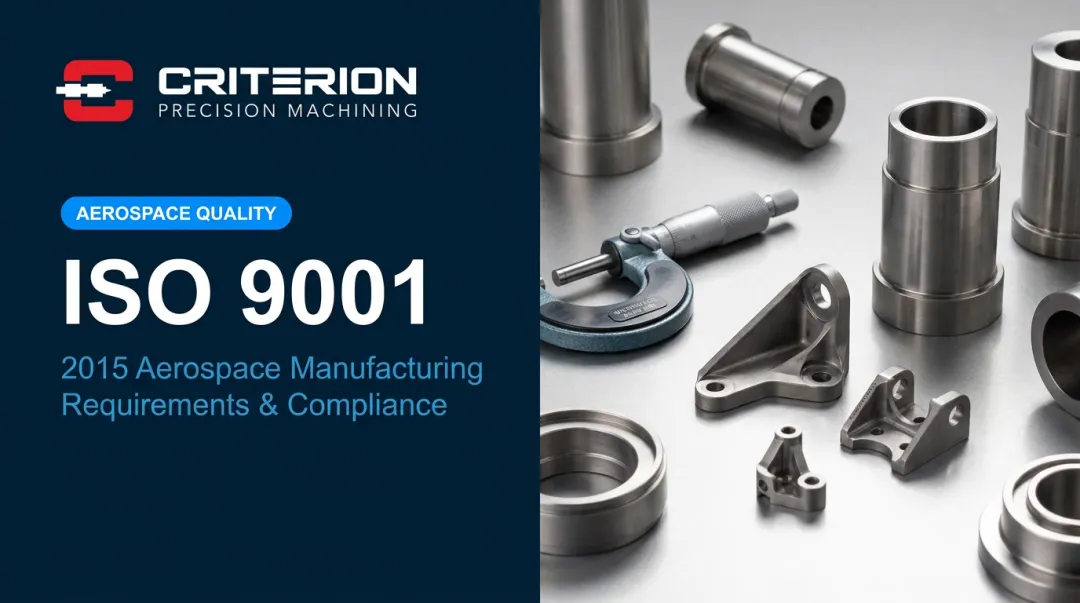
AS9100D is the International Aerospace Quality Group (IAQG) standard that establishes quality management system requirements for aviation, space, and defense industries. Released in 2016 as AS9100:2016 Revision D, it incorporates the entire text of ISO 9001:2015 and adds approximately 105 aerospace-specific requirements addressing industry-unique risks and regulatory compliance.
Key characteristics of AS9100D:
- Applies to all supply chain levels—from Tier 1 suppliers to sub-contractors
- Covers the entire product lifecycle: design, development, production, delivery, and post-delivery support
- Follows the same 10-clause Annex SL structure as ISO 9001, simplifying integration with other management systems
- Can be used globally to standardize quality requirements and reduce organization-specific demands
While AS9100D is not legally mandated, major aerospace OEMs including Boeing, Airbus, Lockheed Martin, and Northrop Grumman require suppliers to maintain this certification as a condition of doing business. Boeing requires suppliers to maintain accredited Industry Controlled Other Party (ICOP) certification listed in the IAQG OASIS database — meaning certification isn't a differentiator for suppliers; it's the floor.
Why AS9100D Matters for Mission-Critical Components
Aerospace components operate in extreme environments where single-point failures can have catastrophic consequences. Temperature fluctuations, vibration, pressure differentials, and sustained stress loads demand components that perform flawlessly throughout their service life.
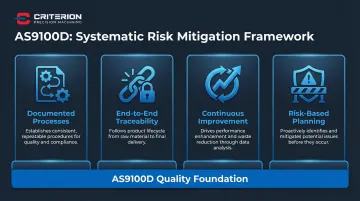
The standard provides systematic risk mitigation through:
- Documented processes: controlled workflows that produce repeatable results across every production run
- End-to-end traceability: material certifications, inspection records, and chain-of-custody documentation at every stage
- Mandatory continuous improvement: formal corrective action and audit cycles that close quality gaps over time
- Risk-based planning: proactive identification and mitigation of failure modes before they reach the flight line
Non-compliance carries real consequences. OEMs can revoke supplier recognition, and quality escapes in aerospace have historically triggered fleet groundings, safety investigations, and recall costs that run into the tens of millions. For a machining partner, losing AS9100D certification doesn't just mean losing one contract — it typically means losing access to the entire tier.
Critical AS9100D Requirements Aerospace Buyers Should Verify
These core compliance areas differentiate AS9100D from general manufacturing quality standards and represent the most critical verification points during supplier evaluation.
Risk Management and Opportunity Assessment
Requirement: AS9100D Clause 8.1.1 mandates formal operational risk assessment throughout the product lifecycle, not just reactive problem-solving.
What buyers should verify:
- Documented risk registers identifying potential failure modes in manufacturing processes
- Evidence of FMEA (Failure Mode and Effects Analysis) processes for both design (DFMEA) and manufacturing (PFMEA)
- Mitigation plans with assigned responsibilities and completion dates
- Regular review and updates to risk assessments when processes or products change
The standard requires organizations to plan actions to address risks and evaluate the effectiveness of these actions, making risk management an active control process, not a compliance checkbox.
Configuration Management and Change Control
Requirement: AS9100D Clause 8.1.2 ensures physical products match engineering specifications and documentation throughout production.
Configuration management prevents the costly problem of producing parts to obsolete revision levels. Buyers should verify suppliers have:
- Formal change control processes with approval workflows
- Engineering Change Order (ECO) systems that track all design modifications
- Version control for drawings, specifications, and work instructions
- Processes to ensure production uses current revisions only
Without robust configuration management, suppliers risk manufacturing parts that don't match current specifications. In aerospace, that's not a rework inconvenience — it's a safety failure.
Product Safety and Critical Item Control
Requirement: AS9100D Clause 8.1.3 requires identification and special handling of safety-critical and key characteristics.
What buyers should verify:
- Systems to identify critical dimensions, safety-critical features, and key characteristics in quality plans
- Hazard assessments for products and processes
- Special controls for safety-critical items (enhanced inspection, process monitoring, traceability)
- Training programs ensuring personnel understand consequences of non-conformance
This requirement doesn't exist in ISO 9001 — it's specific to AS9100D because aerospace components can directly affect human safety.
Counterfeit Parts Prevention
Requirement: AS9100D Clause 8.1.4 mandates controls to prevent counterfeit, fraudulent, or suspect material from entering the supply chain.
What to verify:
- Approved supplier lists with qualification criteria
- Material traceability systems linking parts to mill certifications
- Incoming inspection procedures that verify authenticity
- Certificate of conformance validation processes
- Training programs on counterfeit identification
Buyers should ask: "How do you verify that raw materials and purchased components are authentic?" Strong suppliers will describe multi-layered verification including supplier qualification, material certification review, and physical inspection.
First Article Inspection (FAI) and Special Process Control
Requirement: AS9100D Clause 8.5.1.3 mandates production process verification, typically fulfilled through AS9102 First Article Inspection.
FAI is the complete verification that a production process can repeatedly produce parts meeting all specifications. Boeing explicitly adopts AS9102 for hardware FAI and requires submission via Net-Inspect for FAIs completed after January 1, 2024.
FAI is triggered by:
- First production run of a new part
- Design changes affecting fit, form, or function
- Manufacturing source or process changes
- Production lapse of two years or more
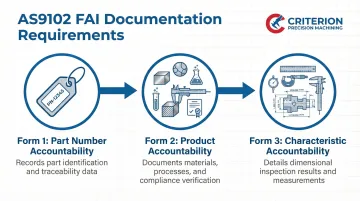
Required AS9102 documentation includes three forms:
- Form 1 — Part Number Accountability: Confirms the correct part number, revision level, and drawing references
- Form 2 — Product Accountability: Documents materials used, special processes performed, and functional test results
- Form 3 — Characteristic Accountability: Records measured results for every dimension, tolerance, and design characteristic on the drawing
Buyers should request FAI reports for similar parts to assess the supplier's inspection thoroughness and documentation quality.
Supplier Management and Flow-Down Requirements
Requirement: AS9100D Clause 8.4 requires certified companies to flow down quality requirements to their sub-tier suppliers.
What buyers should verify:
- Processes to evaluate, select, and approve sub-tier suppliers
- Performance monitoring systems (scorecards, metrics tracking)
- Flow-down of quality requirements in purchase orders
- Evidence of sub-tier audits or assessments
- Traceability through the supply chain
Weak sub-tier supplier management is a common compliance gap. Buyers should ask: "How do you qualify your material suppliers and special process providers? Can you show me your approved supplier list and performance data?"
How AS9100D Differs from ISO 9001 and Other Quality Standards
Most machining shops carry ISO 9001 — but aerospace OEMs require more. AS9100D adds approximately 105 requirements on top of ISO 9001's framework, addressing safety, counterfeit parts, configuration control, and on-time delivery in ways that ISO 9001 simply doesn't touch.
Key Differences Between AS9100D and ISO 9001
Both standards follow the same 10-clause Annex SL structure, but AS9100D incorporates approximately 105 additional requirements:
| Requirement Area | ISO 9001:2015 | AS9100D |
|---|---|---|
| Product Safety | Not addressed | Clause 8.1.3 requires safety considerations throughout product lifecycle |
| Counterfeit Parts Prevention | Not addressed | Clause 8.1.4 mandates specific controls to prevent counterfeit materials |
| Operational Risk Management | General risk-based thinking | Clause 8.1.1 requires formal process for managing operational risks |
| Configuration Management | Basic document control | Enhanced requirements to track product configuration changes |
| On-Time Delivery | Not emphasized | Performance metric tracked and required |
| Awareness of Consequences | General awareness | Specific training on consequences of non-conformance |
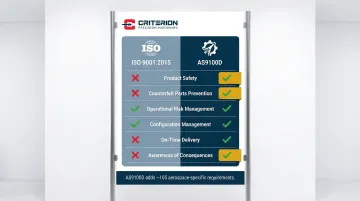
ISO 9001 provides a solid quality foundation, but it does not satisfy aerospace OEM supplier requirements on its own. Machining partners serving aerospace must hold AS9100D certification or demonstrate equivalent aerospace-specific controls across each of these areas.
Relationship to Other Aerospace Certifications
AS9100D rarely stands alone. Aerospace buyers often require companion certifications that address specific process types or regulatory obligations — here's how the most common ones fit together:
NADCAP (managed by Performance Review Institute) accredits specific special processes — heat treating, chemical processing, NDT, and welding. Many OEMs require it for process-specific work alongside AS9100D's broader quality system requirements.
ITAR Registration is a regulatory obligation from the Directorate of Defense Trade Controls (DDTC), not a quality certification. Any shop manufacturing defense-related articles must register and comply with US export control laws — it's non-negotiable for defense supply chains.
ISO 13485 shares ISO 9001's roots but applies to the medical device industry. Suppliers serving both aerospace and medical markets often carry both AS9100D and ISO 13485, which signals strong quality management across multiple regulated industries.
Criterion Precision Machining holds ISO 9001 and ISO 13485 certifications and is FDA and ITAR registered — a combination that reflects the multi-standard quality discipline aerospace and defense buyers require from their machining partners.
Evaluating Your Machining Partner's AS9100D Compliance
Asking "Are you AS9100D certified?" is the starting point — not the finish line. These steps help you verify what's actually behind that certificate.
Verify Current Certification Status
Three-point verification process:
- Request certificate copy and confirm it's current (typically 3-year validity with annual surveillance audits)
- Check scope of certification on the certificate—it should explicitly include relevant activities (e.g., "Design and manufacture of precision machined components" vs. limited scopes that exclude critical processes)
- Verify accreditation by checking the certification body is accredited by recognized bodies like ANAB (ANSI National Accreditation Board) or UKAS (United Kingdom Accreditation Service)
Critical verification: Confirm the supplier appears in the IAQG OASIS database. If a supplier claims AS9100 certification but doesn't appear in OASIS, the certificate is likely invalid or unaccredited.
Request and Review Quality Documentation
Key documents buyers should request:
- Quality manual outlining the quality management system structure
- Process flow charts showing production sequences and inspection points
- Control plans for similar parts showing critical characteristics and inspection methods
- Inspection procedures and work instructions
- FAI reports (AS9102 Forms 1, 2, and 3) for similar parts
- Recent internal audit reports and management review minutes
What to look for:
- Clear processes with defined responsibilities
- Measurable quality objectives with performance tracking
- Evidence of continuous improvement (corrective actions, process improvements)
- Documentation that's current and actively used (not dusty binders)
Conduct or Request Supplier Audits
When to conduct on-site audits:
- New supplier qualification
- High-value or safety-critical components
- History of quality issues
- Major process changes
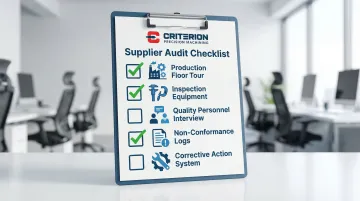
Brief audit checklist:
- Production floor tour: Observe FOD (Foreign Object Debris) controls, cleanliness, organization, and process discipline
- Inspection equipment: Review calibration records and traceability to national standards
- Quality personnel interview: Assess knowledge of AS9100D requirements and company processes
- Non-conformance logs: Examine how the supplier identifies, documents, and resolves quality issues
- Corrective action system: Review CAPA (Corrective and Preventive Action) effectiveness
Assess Traceability and Documentation Systems
Verify end-to-end traceability from raw material certifications through production travelers to final inspection reports.
Modern systems buyers should expect:
- ERP/MRP systems with integrated quality modules (like ProShop ERP)
- Digital traveler systems that eliminate paper and ensure current revision usage
- Automated certificate of conformance generation
- Material traceability linking finished parts to mill certifications
Ask: "Can you trace a finished part back to its raw material certification? How long does it take?" Strong suppliers can demonstrate complete traceability within minutes.
Evaluate Continuous Improvement Culture
AS9100D requires continual improvement, not a static quality system that simply passes audits.
Indicators of strong quality culture:
- Regular management reviews with documented decisions and action items
- Comprehensive employee training records showing ongoing skill development
- Investment in quality equipment and technology upgrades
- Proactive corrective actions (not just reactive fixes)
- Customer satisfaction tracking with action plans
- Quality metrics displayed and actively monitored
Criterion Precision Machining, for example, backs its ISO 9001 and ISO 13485 certifications with a Global Advantage CMM running PC-DMIS software and ProShop ERP for real-time traceability — the same infrastructure disciplines that AS9100D-certified shops require. When evaluating any supplier, ask to see how quality metrics are tracked daily, not just at audit time.
Red Flags and Common Compliance Gaps to Watch For
These warning signs indicate superficial compliance or inadequate AS9100D implementation. Use them as a structured checklist when qualifying a new machining partner or re-evaluating an existing one.
Certification Without Cultural Implementation
Some suppliers hold the certificate without building the infrastructure behind it. Watch for:
- Inability to produce requested documentation quickly (quality manual, control plans, FAI reports)
- Vague or inconsistent answers about processes when interviewing different personnel
- Lack of quality metrics visibility on the production floor
- Operators unfamiliar with inspection requirements or critical characteristics
- Recent certification with minimal quality infrastructure investment
Inadequate Sub-Tier Supplier Management
A supplier's quality is only as strong as their weakest sub-tier vendor. Ask directly how they qualify and monitor the suppliers behind them — and look for:
- Absence of approved supplier lists with qualification criteria
- No supplier performance scorecards or metrics tracking
- Purchase orders that don't flow down quality requirements
- Inability to provide sub-tier certificates of conformance
- No evidence of sub-tier audits or assessments
This gap is especially risky because quality failures can originate anywhere in the supply chain. Boeing and other OEMs explicitly require that certificates of conformance include verification from sub-tier suppliers.
Weak Corrective Action Systems
Repeated non-conformances without genuine root cause resolution signal a reactive shop — one that patches problems rather than eliminating them. When reviewing a supplier's CAPA history, work through these steps in order:
- Request CAPA logs from the past 12 months and scan for repeat issue types
- Verify root cause methodology — look for documented 5-Why or Fishbone analysis, not just a symptom description
- Check effectiveness verification — closed CAPAs should include evidence the fix held
- Assess closure timeliness — chronic open CAPAs signal a backlog, not a quality culture
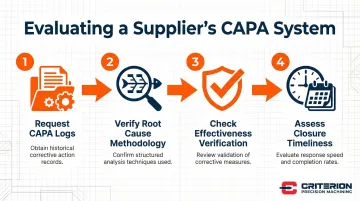
A supplier who can walk you through a past non-conformance — what caused it, how they fixed it, and how they confirmed it stayed fixed — demonstrates exactly the discipline aerospace programs require.
Beyond Certification: Comprehensive Quality Partnerships
AS9100D certification is a baseline requirement, but the best aerospace machining partnerships involve broader quality capabilities and strategic alignment.
Complementary Quality Systems and Certifications
While AS9100D is aerospace-specific, machining partners serving multiple regulated industries may hold complementary certifications that demonstrate a mature quality culture:
ISO 13485 (Medical Device Quality Management): Imposes documentation and traceability requirements comparable to AS9100D. A supplier holding this alongside aerospace work has demonstrated they can manage complex quality systems across multiple regulated environments.
ITAR Registration: Required for defense articles and technical data. ITAR-registered suppliers have cleared a compliance threshold that signals security awareness and regulatory discipline — both valuable in aerospace defense programs.
Holding multiple certifications indicates the supplier's quality system is adaptable, not purpose-built for a single customer. That flexibility matters when your production needs evolve.
For example, Criterion Precision Machining holds ISO 9001, ISO 13485, and ITAR/FDA registration — not AS9100D, but a certification stack that reflects the documentation discipline, traceability, and regulatory compliance aerospace buyers should look for in a machining partner. Their ProShop ERP for full traceability, Global Advantage CMM with PC-DMIS software, and tolerances down to ±0.0002" put them in the same operational tier as many AS9100D-certified shops.
Advanced Quality Capabilities to Seek
High-reliability suppliers employ advanced tools beyond AS9100D baseline requirements:
Statistical Process Control (SPC):
- Real-time monitoring of process variation
- Predictive capability to identify trends before defects occur
- Boeing's Addendum 1 to AS9100 requires establishing SPC for Key Characteristics
Advanced Metrology Equipment:
- Coordinate Measuring Machines (CMM) with PC-DMIS software for complex geometry inspection
- Optical inspection systems for high-throughput dimensional analysis
- Laser scanning for reverse engineering and inspection
Digital Product Definition (DPD) Capabilities:
- Ability to inspect directly against 3D CAD models
- Model-Based Definition (MBD) workflows
- Reduces interpretation errors from 2D drawings
Real-Time Quality Monitoring:
- Digital tools that monitor process stability continuously
- Automated alerts for out-of-control conditions
- Reduced reliance on post-production inspection
Long-Term Partnership Considerations
Technical capabilities only go so far. The day-to-day reality of a supplier relationship depends on communication, flexibility, and genuine investment in your outcomes:
Responsiveness and Communication:
- Quick turnaround on quotes and questions
- Proactive communication about potential issues
- Transparency about capabilities and limitations
Engineering Support:
- Design for manufacturability (DFM) feedback
- Material selection guidance
- Process optimization recommendations
Capacity Planning:
- Ability to scale with your demand
- Backup capacity for surge requirements
- Realistic lead time commitments
Continuous Improvement Initiatives:
- Joint cost reduction programs
- Process improvement collaboration
- Technology investments that benefit your products
Suppliers who invest in these areas treat your program as a long-term commitment — and that distinction becomes apparent the first time a delivery window tightens or a spec revision hits mid-run.
Conclusion
AS9100D certification represents the quality foundation aerospace buyers should demand from machining partners, but the certificate alone doesn't guarantee performance. Thorough supplier evaluation must include verification of active compliance through documentation review, on-site audits, and assessment of quality culture.
The requirements that separate genuinely capable aerospace suppliers from those with surface-level compliance are concrete and verifiable. When evaluating a machining partner, confirm their implementation of:
- Risk management processes tied to production planning
- Configuration control and revision traceability
- Product safety and counterfeit parts prevention programs
- First Article Inspection (FAI) procedures
- Sub-tier supplier qualification and oversight
Understanding what each requirement looks like in practice lets you ask targeted questions and spot gaps before they become delivery or quality problems.
Treat supplier selection as building a long-term quality partnership, not checking a certification box. The machining partners worth keeping are the ones who can walk you through their corrective action history, show you their audit results, and explain exactly how they control your parts from raw material to final inspection. That transparency is what consistent delivery of mission-critical components actually looks like.
Frequently Asked Questions
What is the difference between AS9100 and AS9100D?
AS9100D is the current revision (released 2016 as AS9100:2016 Revision D) that aligns with the ISO 9001:2015 structure and adds enhanced requirements for risk-based thinking, product safety, and counterfeit prevention. Earlier revisions (AS9100, AS9100A, AS9100B, AS9100C) are now superseded and no longer valid for certification.
What are AS9100D standards?
AS9100D is a quality management system standard that builds on ISO 9001:2015 with roughly 105 aerospace-specific requirements. Those additions cover risk management, configuration control, product safety, counterfeit prevention, and supplier oversight — areas where general quality standards fall short for aerospace manufacturing.
What is an AS9100 audit?
AS9100 audits are third-party assessments conducted by accredited certification bodies to verify a company's quality management system meets all standard requirements. The audit cycle includes initial certification audits (Stage 1 document review and Stage 2 implementation audit), annual surveillance audits to maintain certification, and triennial recertification audits.
What is required for a supplier audit?
A thorough supplier audit should confirm current AS9100D certification scope, review quality documentation (control plans, FAI reports, corrective actions), and include a facility walkthrough to assess FOD controls and process discipline. Reviewing traceability systems and interviewing quality personnel rounds out an effective evaluation.
How often should suppliers be audited?
Critical suppliers should be audited at least annually. Additional audits are warranted after quality escapes, major process changes, new product introductions, or production gaps exceeding two years. AS9100D-certified suppliers also face mandatory third-party surveillance audits annually and recertification every three years.
What are the standards for CNC machining?
The primary quality standards for CNC machining are AS9100D (aerospace), ISO 9001 (general manufacturing), and ISO 13485 (medical devices). Aerospace applications also reference GD&T per ASME Y14.5, SAE AMS material specifications, AS9102 for First Article Inspection, and NADCAP accreditation for special processes such as heat treatment and plating.