Introduction
Selecting the right CNC machine shop for medical device manufacturing is a life-or-death decision. When a surgeon implants a bone screw or relies on an anchor system to restore joint function, the precision of that component directly impacts patient outcomes. The stakes extend beyond quality to regulatory compliance, product liability, and the costly consequences of recalls or field failures.
The numbers tell a sobering story: In 2024, medical device recalls hit a 4-year high of 1,048 events, representing a nearly 25% increase from the previous year. With approximately 900 recalls occurring annually between fiscal years 2020 and 2024, a substantial portion stemming from manufacturing defects, rigorous supplier qualification isn't optional — it's foundational. This guide walks through the specific criteria — certifications, capabilities, quality systems, and red flags — that distinguish a qualified medical machining partner from a general job shop.
Key Takeaways
- Qualified medical device shops hold ISO 13485 certification and maintain full material traceability from raw stock to finished part
- Minimum precision capability of ±0.0002" is the baseline — confirm it with calibrated CMM inspection records
- Vet shops on certifications, process validation documentation, material expertise, and medical device production history
- Qualification follows four steps: documentation review, site audit, sample evaluation, and ongoing performance monitoring
Understanding Medical Device Manufacturing Requirements
Medical device manufacturing operates under stricter regulatory frameworks than general industrial machining, where quality is measured not just in tolerances but in patient safety and regulatory compliance.
The regulatory landscape has undergone a major transformation. As of February 2, 2026, the FDA's Quality Management System Regulation (QMSR) is effective, amending 21 CFR Part 820 to incorporate ISO 13485:2016 by reference. This harmonization shifts requirements, mandating that manufacturers verify CNC suppliers are not only ISO 13485 certified but also aligned with specific FDA supplemental requirements regarding records, labeling, and traceability.
ISO 13485 is the international standard specifically designed for medical device quality management systems. While ISO 9001 focuses on customer satisfaction and continual improvement, ISO 13485 emphasizes safety, efficacy, and regulatory compliance with explicit risk management requirements throughout product realization and prescriptive documentation demands.
Qualifying a machine shop means confirming it actively participates in risk management — not just acknowledges it. Suppliers must contribute to Process Failure Mode and Effects Analysis (PFMEA) and control plan development. Risk analysis techniques like FMEA are recognized by the FDA as standard methods for meeting requirements under ISO 13485 and ISO 14971.
Traceability requirements follow directly from this risk framework. Every component must be traceable to its raw material lot, and documentation must cover:
- Raw material certifications for biocompatibility and mechanical properties
- Environmental conditions during production
- CNC production data linked to the device's Unique Device Identification (UDI)
For implantable devices, this chain of custody is mandatory — gaps in traceability can trigger a full lot rejection.
Essential Qualifications for Medical CNC Machine Shops
Not all precision machine shops are equipped for medical device work. Specific qualifications separate capable partners from those merely claiming expertise in this highly regulated field.
ISO 13485 Certification Requirement
ISO 13485 is non-negotiable for medical device suppliers, demonstrating implementation of medical-specific quality and risk management processes. Certification must be current and from an accredited registrar—look for ANAB (ANSI National Accreditation Board) or equivalent accreditation. ANAB-accredited bodies must conform to ISO/IEC 17021-1, ensuring the rigor of the certification process and the validity of the shop's quality management system.
FDA Registration and Compliance
Shops serving U.S. medical device markets should be FDA registered and familiar with 21 CFR Part 820 requirements. Design Control requirements under 21 CFR Part 820 are particularly relevant if the shop will be involved in prototype development or new product introduction activities.
Process Validation Capabilities (IQ/OQ/PQ)
Validation applies when inspection alone can't confirm a process consistently produces conforming output. The IQ/OQ/PQ protocol ensures consistent, repeatable results:
- Installation Qualification (IQ): Confirms CNC equipment and ancillary systems are installed per approved specifications
- Operational Qualification (OQ): Establishes process control limits and action levels so the process reliably meets requirements
- Performance Qualification (PQ): Confirms the process consistently yields acceptable product under real operating conditions
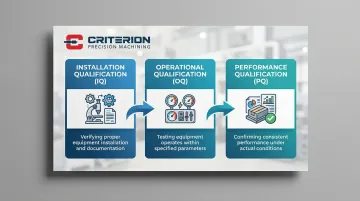
CNC processes like passivation, heat treating, and anodizing particularly benefit — you can't destructively test every part to verify conformance.
Material Certifications and Traceability Systems
Shops must maintain material certifications (mill certs, biocompatibility testing, material property verification) and demonstrate lot traceability from raw material through finished component. "Medical Grade" labeling is insufficient — biocompatibility must be evaluated based on the finished device's contact type and duration per ISO 10993-1:2018. Worth noting: the machining process itself — coolants, tool debris, surface residues — can affect biocompatibility. That makes cleaning process validation as important as the material certifications themselves.
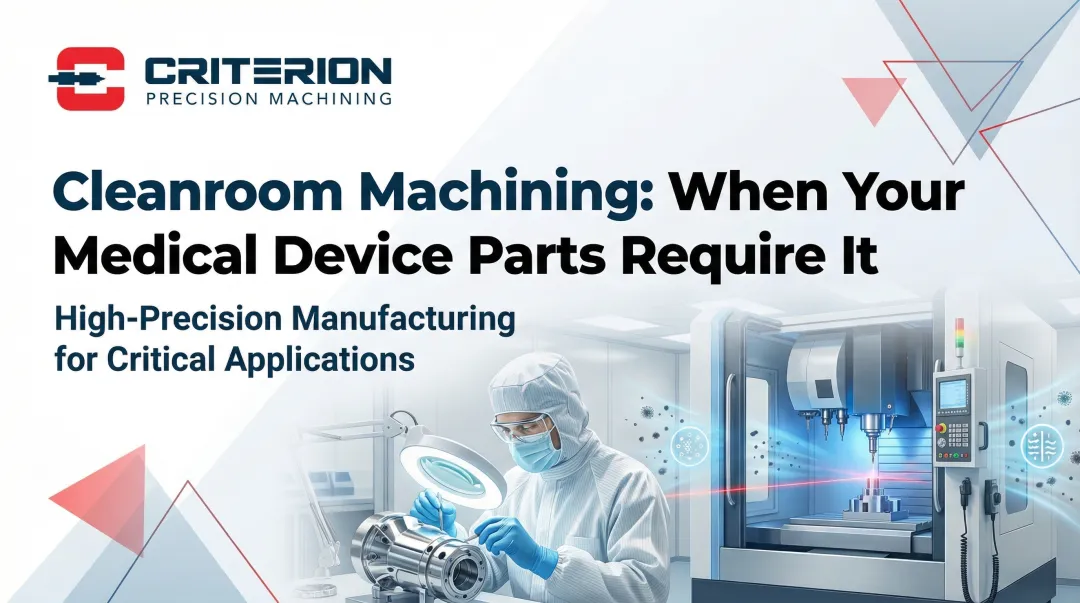
Clean Room or Controlled Environment Capabilities
Clean room manufacturing is necessary for implantable devices and fluid-contact components. Cleanrooms are classified by ISO 14644-1 based on airborne particle concentration:
- ISO Class 7: Common for medical device packaging and assembly (limit: 352,000 particles ≥0.5 μm/m³)
- ISO Class 8: Often used for component manufacturing or molding (limit: 3,520,000 particles ≥0.5 μm/m³)
While not all CNC machining requires a cleanroom, sterile-critical components often demand controlled environments during post-processing and packaging phases.
Key Factors to Evaluate When Qualifying a Shop
Six evaluation areas — spanning technical capability, quality infrastructure, and business track record — separate genuinely qualified medical suppliers from shops that simply claim to be.
Precision Machining Capabilities and Equipment
Confirm the shop has modern multi-axis CNC equipment capable of achieving your required tolerances:
- 5-axis machining centers for complex geometries and reduced setups
- Swiss-type lathes for small-diameter, high-precision components
- Verified tolerance capabilities matching your requirements (medical devices often require ±0.0002" or tighter on critical features)
- Experience with complex geometries, micro-features, and thin-wall components common in medical devices
Quality Management and Inspection Infrastructure
Evaluate inspection equipment and capabilities:
- CMM (Coordinate Measuring Machine) with PC-DMIS or equivalent software
- Optical comparators and surface roughness testers
- Temperature-controlled inspection environment (critical for high-precision measurement)
- Statistical process control (SPC) implementation and real-time process monitoring
Measuring equipment must be calibrated at specified intervals against standards traceable to NIST or equivalent national standards. ISO/IEC 17025 accreditation for the internal lab demonstrates formal competence.
Material Expertise and Biocompatible Material Experience
Assess experience with medical-grade materials:
- Titanium alloys (Ti-6Al-4V) — highly biocompatible for implants and surgical instruments
- Stainless steel (316L) — surgical-grade, withstands repeated sterilization cycles
- Cobalt-chrome — wear-resistant for load-bearing implants
- PEEK and biocompatible polymers — high-performance alternatives where metal isn't appropriate
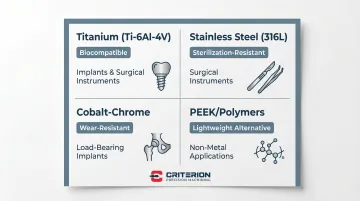
Ask specifically about chain of custody documentation — a shop should be able to trace every raw material certificate to a finished part.
Documentation and Traceability Systems
Evaluate the shop's document control system:
- Procedures, work instructions, and inspection records with deviation management
- Device History Record (DHR) generation capabilities with full traceability to raw materials, processes, and inspection results
- Manufacturing execution systems (MES) or ERP systems capable of maintaining digital traceability
Ask the shop to walk you through how they generate a DHR — the answer reveals whether their traceability is real or theoretical. Under 21 CFR 820.184, the DHR must include dates of manufacture, quantities released, and acceptance records confirming alignment with the Device Master Record (DMR).
Regulatory Experience and Audit Readiness
Assess the shop's experience supporting regulatory oversight:
- Experience with customer audits, FDA inspections, and notified body audits
- Documented quality procedures including CAPA (Corrective and Preventive Action), supplier management, and internal audit programs
- Understanding of design control requirements if supporting prototype or new product development
The GHTF/IMDRF framework outlines a six-step process for supplier control, including planning, selection, evaluation, finalization of controls, delivery monitoring, and feedback.
Track Record and References in Medical Device Manufacturing
Request and verify customer references specifically from medical device manufacturers:
- Years of experience in medical manufacturing
- Types of devices produced (implantable, surgical instruments, diagnostic equipment)
- FDA warning letters, recalls, or quality issues associated with the supplier (publicly available through FDA databases)

How Criterion Precision Machining Can Help
Founded in 1953, Criterion Precision Machining has spent more than seven decades building the certifications, equipment, and process discipline that medical device manufacturers require. Their "No Failure" philosophy reflects a straightforward reality: in medical devices, aerospace, defense, and photonics, a single out-of-tolerance part can have serious consequences.
Here's how Criterion meets the qualification criteria that matter most to medical device OEMs:
Certifications and Compliance
- ISO 13485:2016 and ISO 9001:2015 certified
- FDA and ITAR registered
- Woman-owned business (WBENC certified)
Manufacturing Capabilities
- Swiss turning, 5-axis CNC milling, and CNC turning with tolerances down to ±0.0002"
- Multi-axis capabilities (3-, 4-, 5-axis milling; up to 8-axis Swiss turning)
- Component size range from 0.010" diameter micro-parts to 17"×22"×17" assemblies
Quality Infrastructure
- ProShop ERP for complete digital traceability from quoting through shipment
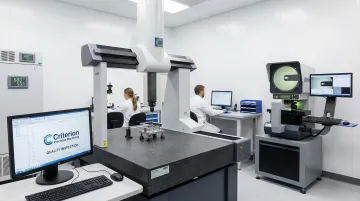
- Global Advantage CMM with PC-DMIS software for precision inspection
- OASIS optical inspection system and Keyence measuring systems (up to 99 dimensions on 100 parts simultaneously)
- Temperature-controlled inspection environment
Material Expertise
- Extensive experience with titanium, surgical-grade stainless steels, PEEK, and specialty alloys
- Documented capabilities with biocompatible materials common in medical devices
- Material certification and traceability from raw stock to finished component
Proven Track Record
- Serving major medical device manufacturers including Riverpoint Medical and Smith & Nephew
- Specialization in surgical instruments, implantable device components, and diagnostic equipment parts
- Production-intent prototyping services for seamless transition from development to manufacturing
Conclusion
Qualifying a CNC machine shop for medical device manufacturing means finding a partner genuinely committed to patient safety, regulatory compliance, and zero-defect output — not just one with capable machines. In an industry where recalls reached a 4-year high in 2024, the cost of the wrong supplier extends well beyond financial impact to patient harm and brand reputation.
The right supplier brings more than machining capability. Look for:
- Validated processes and documented process controls
- Material expertise across titanium, PEEK, stainless, and other medical-grade alloys
- Lot-level traceability systems tied to serialized components
- A quality culture — not just a quality manual — built around ISO 13485 and FDA registration
Every element of their operation should reflect the "No Failure" standard that medical devices demand.
Supplier qualification is an ongoing process requiring periodic re-evaluation, performance monitoring, and continuous improvement collaboration. As the new QMSR brings FDA expectations closer in line with ISO 13485, your CNC partner must keep pace — maintaining audit-ready documentation, updated quality systems, and the traceability infrastructure that keeps patients safe and your devices on the market.
Frequently Asked Questions
What are the 5 criteria to evaluate suppliers?
The five essential criteria are: (1) Quality management system and certifications (ISO 13485, FDA registration), (2) Technical capabilities and equipment (tolerances, multi-axis machining), (3) Material expertise and traceability (biocompatible materials, lot tracking), (4) Regulatory compliance and audit history (inspection readiness, CAPA systems), and (5) Financial stability and business continuity planning.
What is the difference between ISO 9001 and ISO 13485?
ISO 9001 is a general quality management standard focused on customer satisfaction across any industry. ISO 13485 is specifically designed for medical devices, adding requirements for risk management throughout product realization, prescriptive documentation (Device Master Records), and contamination controls that general manufacturing doesn't require.
What should be included in the inspection checklist?
A medical CNC inspection checklist should cover:
- Dimensional verification of critical features using calibrated equipment
- Surface finish measurement to specified Ra values
- Material certification review confirming biocompatibility and mechanical properties
- Visual inspection for defects or contamination
- Full documentation with traceability to material lots and production records
What is CNC in medical devices?
CNC (Computer Numerical Control) machining uses computer-controlled equipment to manufacture medical device components with extreme precision. It removes material from workpieces to produce tight-tolerance metal and plastic parts — implants, surgical instruments, diagnostic equipment — holding tolerances as tight as ±0.0002" that manual machining cannot achieve.
How long does it take to qualify a medical CNC machine shop?
Full supplier qualification typically takes 3–6 months across four phases:
- Documentation review (2–4 weeks): verify certifications and quality procedures
- Site audit (1–2 weeks): assess facilities and processes
- Sample part evaluation (4–8 weeks): validate machining capabilities
- Initial production monitoring (8–12 weeks): confirm consistent performance before full approval
What are the 4 categories of medical devices?
The FDA uses three classifications based on risk, not four. Class I covers low-risk items (bandages, handheld instruments); Class II covers moderate-risk devices requiring 510(k) clearance (infusion pumps, powered wheelchairs); Class III covers high-risk implants requiring premarket approval (heart valves, pacemakers). CNC shops must know a device's classification — Class III implants demand the strictest traceability controls.