Introduction
The FDA's incorporation of ISO 13485:2016 into its new Quality Management System Regulation (QMSR), effective February 2, 2026, has turned a longstanding industry question into an urgent compliance deadline. For precision machining companies supplying the medical device industry, which certification you hold now directly affects regulatory approval, OEM contracts, and market access.
Choosing the wrong certification isn't a paperwork problem — it's a business risk. Rejected components, failed audits, and lost supplier agreements are the real consequences. This article clarifies which certification is essential for medical parts manufacturing and when holding both makes sense.
Key Takeaways
- ISO 13485 is medical device-specific with mandatory risk management and traceability, while ISO 9001 covers general quality management for any industry
- Medical parts suppliers need ISO 13485 certification—ISO 9001 alone won't satisfy medical device OEM requirements or regulatory compliance
- FDA ties ISO 13485 to its Quality System Regulation framework—US market access requirements shift in February 2026
- Manufacturers serving both medical and non-medical sectors—aerospace, defense—benefit from holding dual certification
- Major OEMs like Medtronic and Stryker require ISO 13485 from critical suppliers—not just preferred, expected
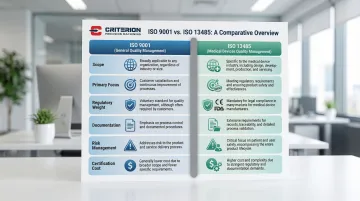
ISO 13485 vs ISO 9001: Quick Comparison
| ISO 9001 | ISO 13485 | |
|---|---|---|
| Scope | Universal — any industry, size, or product type | Exclusively for medical device manufacturers and their supply chains |
| Primary Focus | Customer satisfaction and continuous improvement | Patient safety and regulatory compliance |
| Regulatory Weight | No regulatory standing with medical device authorities | Required for CE marking (EU), accepted under FDA's QMSR framework, mandatory in Canada for Class II–IV devices; baseline for MDSAP across five jurisdictions |
| Documentation | Flexible — organizations define what "documented information" is necessary | Prescriptive: mandatory Quality Manual, Device Master Records, Device History Records per batch, full material traceability, minimum two-year retention |
| Risk Management | Risk-based thinking incorporated into processes; no formal methodology required | Documented risk management per ISO 14971 required at every stage — assessments, mitigation strategies, and ongoing monitoring |
| Certification Cost | Lower — broader auditor availability, scalable documentation requirements | Higher — specialized medical device auditors required; audit scope expands further under MDSAP |
What is ISO 9001?
ISO 9001:2015 is the international standard for quality management systems applicable to any organization regardless of size, industry, or product type. It provides a framework for consistent quality delivery, focusing on customer satisfaction, continuous improvement, and a process-based approach using the Plan-Do-Check-Act cycle.
Use Cases of ISO 9001
ISO 9001 fits manufacturers serving multiple industries where general quality management demonstrates capability without industry-specific regulatory requirements. Its universal applicability makes it particularly common among diversified manufacturers supplying sectors such as:
- Aerospace and defense components
- Automotive parts and assemblies
- General industrial machinery and equipment
As of 2024, there are 1,474,118 valid ISO 9001:2015 certificates worldwide, with manufacturing sectors like "Basic Metal & Fabricated Metal Products" and "Machinery and Equipment" ranking among the top five industries for certification. This widespread adoption makes ISO 9001 a standard expectation for industrial suppliers—though it's often insufficient for specialized sectors like medical devices.
Key Requirements and Benefits
ISO 9001:2015 is built on seven quality management principles:
- Customer focus - Meeting requirements and exceeding expectations
- Leadership - Establishing unified purpose and direction
- Engagement of people - Empowering competent, engaged teams
- Process approach - Understanding interrelated activities as coherent systems
- Improvement - Maintaining ongoing optimization focus
- Evidence-based decision making - Analyzing data for informed choices
- Relationship management - Managing supplier and stakeholder relationships
The standard delivers measurable benefits for manufacturers:
- Reduces waste and streamlines operations through process discipline
- Builds customer confidence with documented quality controls
- Drives consistency via structured internal audits
That said, ISO 9001 is a foundational framework. It lacks the medical device-specific controls required for regulated healthcare products—mandatory risk management, design controls, and component traceability requirements are absent from its scope.
What is ISO 13485?
ISO 13485:2016 is the quality management system standard specifically for medical device manufacturers and their supply chains, emphasizing regulatory compliance and patient safety over customer satisfaction metrics. Where ISO 9001 centers on continuous improvement and meeting customer expectations, ISO 13485 centers on demonstrating consistent compliance with regulatory requirements.
One important structural note: ISO 13485:2016 is based on ISO 9001:2008, not the 2015 version. ISO Technical Committee 210 deliberately avoided adopting the newer structure, citing concern that terminology changes in ISO 9001:2015 would conflict with existing medical device regulations.
As a result, ISO 13485 retains prescriptive requirements — a Quality Manual, a designated Management Representative — that ISO 9001:2015 made optional. That's not an oversight. It's intentional regulatory rigor.
Use Cases of ISO 13485
ISO 13485 certification is essential for:
- Medical device OEMs
- Component and parts suppliers
- Contract manufacturers
- Sterilization services
- Anyone in the medical device supply chain
Specific medical parts requiring ISO 13485 include surgical instruments, implantable components like orthopedic fasteners and bone plates, diagnostic equipment parts, and precision components for surgical tools. For example, manufacturers producing tendon repair devices, implant anchor systems, or surgical pins must demonstrate ISO 13485 compliance to qualify as suppliers to major medical device companies.
As of 2024, there are 31,215 valid ISO 13485:2016 certificates globally, with top markets including China (4,595), the United States (3,573), Italy (2,438), Germany (2,209), and India (1,976). That market concentration reflects where medical device manufacturing — and its supply chain scrutiny — is most concentrated.
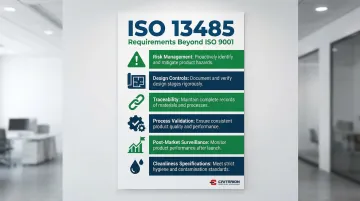
Key Requirements Beyond ISO 9001
ISO 13485 layers on requirements that ISO 9001 doesn't mandate. These aren't administrative add-ons; each one addresses a specific failure point in medical device manufacturing:
- Risk management: A documented process aligned with ISO 14971, covering risk analysis, evaluation, control, and post-production monitoring throughout product realization
- Design controls: Device-specific design and development files, with inputs that must incorporate risk management outputs
- Traceability: Batch records and Device History Records for all devices; for implantables, traceability extends to individual components, materials, and environmental conditions during manufacture
- Process validation: Any process where output can't be fully verified — sterilization, welding, heat treating — requires validated protocols with documented evidence
- Post-market surveillance: Formal complaint handling and adverse event reporting procedures that feed directly into regulatory obligations
- Cleanliness specifications: Documented cleanliness requirements for any product cleaned before delivery or supplied non-sterile
ISO 13485 vs ISO 9001: What is Better for Medical Parts?
If you manufacture parts for medical devices, ISO 13485 is essential—ISO 9001 alone is insufficient for regulatory compliance and customer requirements. It's a market access requirement, full stop.
Major OEMs like Medtronic and Stryker explicitly state in their supplier quality manuals that suppliers are expected to have a QMS aligned with or certified to ISO 13485. Without this certification, you won't even qualify for the supplier approval process at most medical device manufacturers.
When You Need ISO 13485
ISO 13485 certification is mandatory in these scenarios:
- Supplying medical device OEMs who require supplier certification as part of their purchasing controls
- Pursuing CE marking as a component manufacturer in the European market
- Meeting FDA supplier requirements under the new QMSR framework (effective February 2, 2026)
- Bidding on medical device contracts where certification is a qualification prerequisite
- Demonstrating capability in material traceability, process validation, and design control
When Both Certifications Make Sense
Maintaining both ISO 9001 and ISO 13485 makes business sense when you serve diverse "No Failure" industries—medical, aerospace, defense—where each has specific quality expectations.
Criterion Precision Machining holds both certifications for exactly this reason. ISO 13485 governs medical device work—implants, surgical instruments, diagnostic components—while ISO 9001 anchors quality management across aerospace, defense, and photonics programs. One integrated system serves all four verticals without maintaining separate QMS frameworks for each.
The Cost-Benefit Analysis
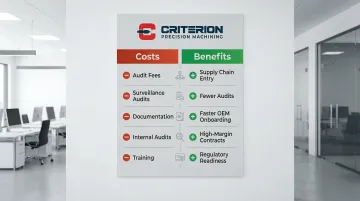
When evaluating certification investment, consider:
Costs:
- Initial certification audit fees
- Annual surveillance audits
- Documentation development and maintenance
- Internal audit resources
- Training and competency development
Benefits:
- Supply chain entry: Unlocks qualification at OEMs that require ISO 13485 as a baseline
- Fewer second-party audits: Certified suppliers face reduced customer audit frequency
- Accelerated OEM onboarding: Skips early supplier approval stages that non-certified shops go through
- High-margin contract eligibility: Medical device work carries price premiums that reflect the rigor required
- Regulatory readiness: Positions you for FDA QMSR, Health Canada, and EU MDR requirements now rather than later
With OEMs actively consolidating their supplier bases, ISO 13485 certification increasingly separates suppliers who get considered from those who don't. The February 2026 FDA QMSR deadline makes that timeline concrete—shops that aren't certified by then face a harder path into regulated supply chains.
Real World Example: Dual Certification in Medical Manufacturing
Precision machining companies serving multiple "No Failure" industries demonstrate the practical value of maintaining both ISO 9001 and ISO 13485 certifications. Criterion Precision Machining, a woman-owned manufacturer in Brook Park, Ohio, exemplifies this dual certification strategy.
Criterion holds both ISO 9001:2015 and ISO 13485:2016 certifications, achieved through partnership with Smithers, an accredited certification body. This dual approach enables them to manufacture surgical instruments, implantable components, and diagnostic equipment parts for medical device customers while simultaneously serving aerospace, defense, and photonics industries with the same quality rigor.
In practice, the two standards serve distinct but complementary roles:
- ISO 13485 anchors the QMS for all medical work, with full traceability through ProShop ERP covering every operation, tool, and measurement from quoting through shipment
- ISO 9001 provides the corporate-level quality framework across all business units, ensuring consistent management principles regardless of industry served
- Together, they eliminate the need for separate quality systems when switching between medical, aerospace, and defense contracts
Dual certification directly expands the contract pipeline. Criterion pursues medical device work with customers like Smith & Nephew and Riverpoint Medical while staying fully qualified for aerospace and defense programs — all under a single integrated quality system.
For precision manufacturers, that flexibility isn't just operationally convenient. Diversification across regulated industries builds business resilience, and the discipline that medical device standards demand tends to raise the quality bar across every program the shop runs.
Conclusion
For medical parts manufacturers, the decision framework is clear: ISO 13485 is non-negotiable, while ISO 9001 provides additional value for diversified operations. With the FDA's QMSR incorporating ISO 13485:2016 by reference effective February 2026, and major OEMs explicitly requiring or preferring certified suppliers, market forces have largely made this decision for you.
The right certification affects regulatory compliance, customer qualification, and your ability to compete for contracts in precision manufacturing. Working with suppliers who hold both certifications — and understand the practical differences between them — gives medical device OEMs one less variable to manage in an already complex supply chain.
For manufacturers still weighing the options, the priority is clear: secure ISO 13485 first. Criterion Precision Machining holds both ISO 13485 and ISO 9001 certifications, which means your medical components are produced under a quality management system built specifically for the demands of the medical device industry.
Frequently Asked Questions
What are the main differences between ISO 9001 and ISO 13485?
ISO 9001 is a general quality standard for any industry, focused on customer satisfaction and continuous improvement. ISO 13485 is medical device-specific, adding mandatory risk management (ISO 14971), Device History Records, design controls, and regulatory reporting. It's based on ISO 9001:2008 — not the 2015 revision — and keeps stricter documentation rules that ISO 9001:2015 relaxed.
Do I need ISO 9001 if I have ISO 13485?
No. ISO 13485 covers the core quality management principles of ISO 9001, so a separate ISO 9001 certification isn't required. That said, some manufacturers — like those serving aerospace or defense alongside medical device customers — maintain both to demonstrate broader quality compliance.
Does FDA recognize ISO 13485?
Yes, FDA recognizes ISO 13485:2016 as part of the Quality System Regulation framework. The FDA's new Quality Management System Regulation (QMSR), effective February 2, 2026, incorporates ISO 13485:2016 by reference, which the FDA has designated as substantially similar to the previous QSR. Manufacturers must still meet FDA-specific requirements in 21 CFR Part 820, but ISO 13485 certification provides the compliance baseline.
What are the ISO 13485 requirements?
ISO 13485 covers eight core areas:
- QMS documentation: Mandatory Quality Manual and controlled procedures
- Risk management: Integrated throughout product realization per ISO 14971
- Design controls: Documented design and development files
- Supplier management: Risk-based evaluation and quality agreements
- Process validation: Required where output can't be fully verified
- Traceability: Device History Records maintained for each batch
- Complaint handling: Procedures with regulatory reporting mechanisms
- Record retention: Device lifetime, with a minimum of two years from release