Introduction
Active payloads in orbit reached roughly 11,000 by the end of 2024, according to the ESA Space Environment Report 2025. That number spans everything from crewed lunar capsules to commercial satellite constellations — and the manufacturing demand behind each one is growing steadily.
Despite this diversity, virtually every spacecraft shares the same underlying architecture: a bus that keeps the vehicle operational and a payload that delivers mission value. How these systems interact — and what each demands from its components — shapes every design, material, and manufacturing decision on a program.
This guide covers the seven major spacecraft subsystems, the materials that make them work, and why precision manufacturing is the foundational requirement tying everything together.
Key Takeaways
- Every spacecraft divides into two primary sections: the bus (supporting infrastructure) and the payload (mission instruments)
- Core bus subsystems include structure, power, propulsion, thermal control, avionics, command and data handling, and communications
- Material selection — aluminum alloys, titanium, carbon-fiber composites — prioritizes strength-to-weight ratio and durability in extreme environments
- Components must be manufactured to tolerances as tight as ±.0002", with no opportunity for field repair
- The ground segment — mission operations, tracking, and control — is as critical to mission success as the spacecraft itself
Spacecraft Anatomy: The Bus and Payload Framework
Every spacecraft built — whether a deep-space probe, a geostationary communications satellite, or a crewed capsule — divides into two functional sections.
The bus is the supporting infrastructure: the structure, power system, propulsion, thermal control, avionics, and communications hardware that keeps the vehicle alive and operational. The payload is the mission-specific equipment — imaging cameras on Earth observation satellites, transponders on communications satellites, spectrometers on scientific probes, or life support systems on crewed vehicles.
According to NASA's Small Spacecraft Systems Virtual Institute, the spacecraft bus provides common services that support the payload. The payload drives the mission; the bus keeps the payload functional.
Mission Architecture Elements
A complete spacecraft mission involves more than the vehicle itself. NASA's SmallSat program identifies the core architecture elements as:
- Payload — mission instruments
- Spacecraft bus — supporting subsystems
- Launch system — the rocket delivering the spacecraft to orbit
- Orbit — the trajectory defining the operational environment
- Ground system — antennas, control centers, and data processing
- Mission operations — the team managing the vehicle day-to-day
The bus subsystems are broadly consistent across vehicle classes. A LEO Earth observation satellite and a deep-space probe both need power, propulsion, thermal management, and communications.
What changes dramatically is the payload — and those payload requirements cascade through every bus design decision.
Structural Frame and Mechanisms: The Foundation of Flight
The structural frame is the load-bearing skeleton that integrates every other subsystem. Its engineering requirements are straightforward to state and extremely difficult to meet simultaneously:
- Survive launch loads, including acceleration, vibration, and acoustic pressure (protoflight hardware must pass a minimum 138 dB acoustic test per NASA GSFC-STD-7000A)
- Maintain dimensional stability through the extreme thermal cycling of the space environment
- Minimize mass, since every kilogram added to the structure directly increases launch cost
Primary Structural Materials
NASA's SmallSat State of the Art report identifies the dominant structural materials and their trade-offs:
| Material | Key Properties | Typical Use |
|---|---|---|
| Aluminum 6061/7075 | High strength-to-weight, machinability | Primary frames, brackets, housings |
| Ti-6Al-4V Titanium | Corrosion resistance, usable to ~750°F | Fasteners, fittings, high-stress interfaces |
| Carbon-fiber composites | Tailorable stiffness, low thermal expansion | Panels, booms, precision optical benches |
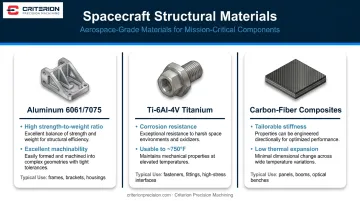
Material selection isn't arbitrary — it's driven by the operating environment. Titanium, for example, is chosen for plumbing and structural fittings where its corrosion resistance and temperature performance justify the higher machining cost.
Precision Manufacturing Requirements
Structural components — brackets, housings, fittings, and interface hardware — must be manufactured to extremely tight tolerances. Mating interfaces between subsystems, spacecraft and launch vehicle adapter plates, and mechanism pivot points all require dimensional control that commodity machining cannot deliver.
Criterion Precision Machining, based in Brook Park, Ohio, produces aerospace structural components in titanium, aluminum, and specialty alloys using 5-axis CNC milling, CNC turning, and Swiss turning — holding tolerances as tight as ±.0002". At structural interfaces, even minor misalignment propagates through an entire assembly — making that tolerance window a functional requirement, not a specification target.
Deployable Mechanisms
Beyond the primary structure, spacecraft rely on mechanisms that must work reliably after months in storage and after surviving the acoustic and vibration environment of launch:
- Solar array deployment hinges and torsional springs
- Antenna deployment systems
- Payload release mechanisms
- Separation systems between spacecraft and launch vehicle
Each mechanism gets one chance to perform. Tight tolerances aren't a quality preference — they're the engineering margin between mission success and permanent failure.
Power and Propulsion Systems
Electrical Power System
Most spacecraft generate primary power from photovoltaic solar arrays. Modern multi-junction gallium arsenide cells achieve efficiencies of 30–34%, a significant improvement over older silicon cells at approximately 20%. The scale of solar power generation varies enormously by mission: the International Space Station's arrays generate 84–120 kW across roughly 27,000 square feet of cells, while Orion's European Service Module produces 11 kW from four solar array wings.
Energy storage is handled by lithium-ion batteries — standard across modern spacecraft for their energy density of 150–270 Wh/kg — which power the vehicle during eclipse periods when it passes through Earth's shadow.
For missions beyond the inner solar system, solar flux becomes too weak to support arrays. NASA's deep-space probes use Radioisotope Thermoelectric Generators (RTGs) instead:
- GPHS-RTG (Cassini, New Horizons) — produced 292 W electric at start of mission
- Multi-Mission RTG (Perseverance) — generates approximately 110 W
Propulsion System
Spacecraft propulsion serves two functions: orbit adjustment (raising, lowering, or changing orbital inclination) and attitude control (fine-tuning pointing direction). Three primary technology categories cover most missions:
- Cold gas systems — simple, low thrust, suitable for attitude control on small satellites
- Chemical propulsion — liquid or solid propellants delivering high thrust for orbit insertion and rapid maneuvers
- Electric propulsion — ion or Hall-effect thrusters that ionize propellant (xenon, krypton, or argon) for high fuel efficiency on long-duration missions
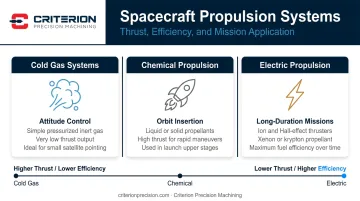
Fuel efficiency — measured as specific impulse — is a critical design driver, because propellant mass directly affects launch cost. NASA's Dawn spacecraft illustrated this tradeoff: it carried 425 kg of xenon, fired its ion engines for more than 2,000 days, and produced up to 91 mN of continuous thrust. That output is far below a chemical engine's peak, but sustained over years it enabled Dawn to orbit two separate bodies in the asteroid belt — something no chemical-propulsion mission could have afforded.
Avionics, Command, Data Handling, and Navigation
Avionics and Command & Data Handling
The Command and Data Handling (C&DH) subsystem is the spacecraft's operational brain. It processes commands from ground controllers, distributes instructions to subsystems, collects health and status telemetry, and stores mission data before transmission to Earth.
Redundancy is non-negotiable. Orion carries four flight computers — two active, two backup — so that if any single unit fails due to radiation-induced errors or hardware faults, the system detects the failure and continues operating without interruption.
All avionics components must be radiation-hardened or radiation-tolerant. Standard commercial processors are vulnerable to bit-flip errors caused by cosmic rays and energetic particles. Radiation hardness assurance for spaceflight avionics follows NASA guidelines covering three primary threat categories:
- Total ionizing dose — cumulative energy deposited by charged particles over the mission
- Displacement damage — structural defects in semiconductor lattices caused by energetic neutrons and protons
- Single-event effects — transient bit-flip or latch-up events triggered by a single high-energy particle
Meeting these requirements demands fundamentally different semiconductor design and testing than anything used in terrestrial electronics.
Guidance, Navigation, and Control
The GN&C subsystem determines where the spacecraft is and what direction it is pointing, then executes corrections. The sensor suite typically includes:
- Inertial measurement units (IMUs) for acceleration and rotation sensing
- Star trackers for precise attitude determination using star field imagery
- Sun sensors for coarse pointing reference
- GPS receivers in low Earth orbit
- Optical navigation cameras for deep space
Attitude control actuators translate GN&C commands into physical corrections:
- Reaction wheels — spinning wheels whose angular momentum changes reorient the spacecraft
- Control moment gyroscopes — for larger vehicles requiring higher torque
- Magnetorquers — coils interacting with Earth's magnetic field, suitable for small satellites
- Reaction control system thrusters — for larger corrections
Precise attitude control allows a spacecraft to keep its solar arrays pointed at the Sun, its antenna locked on a ground station, and its payload instrument aimed at a target — all at once.
Thermal Control and Communications Systems
Thermal Control System
The thermal environment of space is extreme. A spacecraft in low Earth orbit can swing from approximately -65°C in shadow to +125°C in sunlight within a single orbit. Every component — batteries, electronics, propellant tanks, optical instruments — operates within a narrow acceptable temperature range.
Thermal control combines passive and active methods:
- Passive: Multi-layer insulation blankets, surface coatings, thermal paints, and radiators
- Active: Thermostat-controlled heaters, heat pipes, and fluid loop heat exchangers
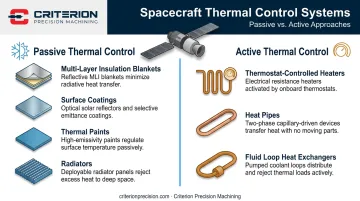
Thermal control failure is not a minor inconvenience. In 2006, Mars Global Surveyor was likely lost after a software error caused the spacecraft to point so that one battery was exposed to direct sunlight — the battery overheated, both batteries depleted, and contact was never reestablished. A thermal management failure destroyed a mission that had operated successfully for nearly a decade.
Communications and Tracking System
The communications system connects the spacecraft to Earth across three functions:
- Uplink — commands received from ground controllers
- Downlink — mission data and telemetry transmitted to Earth
- TT&C — Telemetry, Tracking, and Command functions enabling health monitoring and orbital determination
Antenna selection depends on mission requirements. Low-gain omni-directional antennas handle TT&C at low data rates in any spacecraft orientation. High-gain parabolic dish antennas support high-data-rate downlinks on large spacecraft. Phased array antennas — used on Orion, which carries four phased arrays on the crew module — electronically steer their beam without mechanical movement, providing flexible coverage without the complexity of a gimbaled dish.
Frequency band selection involves trade-offs between antenna size, data rate, and atmospheric attenuation. Each band offers a different balance of these characteristics:
| Band | Frequency Range | Primary Use |
|---|---|---|
| S-band | 2–4 GHz | TT&C, low-rate science |
| X-band | 8–12 GHz | Deep space downlinks, SAR |
| Ka-band | 26–40 GHz | High-rate science data |
The link budget calculation ties these choices together. It accounts for transmitter power, antenna gain, transmission distance, and receiver sensitivity to determine whether a given configuration will close reliably.
Payload: The Mission-Specific Heart of a Spacecraft
The payload is everything aboard the spacecraft that directly serves the mission objective. Payloads are inherently mission-specific, and their requirements cascade through every bus subsystem design decision.
The satellite industry generated $105 billion in services revenue in 2025, according to the Satellite Industry Association — a figure that reflects the diversity of payload types operating across the commercial and government markets.
Primary Satellite and Mission Categories
| Mission Type | Payload | Example |
|---|---|---|
| Earth Observation | Imaging cameras, synthetic aperture radar | Landsat 9 (OLI-2 and TIRS-2 instruments) |
| Communications | Transponders, signal processing arrays | Geostationary broadband satellites |
| Navigation/GNSS | Radio signal transmitters | GPS constellation at ~20,200 km altitude |
| Scientific Research | Spectrometers, particle detectors, cameras | Hubble Space Telescope |
| Defense/Surveillance | Imaging, signals intelligence systems | Various government programs |
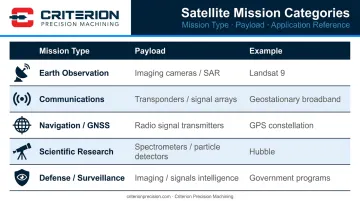
Each mission type demands different bus configurations. A navigation satellite needs precise orbit maintenance and timing systems. An Earth observation satellite needs fine pointing control for its imaging instruments. A deep-space probe needs an RTG power system and high-gain antenna optimized for extreme distances.
This diversity sustains consistent demand for precision-manufactured spacecraft components. The payload represents the unique mission value; the bus subsystems supporting it are broadly consistent across vehicle classes:
- Structure, power, and propulsion
- Thermal control and avionics
- Communications and command handling
Across both payload and bus, the foundational requirement is the same: components manufactured to tolerances that survive launch, perform reliably in space, and leave no margin for field repair.
Frequently Asked Questions
What are the main spacecraft components?
Every spacecraft consists of two primary sections: the bus and the payload. The bus encompasses the structural frame, electrical power system, propulsion, thermal control, avionics and C&DH, GN&C, and communications subsystems. The payload carries the mission-specific instruments — cameras, transponders, scientific sensors, or crew systems.
What are the essential things needed for humans in space?
Crewed spacecraft must support human survival across all mission phases. Core requirements include:
- Pressurized habitation volume
- Environmental control and life support (oxygen supply, CO₂ removal, temperature)
- Potable water and waste management systems
- Radiation shielding
- A re-entry vehicle for safe crew return
What are the main types of satellites?
The primary categories are communications, Earth observation, navigation/GNSS, scientific research, and defense/surveillance satellites. Most share the same fundamental bus architecture, with the payload defining the mission type.
What is the difference between a spacecraft bus and its payload?
The bus is the supporting infrastructure — power, structure, propulsion, thermal control, avionics, and communications — that keeps the spacecraft operational. The payload is the mission-specific equipment that delivers scientific, commercial, or operational value. Without a functional bus, no payload can operate; without a payload, there is no mission.
What materials are most commonly used in spacecraft components?
Aluminum alloys dominate structural frames, while titanium handles high-stress fittings and plumbing. Carbon-fiber composites are used where low thermal expansion and high stiffness matter most, such as panels and booms. All spacecraft materials must meet strict low-outgassing and durability requirements for the space environment.
Why are tight manufacturing tolerances critical for spacecraft components?
Spacecraft components must interface precisely, survive launch vibration, and perform across extreme thermal cycles with no option for field repair. Even minor dimensional deviations at a structural interface can cascade into alignment errors, fastener failures, or mechanism jams that end a mission.