What is orthopedic implant contract manufacturing?
Orthopedic implant contract manufacturing typically includes production-intent prototyping, CNC milling, Swiss turning, CNC turning, finishing, laser marking, inspection, and documentation. Criterion Precision Machining supports implantable device components, orthopedic fasteners, surgical instruments, and diagnostic equipment parts with ISO 13485 quality systems, material traceability, FAIRs, Certificates of Conformance, and in-house metrology for regulated medical device programs.
What materials are used for orthopedic implant components?
Criterion Precision Machining commonly works with titanium, stainless steels, specialty plastics such as PEEK and UHMWPE where required, biocompatible alloys, aluminum, and other specialty materials. Material selection depends on the implant application, performance requirements, regulatory expectations, and customer specifications. Incoming material verification and traceability records are built into the quality process.
Is Criterion Precision Machining certified for medical device manufacturing?
Criterion Precision Machining holds ISO 13485 and ISO 9001 certifications and is FDA registered. These credentials support quality management, medical device manufacturing controls, documentation, and traceability expectations. The company also supplies full FAIR, Certificate of Conformance, and material-traceability documentation at no additional charge for regulated programs requiring strong quality records.
How tight can your tolerances be for implant components?
Capabilities include tolerances down to ±0.0002 inches, depending on the geometry, material, feature size, and manufacturing process. Inspection is performed with Global Advantage CMM using PC-DMIS, OASIS optical inspection, and Keyence image-dimension systems. These systems help verify small, complex, and high-repeatability components used in orthopedic and implantable device applications.
Can you support prototype-to-production implant programs?
Yes. Criterion Precision Machining offers production-intent prototyping rather than hobbyist or single-sample prototyping. Prototype runs are made on the same production machine cells and inspected on the same metrology equipment used for final manufacturing. Once a prototype run is approved, the program can transition into higher-volume production without reprogramming or requalification.
Do you provide UDI laser marking and serialization?
Yes. In-house laser marking is performed with a FOBA M3000 C-axis fiber laser for permanent identification, serialization, lot numbers, 2D matrix codes, logos, and UDI marking. Keeping laser marking inside the same facility reduces handling risk, preserves chain of custody, and supports FDA traceability expectations for medical device components.
What quality documentation is included with implant manufacturing?
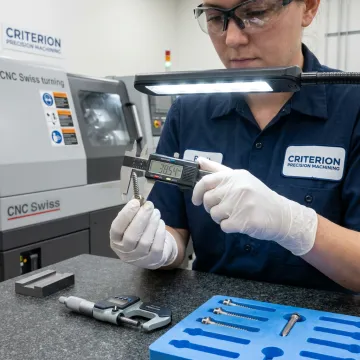
Quality inspection is integrated from incoming material verification through First Article Inspection, in-process checks, and final inspection before shipment. Criterion Precision Machining uses CMM, optical, and image-dimension measurement systems to validate dimensions and features. Documentation packages may include FAIRs, Certificates of Conformance, final inspection reports, and material traceability records.
How do I request a quote for orthopedic implant machining?
To request a quote, provide drawings, models, specifications, material requirements, estimated volumes, tolerance requirements, finishing needs, marking requirements, and any documentation expectations. Criterion Precision Machining reviews manufacturability, inspection strategy, process requirements, and production fit before estimating. Clear upfront specifications help align cost, timeline, quality controls, and program risk.