Introduction
In aerospace and medical device development, a single tolerance failure at the prototype stage doesn't just mean scrapping a part. It can invalidate design verification data, trigger an Additional Information request during FDA 510(k) review (which places the submission on hold with a 180-day response limit) or force costly redesigns that the NASA Systems Engineering Handbook identifies as "significantly more expensive than early discoveries."
That's the real cost of choosing the wrong CNC milling partner.
CNC milling remains the preferred method for functional prototypes because it produces parts in production-intent materials — titanium, stainless steel, PEEK — with tolerances that additive processes can't match.
FDM typically runs ±0.5 mm. Precision CNC milling achieves ±0.005 in as standard, with specialized shops reaching ±0.0002 in.
The provider you choose at this stage directly shapes whether your prototype validates your design — or sends you back to the drawing board. Here's what to look for.
Key Takeaways
- CNC milling is the standard for engineering-grade prototypes where dimensional accuracy must match production intent
- Multi-axis capability (3- to 5-axis), industry certifications, and proactive DFM feedback are the three non-negotiable selection criteria
- Online platforms prioritize speed; specialized shops deliver tighter tolerances and certified quality documentation
- Choosing on price or lead time alone leads to rework cycles and missed regulatory timelines
- In regulated industries, certifications like ISO 13485, AS9100D, and ITAR registration are required — not optional
What Is CNC Milling for Prototypes?
CNC milling is a subtractive manufacturing process: rotating cutting tools remove material from a solid workpiece based on a CAD file, producing functional parts in aluminum, titanium, stainless steel, PEEK, and specialty alloys.
Unlike additive manufacturing, which builds geometry layer by layer, CNC milling produces parts with the material properties, surface finish, and dimensional accuracy required for functional validation and regulatory evidence.
The Standard Prototype Milling Workflow
- Upload CAD file — the shop receives 3D geometry and 2D drawings with GD&T callouts
- DFM review — engineers flag thin walls, unmachinable features, or tolerance conflicts before cutting begins
- Material and axis selection — engineers choose 3-, 4-, or 5-axis configuration based on part geometry
- Machining — cutting to tolerance, with fixturing strategy determined by complexity
- Inspection — CMM or optical measurement against drawing requirements
- Delivery with documentation — certificates of conformance, CMM reports, material traceability
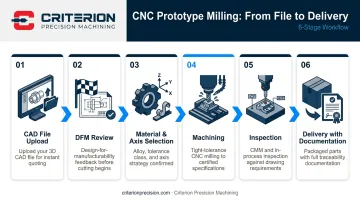
DFM review is where problems get caught before they cost money. Identifying a problematic feature before the first chip falls eliminates rework and prevents tolerance failures from propagating into design verification data.
Why 5-Axis Milling Matters for Prototypes
3-axis milling cuts along X, Y, and Z — cost-effective for prismatic or simpler geometries. 5-axis adds two rotational axes, allowing complex contours, undercuts, and multi-face features to be machined in a single setup.
For prototypes, that single-setup advantage matters more than it does in production. Fewer setups mean fewer fixturing errors — and on a first-article run, fixturing errors are the most common source of out-of-tolerance results.
Aerospace brackets, medical device housings, and photonic components with tight multi-surface tolerances require 5-axis capability. According to Xometry's 5-axis machining resource, 5-axis machines access complex geometries with reduced fixturing complexity — which directly improves first-part quality on prototype runs.
Best CNC Milling Services for Prototypes in 2026
These services were selected based on:
- Axis capability and achievable tolerance range
- Material breadth across metals, plastics, and specialty alloys
- Industry certifications relevant to regulated sectors
- DFM support quality and quoting transparency
- Suitability for low-volume and single-part prototype work
Criterion Precision Machining
Brook Park, Ohio | Founded 1953 | Woman-Owned
Criterion is a third-generation precision machining company under President Tanya DiSalvo, specializing in mission-critical components for what the company calls "No Failure" industries — Medical Device, Aerospace, Defense, and Photonics.
Where Criterion differs from digital platforms is inspection continuity. The shop runs a Global Advantage CMM with PC-DMIS software alongside an OASIS Optical Inspection System capable of measuring 99 dimensions simultaneously — the same equipment used in full production, applied from the first prototype run.
That continuity matters: inspection data from prototyping is directly comparable to production measurements, eliminating re-qualification when transitioning to volume. ProShop ERP provides end-to-end traceability across every operation.
For engineering teams in regulated sectors where a tolerance failure can delay a 510(k) submission or an AS9100-controlled design release, this level of documentation discipline is the differentiator.
| Category | Details |
|---|---|
| Capabilities | 5-axis CNC milling, CNC turning, Swiss turning, wire EDM, fiber laser marking; tolerances to ±.0002"; titanium, stainless steel, aluminum, PEEK, specialty alloys |
| Certifications | ISO 9001:2015, ISO 13485:2016, ITAR registered, FDA registered, WBENC certified |
| Best For | Aerospace, medical device, defense, and photonics prototype teams requiring tight-tolerance milling with certified quality documentation and full traceability |
Protolabs
Maple Plain, Minnesota | Founded 1999
Protolabs operates one of the most recognized automated digital manufacturing platforms in North America. Engineers upload a CAD file, receive automated DFM feedback at quoting, and can have machined prototype parts in as fast as one business day from Protolabs' automated factory.
In October 2025, Protolabs introduced advanced CNC machining capabilities including tighter tolerances, quality documentation, 2D drawing acceptance, no minimum order quantity, and parts shipped from ITAR- and AS9100-compliant facilities. The platform supports 30+ engineering-grade metals and plastics at its automated factory, with the Protolabs Network expanding to 76 materials for more complex requirements.
| Category | Details |
|---|---|
| Capabilities | CNC milling (3-axis and 5-axis indexed), CNC turning; tolerances to ±0.001 in; 30+ metals and plastics (76+ via Network) |
| Certifications | ISO 9001:2015, AS9100D, ISO 13485:2016, IATF 16949:2016, ITAR registered |
| Best For | Engineers needing fast-turn prototypes with automated DFM feedback and straightforward scalability to production |
Fictiv
San Francisco, California | Founded 2013
Fictiv is a managed digital manufacturing platform that connects buyers with a vetted global network of CNC shops, handling quoting, DFM analysis, quality inspection, and logistics centrally while partner facilities execute production.
The platform holds a tolerance floor of ±0.0001 in on metals, PEEK, and ULTEM with drawing. It supports 45+ certified materials and provides full order tracking with dimensional inspection reports for every CNC job. Partner facilities hold AS9100, ISO 13485, IATF 16949, NADCAP, and NABL certifications depending on the application.
| Category | Details |
|---|---|
| Capabilities | CNC milling (3-, 4-, 5-axis), CNC turning, EDM; tolerances to ±0.0001 in; 45+ certified metals and plastics |
| Certifications | ISO 9001:2015 (platform); partner certifications include AS9100, ISO 13485, IATF 16949, NADCAP |
| Best For | Startups and engineering teams requiring high-precision prototypes with full supply chain transparency and industry-specific certification coverage |
Xometry
North Bethesda, Maryland | Founded 2013
Xometry operates an AI-driven manufacturing marketplace connecting buyers with a vetted network of CNC shops. Its AI-powered Instant Quoting Engine — corroborated in Xometry's 2025 10-K filing — provides real-time pricing, lead times from three business days, and DFM feedback before sourcing begins.
No minimum order quantity is a practical advantage for prototype teams: Xometry explicitly allows single-part orders across most services. The platform holds ISO 9001, AS9100D, IATF 16949, ISO 13485, ITAR, and CMMC Level 2 certifications at the platform level.
| Category | Details |
|---|---|
| Capabilities | CNC milling (3-, 4-, 5-axis), CNC turning, EDM; broad material range; lead times from 3 business days; no MOQ |
| Certifications | ISO 9001, AS9100D, IATF 16949, ISO 13485, ITAR, CMMC Level 2 |
| Best For | Product teams needing sourcing flexibility, instant quoting, and single-part orders across a wide range of prototype complexities |
Quickparts
Seattle, Washington
Quickparts is an on-demand manufacturing platform offering CNC milling and turning alongside SLA, SLS, sheet metal, injection molding, and die casting — a deliberate multi-process structure designed for engineers managing several fabrication methods within a single development cycle.
The QuickQuote portal delivers instant pricing with DFM feedback on upload. CNC Express lead times start at two business days for orders of five or fewer parts. Tolerances reach ±0.0002 in on its precision CNC service. The 200+ material count across Quickparts' platform covers both CNC and complementary processes.
| Category | Details |
|---|---|
| Capabilities | CNC milling and turning; tolerances to ±0.0002 in; 200+ materials across CNC and complementary processes; 2-day lead times (up to 5 parts) |
| Certifications | ISO 9001:2015, ITAR registered |
| Best For | Engineers managing multi-process prototyping projects who need CNC milling alongside additive or molding services under one platform |
How We Chose the Best CNC Milling Services for Prototypes
The Two Mistakes That Cost Engineering Teams the Most
Mistake 1: Choosing on price or speed alone. A shop quoting 10 days faster may not hold ±0.001 in on a critical bore feature, or may lack ISO 13485 documentation your regulatory submission requires. Those savings disappear in the first rework cycle.
Mistake 2: Sending prototype work to a production-volume shop. Production shops optimize for throughput, not setup attention. Low-volume prototype work requires DFM flexibility, willingness to iterate on a single part, and inspection discipline that commodity shops aren't built to provide.
Both mistakes stem from the same root problem: applying the wrong selection criteria. The five factors below address each directly.
Evaluation Criteria
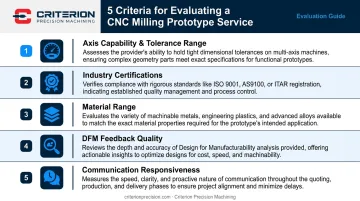
Each service on this list was assessed against five factors:
- Axis capability and tolerance range — Can the shop hold ±0.001 in or tighter on features calling for GD&T per ASME Y14.5? Does 5-axis capability exist for complex geometries?
- Industry certifications — ISO 9001:2015, AS9100D, ISO 13485, and ITAR registration. Certifications reflect documentation rigor and process control, not just equipment on the floor.
- Material range — Minimum coverage of relevant metals and engineering plastics for the industries served
- DFM feedback quality — Identifies issues proactively before machining begins, not reactively after the part fails inspection
- Communication responsiveness — Relevant for prototype teams working iterative design cycles where a 48-hour response delay compounds across revisions
Online platforms — Protolabs, Fictiv, Xometry, Quickparts — offer speed and sourcing flexibility well suited for early-stage design validation or lower-complexity geometries. Specialized precision shops fill a different need: tight tolerances, certified quality documentation, and sector-specific expertise for prototype teams where the part must perform exactly like the production version.
Conclusion
The best CNC milling service for your prototypes is the one whose axis capability, tolerance range, certifications, and material expertise match the actual demands of your end-use application — not just the lowest quote or the fastest lead time.
Before committing, evaluate any provider on three things:
- Scalability — Can they carry the same part from prototype through production without re-qualifying the process?
- Quality documentation — Do they provide CMM reports, FAI, and full material traceability as standard, or only on request?
- DFM depth — Do they proactively flag design issues, or simply cut what's given?
If those criteria matter to your program, Criterion Precision Machining is worth a direct conversation. Criterion offers ISO 13485, ISO 9001, FDA-registered, and ITAR-registered 5-axis CNC milling with tolerances to ±.0002" — built specifically for medical device, aerospace, defense, and photonics teams where a tolerance failure at the prototype stage isn't recoverable. Inspection traceability runs through CMM, OASIS optical inspection, and ProShop ERP documentation from the first prototype run through full production.
Contact Criterion at office@criteriontool.com or call 216-267-1733 to discuss your prototype requirements.
Frequently Asked Questions
What are the trends for CNC machining in 2026?
The machining centers market is projected at $23.67 billion in 2026, with 5-axis configurations growing at a 6.78% CAGR driven by aerospace demand. Key trends include AI-powered toolpath optimization, tighter ERP-to-shop-floor integration for traceability, and hybrid manufacturing that combines additive near-net shaping with CNC finish milling. Together, these shifts are compressing prototype iteration timelines across regulated industries.
What is the typical lead time for CNC milled prototypes?
Automated digital platforms deliver simple geometries in 1–3 business days. Specialized shops handling tight-tolerance, complex parts typically run 2–3 weeks depending on material availability, axis complexity, and required finishing operations. Request specific timelines during quoting — stated lead times and actual lead times diverge more often than vendors advertise.
What materials can be CNC milled for prototypes?
Common metals include aluminum (6061, 7075), stainless steel (303, 304, 316L, 17-4 PH), titanium, brass, and Inconel. Engineering plastics include PEEK, nylon, Delrin, polycarbonate, and PTFE. Shops quoting titanium or exotic alloys should be verified for controlled toolpath strategies and appropriate cooling capability — not every digital platform routes those jobs to shops actually equipped for them.
What tolerances can CNC milling achieve for prototype parts?
Standard CNC milling achieves ±0.005 in for general prototypes. Precision shops hold ±0.001 in on critical features; specialized shops reach ±0.0002 in or tighter. All critical tolerances should be called out on drawings using GD&T per ASME Y14.5-2018. Verbal tolerance requests carry no regulatory weight.
What certifications should I look for in a CNC milling service?
Match certifications to your industry: ISO 9001:2015 for general quality; ISO 13485 for medical device; AS9100D for aerospace and defense; ITAR registration for export-controlled defense work; IATF 16949 for automotive. Certifications signal process discipline and documentation rigor — a shop with ISO 13485 has been audited on its quality system, not just its equipment.
What is the difference between 3-axis and 5-axis CNC milling for prototypes?
3-axis milling cuts along X, Y, and Z. It's cost-effective and sufficient for prismatic geometries. 5-axis adds two rotational axes, enabling complex contours, undercuts, and multi-face features in a single setup. Fewer setups mean fewer fixturing errors and tighter multi-surface tolerance control. For aerospace brackets, medical housings, and optical components, 5-axis is typically the only viable option.