Introduction
Some of the most demanding parts in American manufacturing are smaller than a fingertip. Surgical implants, missile guidance components, fiber optic housings — these parts are machined to tolerances tighter than a human hair, and a single out-of-spec dimension can mean a recalled device or a failed mission.
According to U.S. Bureau of Labor Statistics data, the machine shop services industry spans roughly 18,700 establishments and employs over 259,000 workers nationally — ranging from automated digital platforms to multi-generation family shops with deep sector expertise. For engineers and procurement managers, finding the right fit takes more than a Google search.
This guide profiles five leading U.S. CNC machining companies evaluated on quality certifications, machining capabilities, material expertise, and documented track records in regulated industries — so your sourcing decision takes days, not weeks.
Key Takeaways
- Match supplier type to need: digital platforms suit rapid prototypes; precision shops handle regulated production
- For medical and aerospace work, ISO 13485 and AS9100 matter more than ISO 9001 alone
- For mission-critical parts, tolerance capability, CMM inspection, and ERP-driven traceability are non-negotiable
- The five companies here span digital on-demand platforms, large-format shops, and precision specialists
- Criterion Precision Machining (Brook Park, OH): ISO 13485 + ISO 9001, ±.0002" tolerances, founded 1953
Overview of CNC Machining in the USA
CNC machining is a subtractive manufacturing process where computer-controlled cutting tools remove material from metal or plastic stock to produce precise finished parts. It remains the backbone of American aerospace, medical device, defense, and industrial manufacturing — irreplaceable for applications requiring dimensional accuracy, material traceability, and repeatable quality at scale.
The industry's scale reflects that criticality. IBISWorld reports the U.S. machine shop services market at $46.3 billion in 2026, with nearly 19,000 establishments operating across the country.
Not all of those establishments are equipped to handle regulated work. The five companies below were selected for their certifications, technical capabilities, and demonstrated ability to serve demanding industries — criteria that matter far more than revenue or headcount when sourcing mission-critical parts.
Top CNC Machining Companies in the USA
These companies were selected based on quality certifications, machining capabilities, industry specialization, and documented customer track records. Selection criteria are detailed in the evaluation section below.
Criterion Precision Machining
Location: Brook Park, Ohio | Founded: 1953
Criterion is a third-generation, woman-owned precision machining company that has operated since 1953. Under current President Tanya DiSalvo, the company focuses exclusively on what it calls "No Failure" industries — medical device, aerospace, defense, and photonics — where a non-conforming component is never an acceptable outcome.
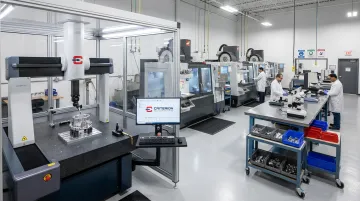
What separates Criterion from most shops is the combination of certifications and inspection infrastructure operating under the same roof. Criterion holds dual ISO 13485:2016 and ISO 9001:2015 certifications (awarded by Smithers Quality Assessments), FDA establishment registration, and ITAR registration.
Its quality program runs multi-point inspection at four stages: incoming material verification, First Article Inspection, in-process inspection at the machine, and final inspection before shipment.
Inspection equipment includes:
- Global Advantage CMM with PC-DMIS software
- OASIS Optical Automatic Smart Inspection System for simultaneous non-contact dimensional measurement
- Keyence IM-series vision systems capable of measuring up to 99 dimensions on up to 100 parts at once
ProShop ERP supports full production traceability from quoting through delivery.
In-house capabilities extend beyond Swiss turning and 5-axis milling to include wire EDM (Mitsubishi MV1200), fiber laser marking (FOBA M3000), and mass finishing. Customers include Riverpoint Medical, Smith & Nephew, and Corning.
| Capability | Details |
|---|---|
| Core Services | Swiss CNC turning, 5-axis CNC milling, CNC turning, wire EDM, fiber laser marking, mass finishing |
| Materials | Titanium, stainless steel, aluminum, PEEK, cobalt-chrome, Hastelloy, Inconel, Nitinol, specialty alloys |
| Certifications | ISO 13485:2016, ISO 9001:2015, FDA registered, ITAR registered, WBENC certified |
| Tolerances | Down to ±.0002" |
| Industries | Medical device, aerospace, defense, photonics/optics |
Protolabs
Location: Maple Plain, Minnesota | Founded: 1999
Protolabs operates as a digital-first rapid manufacturing platform, offering CNC machining alongside 3D printing, injection molding, and sheet metal fabrication through an automated online quoting system. Its primary advantage is speed : CNC machining lead times can be as fast as one day, with standard turnaround at three days.
The platform's automated design-for-manufacturability (DFM) feedback catches issues before machining begins, which reduces revision cycles for engineering teams. Protolabs holds ISO 13485, AS9100D, and ITAR registration, giving it credibility for regulated prototype and low-volume work. Its global manufacturing network spans the U.S., Europe, and Asia.
The trade-off is scope: Protolabs suits prototype and low-volume work well, but programs requiring full production documentation packages, multi-stage in-process inspection, or long-term engineering partnership will need a dedicated contract machining shop.
| Core Services | CNC machining, 3D printing, injection molding, sheet metal fabrication |
| Certifications | ISO 13485, AS9100D, ITAR registered |
| Industries | Aerospace, automotive, medical, electronics, consumer products |
United CNC Machining
Location: Auburn Hills, Michigan | Founded: 1979
United CNC Machining operates 60+ advanced CNC work centers and specializes in 5-axis milling, multi-axis turning, and exotic alloy machining. Its part size range is substantial — 5-axis milling from micro-size up to 130" × 200", and CNC turning up to 34" × 80" diameter — giving it capacity for both precision small parts and larger structural components.
The shop's certification stack is particularly relevant for defense primes: AS9100D, ISO 9001, ITAR, and CMMC 2.0. CMMC 2.0 compliance means United CNC has verified cybersecurity controls for handling Controlled Unclassified Information, a requirement that is increasingly appearing in DoD contract requirements.
| Core Services | 5-axis CNC milling, multi-axis turning, exotic alloy machining, prototyping |
| Certifications | AS9100D, ISO 9001, ITAR, CMMC 2.0 |
| Industries | Aerospace, defense, advanced manufacturing |
Baker Industries (a Lincoln Electric Company)
Location: Macomb, Michigan | Founded: 1992
Baker Industries, acquired by Lincoln Electric in 2019, is built for scale. Key capacity indicators:
- Five facilities on a single campus totaling over 250,000 sq. ft.
- Operations running two 12-hour shifts, five to seven days per week
- One machine with a work envelope of 236" × 551" × 98" and a rotary table load capacity exceeding 88,000 lbs.
Beyond machining, Baker offers fabrication and welding, large-format metal additive manufacturing, and complex assembly. Certifications include ISO 9001, AS9100, ISO 14001, and Nadcap Measurement & Inspection — the last of which is a significant differentiator for aerospace and defense programs requiring accredited inspection.
| Core Services | Large-format CNC machining, fabrication and welding, 3D metal printing, assembly and finishing |
| Certifications | ISO 9001, AS9100, ISO 14001, Nadcap M&I, ITAR |
| Industries | Aerospace, defense, space, automotive, shipbuilding, semiconductors |
UPTIVE Advanced Manufacturing
Location: Multiple U.S. facilities | Founded: 2016
UPTIVE positions itself as a single-source manufacturing partner, offering an integrated range from CNC milling and turning through sheet metal fabrication, injection molding, additive manufacturing, and post-processing finishing. Its Swiss turning capability runs 2–8 axis configurations, and milling spans 3-, 4-, and 5-axis platforms.
The company holds AS9100:2016 certification and ITAR registration, and its multi-facility structure supports production scaling from prototype through higher volume runs. For companies that want to avoid managing multiple specialized vendors, UPTIVE's breadth is its clearest selling point.
| Core Services | CNC milling (3/4/5-axis), Swiss turning (2–8 axis), additive manufacturing, sheet metal, injection molding |
| Certifications | AS9100:2016, ITAR registered |
| Industries | Aerospace and defense, automotive, medical, electronics, industrial equipment |
How We Chose the Best CNC Machining Companies in the USA
The most common sourcing mistake is selecting a machining partner based on price or lead time without verifying whether the supplier's quality systems match the application's risk level. A shop that machines automotive brackets at ISO 9001 level is not equipped to produce an implantable surgical component under ISO 13485.
Certifications That Actually Matter
| Application | Required Certification |
|---|---|
| Medical device components | ISO 13485:2016 |
| Aerospace structures and systems | AS9100D |
| Defense / ITAR-controlled parts | ITAR registration |
| Defense contracts with CUI requirements | CMMC 2.0 |
| General manufacturing quality | ISO 9001:2015 |
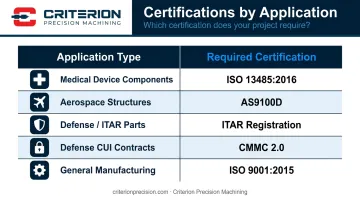
AS9100D incorporates ISO 9001 requirements plus additional aviation, space, and defense controls. ISO 13485 is specifically aligned with FDA's Quality Management System Regulation (QMSR), which as of February 2026 incorporates ISO 13485:2016 by reference into 21 CFR Part 820. A shop holding ISO 13485 is already operating in alignment with current FDA requirements.
Tolerance and Inspection Infrastructure
Standard commercial CNC tolerances run around ±.005". Precision applications — surgical instruments, optical housings, aerospace fittings — require ±.002" or tighter. Achieving and verifying tolerances to ±.0002" requires CMM equipment, documented inspection plans, and calibrated measurement systems.
Look for:
- CMM inspection with software like PC-DMIS for documented measurement routines
- In-process inspection, not just end-of-line sampling
- ERP systems that generate traceability records per job
- First Article Inspection (FAI) documentation delivered as a standard quality output
Service Model Fit
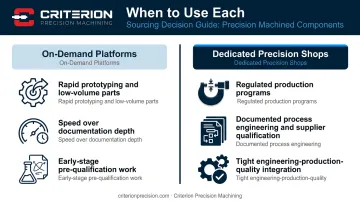
Not every supplier model fits every program. The right choice depends on where you are in the product lifecycle and how much regulatory documentation your program demands.
On-demand platforms (Protolabs, Xometry) are well-suited for:
- Rapid prototyping and low-volume one-off parts
- Programs where speed outweighs documentation depth
- Early-stage development before supplier qualification
Dedicated precision shops are better suited for:
- Production programs in regulated industries (medical, aerospace, defense)
- Programs requiring documented process engineering and long-term supplier qualification
- Tight integration between engineering, production, and quality at every stage
Conclusion
Choosing the right CNC machining partner comes down to fit — whether their certifications, tolerance capabilities, material expertise, and quality infrastructure match what your application actually requires.
Before committing to a production supplier, run through a short verification checklist:
- Request a facility tour or virtual walkthrough
- Ask for sample inspection reports or First Article Inspection (FAI) documentation
- Confirm ERP and end-to-end traceability systems are in place
For engineering teams sourcing precision machined components for medical device, aerospace, defense, or photonics applications, Criterion Precision Machining (Brook Park, OH) has been producing tight-tolerance components since 1953. The company holds AS9100, ISO 13485, and ISO 9001 certifications, maintains FDA and ITAR registration, and holds tolerances to ±.0002" with an integrated inspection program built for regulated industries.
Contact Criterion at office@criteriontool.com or 216-267-1733 to discuss your project requirements.
Frequently Asked Questions
What certifications should a CNC machining company have for medical device or aerospace parts?
ISO 13485 is the standard for medical device component suppliers and is now aligned with FDA's QMSR under 21 CFR Part 820. AS9100D is required for aerospace work, and ITAR registration is mandatory for defense-controlled parts. These certifications require documented process controls well beyond what basic ISO 9001 covers.
What is Swiss CNC machining and when should I use it?
Swiss machining uses a sliding headstock lathe with a guide bushing to support long, slender workpieces during cutting, which dramatically reduces vibration and deflection. It is the preferred process for small-diameter, high-precision parts, including surgical instruments, micro-components, and connectors, where standard turning cannot maintain required tolerances.
What tolerances can precision CNC machining achieve?
Standard commercial CNC tolerances typically run ±.005". Precision applications can reach ±.002" or tighter, with specialized shops capable of holding ±.0002" on critical features. Achieving and verifying these tolerances requires calibrated CMM inspection and rigorous in-process controls, not just capable equipment.
What is the difference between a digital manufacturing platform and a precision machine shop?
Digital platforms use automated quoting and broad supplier networks to optimize for speed and volume — ideal for prototypes and low-risk parts. Dedicated precision shops offer deeper process engineering, tighter tolerances, and the documentation-heavy quality systems that regulated medical device and defense programs require.
How do I verify a CNC machining supplier's quality before placing a production order?
Request a First Article Inspection (FAI) report, review the supplier's current certificates and their stated scope, confirm in-process inspection frequency, and verify that calibrated CMM equipment is in use. Ask specifically whether the shop maintains traceability records from raw material receipt through final shipment.
What materials can be CNC machined for aerospace and medical applications?
Common aerospace and medical materials include titanium, surgical-grade stainless steel, aluminum, Inconel, cobalt-chrome, and PEEK. Machinability varies significantly across these alloys and plastics, so confirm the supplier has documented experience with your specific material before qualifying them.