Introduction
Engineers and procurement teams in aerospace, medical devices, and defense face a persistent tension: parts need to be precise, compliant, and available quickly — but quantities are often too small to justify the tooling investment that mass production demands.
That pressure is exactly what low volume CNC machining was built to resolve. It occupies the space between one-off prototypes and full production runs, delivering components in production-grade materials with full quality documentation — without the six-figure mold costs or eight-week tooling lead times.
For regulated, mission-critical industries, getting that equation right — speed, compliance, and precision at low quantities — is the difference between a program that moves and one that stalls.
Key Takeaways
- Low volume CNC machining covers runs from a single part to roughly 1,000 units, with no dedicated tooling required
- Design changes between runs are fast — update the CAD file, re-program the toolpath, machine the revised part
- The program — not operator skill — controls precision and part-to-part consistency
- Aerospace, medical devices, defense, and photonics depend on it because failure isn't acceptable and quantities are inherently small
- Choosing the wrong shop creates compliance exposure that compounds fast — especially in regulated industries
What Is Low Volume CNC Machining?
Low volume CNC machining is a precision manufacturing approach for producing small batches — typically from a single unit up to roughly 1,000 parts — using computer-controlled cutting tools, without the dedicated molds or custom fixtures that mass production requires.
There's no universally standardized threshold. Published manufacturer definitions range from 10 to 10,000 parts, and some organizations treat anything under 50,000 as low volume depending on the production context. The defining characteristic isn't the number — it's the absence of high-volume dedicated tooling.
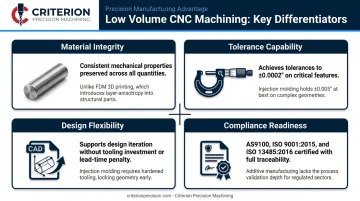
Several characteristics distinguish it from 3D printing or injection molding:
- Material integrity — parts are machined from the same production-grade alloys (titanium, stainless steel, PEEK) used in the final product
- Tolerance capability — complex geometries held to tight dimensional specs, not approximated
- Design flexibility — changes between runs require no tooling modifications, only re-programming
- Compliance readiness — documented inspection records, material traceability, and quality certifications apply from the first part
It's the practical choice when designs are still evolving, demand is specialized, or the part must meet regulatory standards that alternative processes can't reliably document from day one.
Key Advantages of Low Volume CNC Machining
The advantages below connect to real operational outcomes — cost control, quality assurance, speed, and risk reduction. Each becomes more significant in industries where a single out-of-spec part can trigger a recall, a safety failure, or a regulatory audit.
Production Flexibility Without Tooling Investment
Low volume CNC requires no dedicated molds. The digital program is the tool. Design changes are made between runs without writing off expensive tooling or waiting weeks for mold modifications.
In practice: an engineer updates a CAD file, the toolpath is re-programmed, and a revised part comes off the machine in the same production window. That kind of iteration speed is impossible in injection molding.
The financial difference is significant. Injection mold tooling for 1,000–5,000 units can range from $2,000 to $5,000 for simple aluminum molds, and well above $100,000 for complex multi-cavity steel tooling. CNC avoids that fixed investment entirely — shifting costs to programming, fixturing, and machine time, spread across the actual quantity needed.
This matters most during:
- New product introduction (NPI), when design changes are frequent
- Bridge production phases, when tooling isn't yet justified
- Medical device platform development with multiple instrument variants requiring simultaneous iteration
Eliminating tooling investment also eliminates tooling risk. A business can test a design in production-grade titanium before committing to high-volume tooling and confirm the design performs as specified before finalizing the production commitment.
Precision and Part-to-Part Consistency for Mission-Critical Applications
CNC machining is driven by programmed instructions, not manual technique. Every part in a low volume run is held to the same dimensional specifications. Tolerance is controlled through the machine program, which doesn't fatigue, rush, or vary by shift.
Advanced capabilities (5-axis milling, Swiss turning, multi-axis CNC turning) allow shops to hold extremely tight tolerances on complex geometries. At low volumes, where every part must pass rather than a statistical sample, that consistency isn't just convenient. It's required.
What rigorous low volume precision looks like in practice:
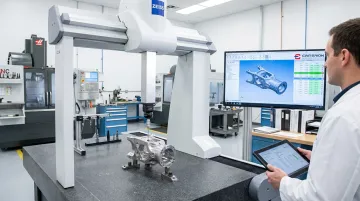
Criterion Precision Machining holds tolerances to ±.0002" across its aerospace, medical device, defense, and photonics work out of Brook Park, Ohio. The QA program includes First Article Inspection (FAI), in-process checks at the machine, and final CMM reports using a Global Advantage CMM with PC-DMIS software.
Quality is built into the process, not applied at the end.
ISO-certified shops (ISO 9001:2015, ISO 13485:2016) formalize this approach. Under 21 CFR Part 820 (the FDA's Quality Management System Regulation, which incorporates ISO 13485:2016) medical device manufacturers must maintain documented controls over every production event, including machining.
Real consequences of dimensional nonconformance are documented in FDA recall records: a 2019 Class 2 recall involved dimensional interference between orthopedic components that caused surgical delays; a 2009 recall involved a lag screw hole diameter out of specification. Both trace directly to tolerance control failures on regulated components.
Traceability supports compliance, too. Fully documented, traceable part records support regulatory submissions, customer audits, and internal quality management systems. A shop with AS9102-compliant FAI documentation and ISO 13485 traceability isn't just producing parts ; it's producing evidence that those parts meet specification.
Faster Time to Market Without Sacrificing Material Integrity
Low volume CNC uses the same production-grade materials as the final product: titanium, stainless 316L, aluminum, PEEK. Parts produced during prototyping or bridge production phases behave identically to the eventual production component. There's no performance gap between the test article and the finished part.
That material continuity compresses the development timeline in a measurable way. Functional prototypes that can be stress-tested, fit-checked, and submitted for regulatory review come off the same machines in days, not the weeks required to procure and validate injection-molded tooling.
FDA guidance on bench testing states that tested devices should generally represent the final finished device, including manufacturing processes and materials, with justification required when samples are not final finished. That requirement creates a direct path for low volume CNC: parts produced in production-equivalent titanium on the same machines and with the same inspection protocols as final production parts satisfy this expectation.
The hidden risk in prototype material substitution:
The gap between prototype material performance and production material performance is a real liability in product development. A design validated in a lower-grade surrogate material may behave differently when produced in the specified alloy , forcing costly late-stage redesigns. Using CNC for both prototyping and low volume production eliminates that variable entirely.
Most impactful when:
- Regulatory submissions require testing on production-equivalent parts
- Customers require material certifications and process documentation on the prototype itself
- A team needs to respond to design revisions or regulatory feedback without waiting on tooling
Where Low Volume CNC Machining Delivers Results: Applications by Industry
Low volume CNC machining isn't a startup strategy or a prototype-only workaround. For many specialized components, it's the standard production method — because quantities are inherently small, requirements are exacting, and the cost of failure is extreme.
Medical Devices and Surgical Instruments
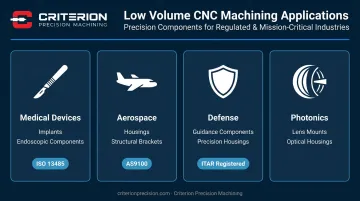
Surgical tools, orthopedic implants, and diagnostic components are often produced in limited quantities by design. A highly specialized bone fixation system or a robotic surgical instrument may never need more than a few hundred units per year — but every one of those units must meet strict biocompatibility, dimensional, and sterility requirements.
Low volume CNC in titanium (Ti-6Al-4V ELI per ASTM F136), stainless 316L, and PEEK (ASTM F2026) supports both prototype validation and final production in ISO 13485-compliant environments. Criterion's medical device work — all held to ±.0002" with full material traceability and FDA-compliant documentation — includes:
- Surgical instruments and endoscopic components
- Small bone implants and orthopedic fasteners
- Tendon repair devices
Aerospace and Defense
Avionics housings, structural brackets, and guidance system components often require small batch runs from aerospace-grade aluminum or titanium, with full material traceability, AS9102-compliant FAI documentation, and tolerances that leave no room for deviation.
For defense applications, ITAR registration is a non-negotiable requirement. U.S. manufacturers of defense articles must register with DDTC under ITAR Part 122, even if they do not export. Criterion holds ITAR registration and has documented defense work alongside organizations including NASA, which is why customers requiring controlled components can engage the shop with confidence.
Photonics and Optics
Photonics components are produced in very small quantities with exceptionally tight tolerances, often from specialty alloys or engineered plastics. Surface finish and geometric precision directly impact optical path alignment — a few tenths of a thousandth of an inch of error can disrupt imaging or laser system performance.
Criterion machines photonics components in aluminum, titanium, specialty alloys, and non-conductive/non-reflective polymers, holding tolerances to ±.0002" with burr-free finishes. Common part types include:
- Lens mounts and precision apertures
- Optical housings and sensor enclosures
Corning is among Criterion's publicly referenced clients in this space.
Bridge Production and Product Launches
When a product is ready to ship to first customers but mass production tooling isn't yet justified, low volume CNC fills the gap. Parts come off the same machines that produced the prototype, with the same documentation, tolerances, and material specifications. When volume eventually scales, no re-qualification or reprogramming is required — the production records are already established.
What Happens When Low Volume CNC Machining Is Poorly Executed
Treating low volume runs as a lesser priority produces a predictable result: inconsistent part quality across a batch that looks identical on the surface. Tolerance drift, surface finish variation, and undocumented material substitutions typically surface only after parts reach assembly or field use, where correcting them costs far more than catching them during production.
Unlike mass production, where a scrap rate is built into the economics, every rejected part in a low volume run hits cost, schedule, and customer confidence disproportionately. McKinsey estimated medical-device quality costs at $26B–$36B industry-wide, with direct cost of quality at 6.8%–9.4% of sales. At the shop level, that translates to rework, replacement parts, expedited delivery, and customer escalations on runs that were already small.
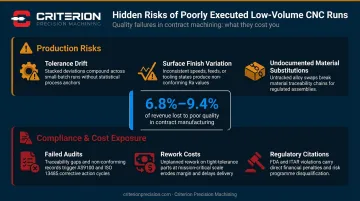
The compliance exposure compounds the cost problem. A low volume run produced without proper inspection documentation, material traceability, or process controls cannot support a regulatory submission, a customer audit, or a root cause analysis.
FDA warning letters issued to device manufacturers have cited failures in nonconforming product procedures, DHR documentation, incoming acceptance, and CAPA — across production environments of all sizes. Small batches don't get an exemption from 21 CFR Part 820, and forcing retroactive validation onto an undocumented run carries real financial and liability consequences in medical or defense applications.
How to Get the Most Value from Low Volume CNC Machining
Low volume CNC works best when the design is ready for it. That means:
- Standard tool sizes where functionally acceptable — custom tooling adds cost and lead time
- Tolerances only where required — applying ±.0001" to every feature inflates per-part cost without adding value
- Geometries completable in minimal setups — each additional setup adds fixturing time, error opportunity, and cost
Design for manufacturability (DFM) feedback early in the process prevents these issues from compounding. A capable machining partner will flag them at the quoting stage.
The partner matters as much as the process. A shop with proven capability in titanium, PEEK, and stainless 316L, carrying ISO 13485, ISO 9001, FDA registration, and ITAR registration, is not interchangeable with a general job shop. For regulated industries, the partner's quality infrastructure is part of what's being purchased.
Criterion's ProShop ERP system tracks every operation, tool, and measurement from quoting through shipment. The result is a complete audit trail that supports customer audits, regulatory submissions, and internal QMS requirements — without additional documentation effort.
Treating low volume CNC as an ongoing practice — not a one-time transaction — is where the real value accumulates. Using a consistent partner across prototyping, bridge production, and low-rate initial production means each phase builds on documented quality records. When volume scales, the setup parameters, inspection plans, and process documentation already exist. Validation cycles shrink. Subsequent runs start from a known baseline rather than from scratch.
Frequently Asked Questions
What is considered low volume manufacturing?
Low volume manufacturing typically covers production runs from a single part up to roughly 1,000 units, though manufacturer definitions vary — some treat anything under 10,000 parts as low volume. The defining characteristic is production without dedicated high-volume tooling, where cost shifts to programming, fixturing, and machine time.
What is the tightest CNC tolerance achievable?
Advanced CNC machining can hold tolerances to ±.0001"–±.0002" on precision components. Achieving this requires appropriate machine capability, proper fixturing, environmental controls, and rigorous dimensional verification with CMM or optical measurement systems. Under highly specialized conditions, sub-micron capability is achievable, though it demands purpose-built equipment and controlled environments.
What industries benefit most from low volume CNC machining?
Aerospace, medical devices, defense, and photonics benefit most, because these sectors require small quantities of highly precise, fully traceable components where failure carries serious safety, regulatory, or mission consequences. In these industries, inherently low production volumes combined with exacting requirements make low volume CNC the default approach, not a workaround.
How does low volume CNC differ from mass production?
Low volume CNC requires no dedicated tooling investment, offers greater design flexibility between runs, and carries a higher per-part cost with far lower upfront commitment. It's better suited to complex, custom, or compliance-sensitive parts than high-volume stamping or molding — processes that only make financial sense at scale.
What materials are best suited for low volume CNC machining?
Aluminum, stainless steel (316L), titanium, and engineering-grade polymers like PEEK are among the most common, selected based on application requirements — strength, biocompatibility, corrosion resistance. Specialty alloys including Hastelloy and Inconel are also routinely machined. A qualified shop can machine all of these to tight tolerances with full material certification.
When should I choose low volume CNC over 3D printing or injection molding?
Low volume CNC is the right choice when parts require production-grade material properties, tight tolerances, or regulatory documentation. 3D printing suits early concept iteration. Injection molding becomes cost-effective at higher volumes where tooling cost can be amortized across thousands of identical parts — but at low quantities, the tooling investment makes it the most expensive option per part.