Introduction
The global photonics market reached USD 1,118.80 billion in 2026, growing at a 6.7% CAGR through 2034. AI data center interconnects, defense sensing systems, and medical imaging devices have all converged on the same dependency: precision optical components that perform without failure.
Heading into 2026, the performance bar has shifted sharply. AI clusters now demand 800G and 1.6T optical transceivers. Defense programs require ruggedized laser assemblies rated for field conditions. Surgical systems need sub-micron alignment tolerances backed by documented quality systems — requirements that have pushed manufacturers well beyond what was achievable five years ago.
Choosing the right optical component manufacturer now means evaluating technology depth, compliance credentials, and application-specific track records — not just catalog size. The five manufacturers profiled below are evaluated across exactly those criteria.
Key Takeaways
- The global photonics market exceeds $1.1 trillion in 2026, with AI, defense, and medical applications driving component demand.
- Leading optical component manufacturers stand out through vertical integration, verified certifications (ISO, ITAR, AS9100), and demonstrated tight-tolerance manufacturing capability.
- Photonic integrated circuits (PICs) are the fastest-growing component category, with silicon photonics projected at 29.5% CAGR through 2030.
- Optomechanical housings and mounts are a critical but underspecified part of every photonics system, typically sourced from specialized contract machinists.
- Qualifying suppliers on verified tolerances and certifications directly shortens program timelines and lowers program risk.
Optical Components in Advanced Photonics: What You're Actually Selecting
"Optical components" covers more ground than most procurement teams realize. According to Photonics Media, the category splits into transmissive elements (lenses, filters, windows, prisms, polarizers, beamsplitters, wave plates, fiber optics) and reflective elements including mirrors and retroreflectors.
Add photonic integrated circuits (PICs), laser assemblies, and the optomechanical structures that house and align everything, and you have a supply chain spanning dozens of specialized manufacturers.
End-Use Markets Driving 2026 Demand
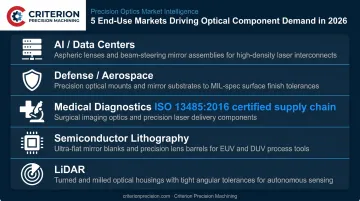
Each vertical has distinct component requirements:
- AI and data centers: silicon photonics transceivers and co-packaged optics for 800G/1.6T links; co-packaged optics projected to grow from USD 46M in 2024 to USD 8.1B by 2030
- Defense and aerospace: ruggedized laser components, ring laser gyroscopes, inertial navigation optics, UAV guidance systems
- Medical diagnostics: OCT imaging systems, surgical guidance optics, laser delivery devices requiring ISO 13485 and FDA-compliant supply chains
- Semiconductor lithography: high-precision optical modules and microoptics from DUV through EUV wavelengths
- LiDAR: compact laser sources and detector assemblies for autonomous vehicles and atmospheric sensing
One component category that rarely appears in RFQs but matters enormously: optomechanical housings, mounts, and structural assemblies. Every photonics system needs precision-machined metal or plastic structures to hold optical elements in alignment. These parts — produced by contract machining suppliers — must meet tolerances comparable to the optics themselves, often requiring CMM-verified inspection and full traceability documentation.
Selecting the right optical component manufacturer means evaluating technology depth, quality system rigor, and sector-specific compliance. The sections below profile the manufacturers and contract suppliers that procurement teams are actually specifying in 2026.
Top Optical Component Manufacturers in Advanced Photonics 2026
These manufacturers were selected based on demonstrated precision manufacturing capability, depth of photonic/optical product portfolios, relevant certifications, and proven presence in mission-critical applications as of 2026.
Coherent Corp.
Coherent's clearest differentiator is vertical integration: the company manufactures from the substrate up, covering thin-film deposition, wafer fabrication, and final packaging. In 2024, Coherent demonstrated 1.6T-DR8 and 800G-DR4 OSFP transceivers for hyperscale AI data centers — the 1.6T module using silicon photonics and an NVIDIA DSP, while the 800G-DR4 uses proprietary 200G EML technology. At OFC 2025, it showed 1.6T-SR8 modules based on 200G VCSEL arrays and an 800G coherent QSFP-DD using an InP IC-TROSA optical engine.
Coherent Corp. was formed when II-VI Incorporated completed its acquisition of legacy Coherent Inc. on July 1, 2022. The company operates across three segments — Networking, Materials, and Lasers — covering compound semiconductor wafer growth through packaged optical modules.
| Category | Details |
|---|---|
| Key Product Areas | Laser diodes, optical amplifiers, PICs, 800G/1.6T transceivers, optical networking modules, compound semiconductor wafers |
| Target Industries | Telecom/datacom, AI data centers, industrial lasers, defense, semiconductor, life sciences |
| Certifications | ISO 9001, ISO 13485, ISO 14001, ISO 45001, ISO 50001, IATF 16949 (varies by site); ITAR/EAR compliance documented in annual filings |
Edmund Optics
Founded in 1942 and headquartered in Barrington, New Jersey, Edmund Optics built its reputation on two complementary strengths: a catalog exceeding 28,900 products for fast prototyping and design iteration, and a custom manufacturing arm that handles production-volume optics to tight specifications.
The catalog makes Edmund the default supplier for rapid iteration. The custom arm is where it earns trust for production programs.
Edmund's published tolerance specifications: diameter to +0.000/−0.010 mm, center thickness to ±0.010 mm, surface flatness to λ/20, and surface finish to 5 Angstroms RMS. Coatings span 200 nm to 14 μm (UV through LWIR), tested to MIL-STD-810F and MIL-C-48497A durability standards.
| Category | Details |
|---|---|
| Key Product Areas | Precision lenses, optical filters, mirrors, beam splitters, imaging optics, laser optics, optomechanical components |
| Target Industries | Research/academia, life sciences, defense, semiconductor inspection, machine vision, industrial imaging |
| Certifications | ISO 9001:2015, ISO 13485:2016, ITAR registered |
Jenoptik AG
Jenoptik is a publicly traded German photonics company headquartered in Jena, Germany, with decades of engineering depth in precision optical systems, laser technology, and optoelectronic components. Its Optical Systems division covers classical optics, microoptics, polymer optics, optoelectronics, and digital imaging components — with particular strength in semiconductor equipment applications.
For semiconductor markets, Jenoptik produces high-end objective lenses, high-precision optical thin-film elements, and microoptics for beam shaping, steering, and splitting across DUV to FIR wavelengths. The company also offers the UFO Probe Card for simultaneous opto-electronic testing of PICs at wafer level — a capability that positions it directly in the PIC supply chain as that market scales.
| Category | Details |
|---|---|
| Key Product Areas | Beam shapers, optical modules, freeform optics, microoptics, laser components, high-precision thin-film optics, PIC test systems |
| Target Industries | Semiconductor equipment, automotive, life science, defense and security |
| Certifications | ISO 9001:2015 certified at 100% of manufacturing locations globally; ISO 13485 at biophotonics/optical systems sites in Germany and Jupiter, Florida |
Thorlabs
Founded in 1989 by Alex Cable and headquartered in Newton, New Jersey, Thorlabs is a privately held photonics manufacturer covering optomechanics, motion control, fiber components, laser sources, detectors, cameras, and spectroscopy systems. Its catalog exceeds 24,000 items.
The company manufactures the vast majority of this portfolio in-house across more than 1 million square feet of space in nine countries — an unusual degree of vertical control for a catalog supplier.
Thorlabs' core differentiator for research and OEM customers is depth without fragmentation: engineers can specify laser sources, optomechanical mounts, fiber pigtails, and detection systems from a single vertically integrated supplier. This matters when building or qualifying a photonics system where component interfaces are critical.
| Category | Details |
|---|---|
| Key Product Areas | Optomechanics and motion control, fiber components and patch cables, laser diodes and sources, cameras and detectors, spectroscopy, imaging systems |
| Target Industries | Academic/research, biophotonics, industrial automation, quantum optics, defense R&D |
| Certifications | ISO 9001:2015 (certified through April 2028, covering design and manufacture of opto-mechanical positioning devices and related products) |
IPG Photonics
IPG Photonics was founded in 1990 by Dr. Valentin P. Gapontsev and is headquartered in Oxford, Massachusetts, trading on NASDAQ as IPGP. The company built its position by manufacturing high-power fiber laser systems entirely in-house — from the rare-earth-doped gain fiber through final integration — rather than assembling from third-party components.
That vertical control translates into measurable performance: IPG's standard YLS high-power fiber lasers exceed 40% wall-plug efficiency, with ECO models exceeding 50% — benchmarks solid-state and CO₂ laser alternatives cannot match. Power outputs reach up to 125 kW for industrial applications. In 2025, IPG debuted the CROSSBOW MINI, a 3 kW counter-UAS laser integrated into Lockheed Martin's Sanctum architecture, capable of 12-hour operation on internal battery.
| Category | Details |
|---|---|
| Key Product Areas | CW fiber lasers (up to 125 kW), pulsed fiber lasers, fiber amplifiers, medical laser systems, fiber-optic components |
| Target Industries | Industrial manufacturing (cutting, welding, marking), defense, medical, telecom, scientific research |
| Certifications | ISO 9001:2015, ISO 14001:2015, ISO 50001:2018 |
How We Chose the Best Optical Component Manufacturers for 2026
The five manufacturers above were evaluated on precision manufacturing capability, product portfolio depth, certification status, and documented market presence. A common mistake buyers make is selecting suppliers based on brand recognition or catalog volume rather than verifiable tolerance specifications and sector-specific compliance credentials.
Key Differentiating Factors
1. Precision and tolerance capability Can the manufacturer hold optical and mechanical tolerances appropriate for the application? Surface flatness to λ/20, coating uniformity, and dimensional repeatability vary significantly between suppliers — and these differences determine whether a component performs in a mission-critical environment.
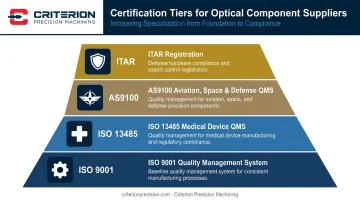
2. Certifications and compliance
- ISO 9001 — baseline quality management
- ISO 13485 — medical device quality systems
- AS9100 — aviation, space, and defense QMS requirements
- ITAR registration — required for defense-related optical hardware
3. Material and coating expertise Substrate selection drives performance. Fused silica handles UV and high-temperature applications where BK7 glass fails. Sapphire provides extreme durability for harsh-environment windows. Compound semiconductors (InP, GaAs, GaN) underpin photonic integrated circuit platforms.
Material choice also affects coating adhesion. High-index substrates require anti-reflection coatings to reduce Fresnel losses — and not every manufacturer has the deposition capability to cover the full wavelength range.
4. Supply chain reliability and traceability Aerospace, defense, and medical photonics programs require more than parts — they require documentation. First Article Inspection Reports, Certificates of Conformance, material certifications, and process records must be available for audit.
The Optomechanical Machining Layer
One factor that often gets overlooked during optical component sourcing: the precision-machined housings, mounts, and structural assemblies that integrate optical elements into a functional system. These parts must match optical tolerances — and they require manufacturing partners with the right certifications, not just the right equipment.
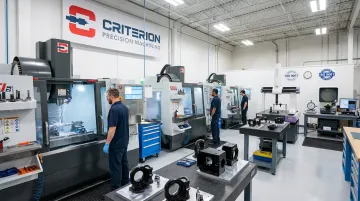
Criterion Precision Machining, based in Brook Park, Ohio, produces precision-machined optomechanical components with tolerances down to ±.0002" for photonics, defense, and medical customers. The company holds ISO 9001:2015 and ISO 13485:2016 certifications and carries both ITAR and FDA registration.
Their ProShop ERP platform tracks every operation from quoting through shipment, generating the complete documentation chain — FAIRs, Certificates of Conformance, material traceability — that regulated programs require.
Conclusion
Selecting an optical component manufacturer in 2026 is a systems decision, not a catalog search. The performance demands of AI data centers, defense laser programs, and medical photonics require manufacturers who can demonstrate — not just claim — tolerance capabilities, certification compliance, and application-specific experience.
Three criteria should anchor your evaluation:
- Scalability — can the manufacturer support production volumes as your program grows?
- Traceability — can they deliver the documentation chain required for ISO 9001, ISO 13485, or FDA submissions?
- Partnership viability — are they equipped to support the program long-term, not just deliver a first article?
That evaluation extends to every layer of the supply chain, including precision-machined optomechanical components. For engineering teams and procurement managers whose photonics programs require precision-machined housings, mounts, and structural assemblies, Criterion Precision Machining offers ISO 9001 and ISO 13485 certified precision machining with tolerances down to ±.0002″, FDA registration, and ITAR compliance.
Contact Criterion at 216-267-1733 or office@criteriontool.com to discuss your program requirements.
Frequently Asked Questions
What types of optical components are most in demand in advanced photonics in 2026?
Photonic integrated circuits (PICs) and silicon photonics transceivers are seeing the highest growth, driven by AI data center bandwidth requirements at 800G and 1.6T. High-power fiber laser components are expanding in industrial and defense applications, while precision lenses and windows for medical imaging and defense targeting remain high-volume categories.
What certifications should an optical component manufacturer hold for aerospace or defense programs?
Aerospace and defense suppliers typically require AS9100D (quality management for aviation, space, and defense organizations), ISO 9001:2015 (baseline quality management), and ITAR registration for defense-related optical hardware. Medical photonics applications add ISO 13485:2016 and FDA registration to that list.
What is the difference between optical components and photonic integrated circuits (PICs)?
Discrete optical components — lenses, mirrors, filters, prisms — are individual elements that perform single optical functions. PICs integrate multiple functions (waveguides, modulators, detectors, laser sources) onto a single chip, enabling compact, high-performance systems where power efficiency and volume scalability are priorities.
What materials are commonly used in advanced optical component manufacturing?
Common substrates include fused silica (UV and high-temperature applications), N-BK7 optical glass (general-purpose visible optics), sapphire (high-durability windows), and Zerodur glass-ceramic (near-zero thermal expansion) — each chosen for refractive index, thermal behavior, and coating compatibility. PIC platforms use silicon, InP, GaAs, and GaN.
How do precision machining suppliers support optical component manufacturers?
Precision-machined parts — lens housings, optomechanical mounts, beam-steering assemblies, detector enclosures — are structural elements in every photonics system. In aerospace, defense, and medical photonics, these parts require machining partners who hold tight tolerances, maintain certified quality systems, and deliver full traceability documentation for program audits.
What tolerances are typically required for optomechanical components in photonics systems?
Lens housings, mirror mounts, and fiber alignment fixtures typically require dimensional tolerances of ±0.001" to ±0.0002" or tighter, depending on the application. CNC multi-axis machining with CMM-verified inspection — using software like PC-DMIS — is standard practice for mission-critical photonics programs.