Using a prototype as a production benchmark means your quality system has no verified process basis. Skipping the pre-production sample stage means unresolved design issues get locked into tooling at significant cost. NIST research confirms that engineering changes become substantially more costly after systems have been built — and in precision machining for "no failure" industries, that cost compounds fast.
This guide covers the distinct definitions, purposes, and approval gates for both stages — and how to determine which one your project actually needs.
Key Takeaways
- A prototype validates design intent and function, typically using substitute materials before production tooling exists
- A pre-production sample validates the production process using final materials, tooling, and parameters
- Design freeze should not occur until prototype validation is complete — it marks the handoff between the two stages
- In regulated industries, both stages involve non-negotiable documentation requirements
- Conflating or skipping either stage introduces compliance risk that typically surfaces after mass production has begun
Prototype vs. Pre-Production Sample: Quick Comparison
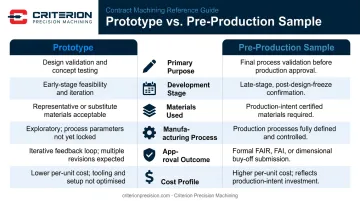
The two stages serve different gates in the development process — one confirms your design works, the other confirms your production process works. Here's how they compare across the dimensions that matter most.
| Dimension | Prototype | Pre-Production Sample |
|---|---|---|
| Primary Purpose | Validate design concept and function | Validate production process and consistency |
| Development Stage | Early (pre-tooling) | Late (post-tooling, pre-mass production) |
| Materials Used | May use substitute or representative materials | Final specified materials and finishes |
| Manufacturing Process | Hand-built, CNC, or rapid-process | Production-intent tooling, fixtures, and processes |
| Approval Outcome | Design freeze or design refinement decision | Go/no-go for bulk production |
| Cost Profile | Lower unit cost; multiple iterations common | Higher unit cost; fewer iterations expected |
What Is a Prototype?
A prototype is an early physical model of a component or product, built to test and validate design intent, geometry, functionality, and material feasibility before production processes are established.
Prototypes exist on a spectrum. According to ASME research on prototype roles in product development, they function as learning and communication artifacts at multiple stages, not just a single build. The three most relevant types for precision machined components:
- Concept prototypes — machined quickly from available material to verify geometry, fit, and basic assembly
- Functional prototypes — built to test mechanical performance under load or in assembly conditions
- Pre-production validation builds (PVT) — machined using production-intent processes as the final design validation step before locking specifications
The core purpose is to surface failure modes when changes are still low-cost. In precision machining, this means verifying critical dimensions, tolerance stack-ups, and material behavior before investing in production tooling or fixturing.
When Material Substitution Is and Isn't Acceptable
Material substitution during prototyping can invalidate test data entirely — a risk that precision manufacturing leaves no room for.
For aerospace brackets or surgical instrument components, an aluminum substitute may work for fit checks, but not for load testing. For medical devices, the FDA's guidance on biocompatibility is explicit: representative test articles must share the same materials, manufacturing processes, chemical properties, and surface properties as the final device.
This applies directly to machined components in titanium, medical-grade stainless, or PEEK — materials where mechanical and chemical behavior under the final manufacturing process is part of what's being validated.
The practical takeaway: confirm what validation data you actually need from the prototype before deciding whether material substitution is acceptable.
Prototype Use Cases in Precision Machining
Use prototypes when:
- The design is still evolving and engineering changes are expected
- You need to test fit and function in assembly before committing to long-lead specialty materials like PEEK or medical-grade titanium
- Stakeholder or regulatory design approval is required before freezing specifications
- Multiple design iterations are anticipated — particularly for surgical instrument components or optical housings where geometric refinements continue through customer review cycles
What Is a Pre-Production Sample?
A pre-production sample (PPS) is a part produced using the exact materials, tooling, fixtures, and process parameters intended for mass production. Its purpose is not to validate the design — that should already be settled — but to confirm that the production system can reliably and consistently deliver the specified quality standard before committing to a full production run.
The PPS is a production process validation record. It proves that machine setups, cutting parameters, inspection protocols, and operator procedures can reproduce the required geometry and finish within tolerance on every part.
In aerospace manufacturing, the standards-backed equivalent is First Article Inspection (FAI), governed by SAE AS9102. IAQG documentation for AS9102 specifies three formal forms capturing part number accountability, material and process compliance, and characteristic verification — including dimensional data, GD&T callouts, and surface finish results.
Medical device manufacturing applies the same logic under different standards. ISO 13485:2016 and FDA's Quality Management System Regulation (QMSR, effective February 2026) both require documented evidence that a process consistently produces output meeting predetermined specifications. This is mandatory where process results cannot be fully verified through later inspection and test alone.
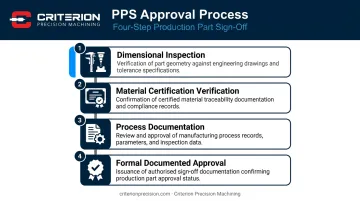
What PPS Approval Involves
A thorough pre-production sample approval typically includes:
- Dimensional inspection against the final drawing — CMM data, GD&T callout verification, surface finish checks
- Material certification verification — confirming material grade, lot traceability, and supplier conformance
- Process documentation — confirming that cutting parameters, fixturing, and setup sheets reflect production-intent conditions
- Formal documented approval — in ISO 13485 environments, this becomes part of the device history record
Once a PPS is approved, it often becomes the golden sample: the physical quality benchmark against which all subsequent production parts are compared.
Pre-Production Sample Use Cases
PPS and FAI are the appropriate validation tool when:
- You're completing first article inspection under AS9102 for an aerospace production program
- A medical device component supplier needs initial production qualification under FDA QMSR or ISO 13485
- You're confirming a new machining setup before a production run on ITAR-controlled defense components
- An engineering change order (ECO) has modified tolerances, materials, or processes — requiring re-qualification before production resumes
Prototype vs. Pre-Production Sample: Which One Do You Need?
Four questions clarify which stage applies to your current project:
- Is your design still evolving, or is it frozen? An evolving design belongs in prototype stage. Frozen design belongs in PPS stage.
- Are you asking "will this design function?" or "can we manufacture this to spec consistently?" Different questions require different validation activities.
- Has production tooling and fixturing been established? No tooling = you're in prototype territory. Tooling exists = PPS is the appropriate next step.
- Does the part require regulatory submission or first article documentation? FAI and process validation documentation require PPS-stage conditions — a prototype cannot substitute.
Decision Framework
Choose a prototype when:
- The design has not been frozen
- Material substitution is acceptable for the validation being performed
- Multiple design iterations are expected
- Stakeholder or customer design approval is needed before committing to final specifications
Choose a pre-production sample when:
- Design is frozen and final drawings are released
- Final materials and tolerances are fully specified
- Production tooling and fixturing exist
- You need documented evidence — FAI report, process validation records, dimensional conformance data — that the manufacturing process meets the required standard
The Critical Mistake to Avoid
The two most common errors, both costly:
- Using a prototype as a production benchmark — quality control has no verified process basis, and downstream production variation is undetected until parts fail in the field
- Skipping prototype stage and going straight to PPS — unresolved design issues become embedded in production tooling, where fixing them costs significantly more than early-stage design iteration
GAO research on defense manufacturing found that successful programs mature designs and manufacturing processes before production — and that immature manufacturing processes at production entry consistently increase acquisition risk. The same principle applies across aerospace and medical device manufacturing.
Design freeze should only happen after prototype validation confirms all functional, dimensional, and regulatory requirements are met — and after all engineering change orders are incorporated into the final drawing package.
From Prototype to Production: How It Works in Precision Machining
The full sequence for precision machined components:
- Concept prototype — geometry, fit, and assembly check
- Functional prototype — mechanical performance validation under real-use conditions
- Design freeze — final drawing release, all ECOs incorporated
- Pre-production sample / First article inspection — production-process validation, full dimensional documentation
- Pilot run — small-scale production confirming process repeatability
- Full production — authorized based on PPS approval and pilot run data
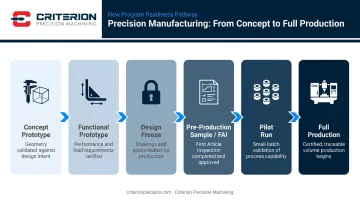
Each step has a defined approval gate. Compressing or skipping stages creates compounding risk. For surgical instruments, aerospace assemblies, and defense systems, a failure caught at the production stage doesn't get a second chance.
What to Look for in a Precision Machining Partner
Not all contract machining shops handle both stages with equal rigor. When evaluating a partner for prototype-to-production work, look for:
- Production-intent prototyping: prototypes machined on the same equipment and held to the same tolerances as production parts — not representative geometry on surrogate processes
- In-house CMM-based FAI — documented first article inspection with GD&T callout verification, not just visual checks
- Certified quality systems: ISO 13485 or ISO 9001 certification that preserves full traceability from prototype approval through production release
- Material traceability — especially for medical-grade titanium, 316L stainless, PEEK, or other regulated material classes
Criterion Precision Machining supports clients from prototype development through full production under ISO 13485:2016 and ISO 9001:2015 certified quality systems. In-house inspection includes a Global Advantage CMM with PC-DMIS software, optical inspection via OASIS, and Keyence dimensional measurement capable of evaluating up to 99 dimensions simultaneously.
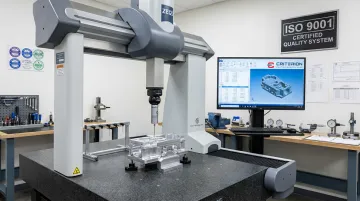
Prototypes are produced on the same Swiss CNC turning centers and 5-axis milling machines used in full production, held to the same ±0.0002" tolerances. That means prototype data directly represents what production parts will look like — no surprises at first article.
If your project requires precision machined prototypes or pre-production samples in medical, aerospace, defense, or photonics applications, contact Criterion Precision Machining to discuss your requirements — from first-article documentation to production-ready components.
Conclusion
The choice between prototype and pre-production sample is not an either/or decision. Both play distinct, irreplaceable roles. A prototype answers whether the design is right. A pre-production sample confirms whether the production process is ready. Skipping either stage doesn't eliminate the risk — it defers it to a point where correction is far more expensive.
In regulated industries like medical devices and aerospace, this distinction carries real weight. A machining partner with documented inspection records, material traceability, and process-qualified setups ensures that what gets approved at the pre-production stage is exactly what ships in production — with the paperwork to prove it.
Frequently Asked Questions
What is the difference between prototype and pre-production sample?
A prototype validates design intent and functionality early in development, often using substitute materials, before production tooling exists. A pre-production sample is produced using final materials, actual tooling, and production-intent processes to confirm the manufacturing system can consistently meet the specified quality standard before bulk production begins.
What does pre-production sample mean?
A pre-production sample (PPS) is a part made under production-intent conditions — using the actual tooling, materials, fixtures, and process parameters planned for mass production — to verify that the production system can reliably deliver components to the required specifications.
What is the difference between PBS and MPS?
PBS (Pre-production Build Sample) validates the production process before full-scale manufacturing begins. MPS (Mass Production Sample) refers to parts sampled from an active production run for ongoing quality verification. PBS confirms the process is ready; MPS confirms it remains in control during production.
Can a prototype replace a pre-production sample?
No. A prototype is typically built using substitute materials or non-production processes, meaning it cannot verify the actual manufacturing system's capability. In regulated industries, documented production process validation is a formal requirement — and that validation requires PPS-stage conditions, not prototype conditions.
How many prototype iterations are typically needed before moving to pre-production?
It varies by product complexity and industry. Precision machined components in medical or aerospace applications commonly require two to four iterations (concept, functional, and pre-production validation builds) before design freeze and first article inspection can occur.
What happens if a pre-production sample fails inspection?
A failed PPS triggers root cause analysis to identify whether the issue lies in the design, tooling, manufacturing process, or measurement system. Corrections are made, and a new PPS must be produced and re-inspected before production is authorized.