Stainless steel is often reduced to a conversation about corrosion resistance. That's accurate but incomplete. Its real value in aerospace comes from a convergence of properties that no single alternative delivers simultaneously: self-regenerating corrosion protection, high tensile strength, thermal stability at extreme temperatures, and durability that compounds over 20–30 year aircraft lifecycles. This article explains the operational reasons why aerospace engineers specify stainless steel for specific components — not what it does in a controlled lab environment, but why it holds up where failure is genuinely not an option.
Key Takeaways
- Stainless steel's chromium-based passive oxide layer is built into the alloy itself — corrosion resistance that doesn't wear off
- 304 and 316 austenitic grades handle service temperatures up to ~925°C; 309 and 310 grades extend that to 1,000–1,150°C
- Precipitation-hardened grades (15-5 PH, 13-8Mo, Custom 465) deliver tensile strengths exceeding 1,500 MPa with corrosion resistance comparable to 304
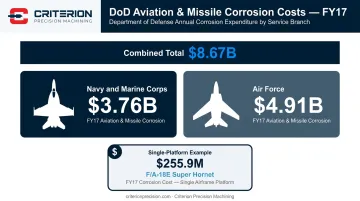
- DoD aviation and missile corrosion costs hit $8.67B in FY17 — making material selection a direct readiness and budget variable
- Material selection only matters when machining holds the tolerances — aerospace components routinely require ±0.0002" or tighter
What Stainless Steel Actually Is in an Aerospace Context
Stainless steel is an iron-based alloy containing a minimum of 10.5% chromium. That chromium reacts with oxygen to form a thin, self-repairing passive oxide layer on the surface — the foundational property that makes it valuable in corrosive service environments.
"Stainless steel" in aerospace is not a single material. It is a family of grades, each engineered for different combinations of requirements:
| Grade Family | Examples | Primary Use Case |
|---|---|---|
| Austenitic | 304, 316, 321 | Corrosion resistance, moderate temperature service |
| High-Temp Austenitic | 309, 310 | Engine and exhaust components to ~1,150°C |
| Precipitation-Hardened | 15-5 PH, 13-8Mo, 17-4 PH | Ultra-high strength structural applications |
A grade designation is the actual specification. Without one, "stainless steel" tells a machinist almost nothing. The grade, heat treatment condition, and alloying additions — molybdenum for chloride resistance, titanium for high-temperature stabilization, nickel for ductility — determine whether a component reaches its rated service life or gets pulled early.
Three Advantages That Drive Aerospace Specifications
Corrosion Resistance That Holds Up in Real Service Environments
Aerospace components face a range of corrosive conditions that have nothing to do with lab testing: salt-laden coastal air during ground operations, hydraulic fluids, de-icing chemicals, and humidity cycling at altitude. Corrosion in these environments directly causes unscheduled maintenance events — and the costs compound fast.
Stainless steel's passive oxide layer provides protection intrinsic to the alloy's chemistry — not applied to the surface. Unlike cadmium-plated alloy steels or anodized aluminum, the protection doesn't scratch off, flake, or degrade through use. When the surface is scratched during service or maintenance, the oxide layer reforms on its own.
That distinction matters operationally. A corroded landing gear strut or fuel tank fitting is not a cosmetic issue — it is a structural failure risk.
The financial scale of corrosion in defense aviation is significant. According to DoD corrosion cost data, FY17 aviation and missile corrosion costs totaled $3.76B for the Navy and Marine Corps and $4.91B for the Air Force — with the F/A-18E alone accounting for $255.9M. These figures treat corrosion resistance as a readiness and sustainment variable, not just a materials engineering preference.
KPIs directly affected:
- Unscheduled maintenance rate
- Component service life
- Inspection interval frequency
- Airworthiness compliance burden
- Total cost of ownership
SAE AMS2400X now designates cadmium plating — historically the default corrosion protection for high-strength alloy steels — as a historical standard, with DoD actively transitioning to zinc-nickel and aluminum-based alternatives. Aerospace OEMs specifying inherently corrosion-resistant alloys sidestep this transition entirely.
Mechanical Strength and Thermal Stability Where Aluminum Falls Short
Corrosion resistance alone doesn't determine material selection. For high-stress structural components, tensile strength, shear modulus, and thermal tolerance set the governing requirements — and aluminum's weight advantage stops being relevant when the material can't meet the load.
Aluminum has dominated aerospace for good reason. But the performance gap in demanding applications is hard to ignore:
| Property | 6061-T6 Aluminum | 304 Stainless | 316 Stainless |
|---|---|---|---|
| Ultimate Tensile Strength | 310 MPa | 505 MPa | 550 MPa |
| Shear Modulus | 26.0 GPa | 86.0 GPa | 77.0 GPa |
| Melting Point | 582–652°C | 1,400–1,455°C | 1,370–1,400°C |
| Max Continuous Service Temp | ~200°C | ~925°C | ~925°C |
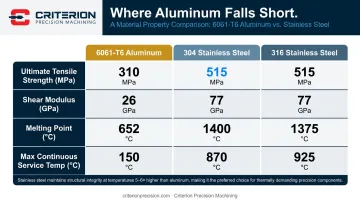
Source: MatWeb material property database
For landing gear, engine mounts, fasteners, and structural joints subject to impact loading and thermal cycling, aluminum cannot meet governing requirements at equivalent section thickness. Specifying stainless in these locations eliminates the overdesign required to compensate for lower strength.
For ultra-high strength structural applications, precipitation-hardened grades push performance further:
- 15-5 PH (H900 aged): Minimum UTS 1,310 MPa
- 13-8Mo (H950 aged): Minimum tensile strength 1,515 MPa
- Custom 465 (H900 aged): UTS up to 1,793 MPa
These PH grades deliver corrosion resistance comparable to 304 while meeting structural demands that neither conventional alloy steels nor standard stainless grades can match simultaneously.
KPIs directly affected:
- Structural weight budget
- Fatigue life and damage tolerance ratings
- Thermal operating limits
- Component cross-section geometry requirements
Long-Term Durability That Reduces Life Cycle Cost
Aerospace programs run 20–30 years. The purchase price of a component is a small fraction of its total cost — the rest is installation, inspection, maintenance, and replacement across the aircraft's operational life.
Stainless steel's resistance to wear, fatigue, and environmental degradation extends service intervals and reduces replacement frequency. This is not a coating-dependent effect. When a stainless steel surface is scratched during maintenance, the corrosion protection is undiminished — because it is throughout the alloy, not a surface layer.
The FAA's Advisory Circular AC 43-4B reflects this directly: it recommends replacing non-stainless steel control cables with corrosion-resistant stainless steel cables where applicable — a maintenance guidance choice grounded in durability, not just material preference.
KPIs directly affected:
- Mean time between maintenance (MTBM)
- Component replacement frequency
- Total lifecycle cost
- Operational availability
- Regulatory compliance documentation burden
The durability benefit is most pronounced in high-cycle components — landing gear struts, engine hardware, fasteners — where longer replacement intervals translate directly into reduced downtime and lower program-level sustainment cost.
Where Aerospace Manufacturers Use Stainless Steel
Stainless steel is not specified universally across an airframe. It is applied strategically where corrosion resistance and structural strength must coexist — often under thermal, mechanical, or chemical stresses that would disqualify lighter alternatives.
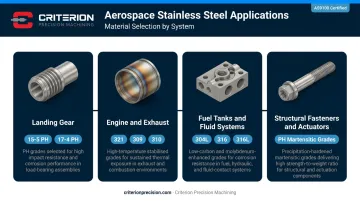
Primary application categories:
- Landing gear components face simultaneous high-impact loads and ground-level contaminant exposure; PH grades (15-5 PH, 17-4 PH) are specified to meet both demands
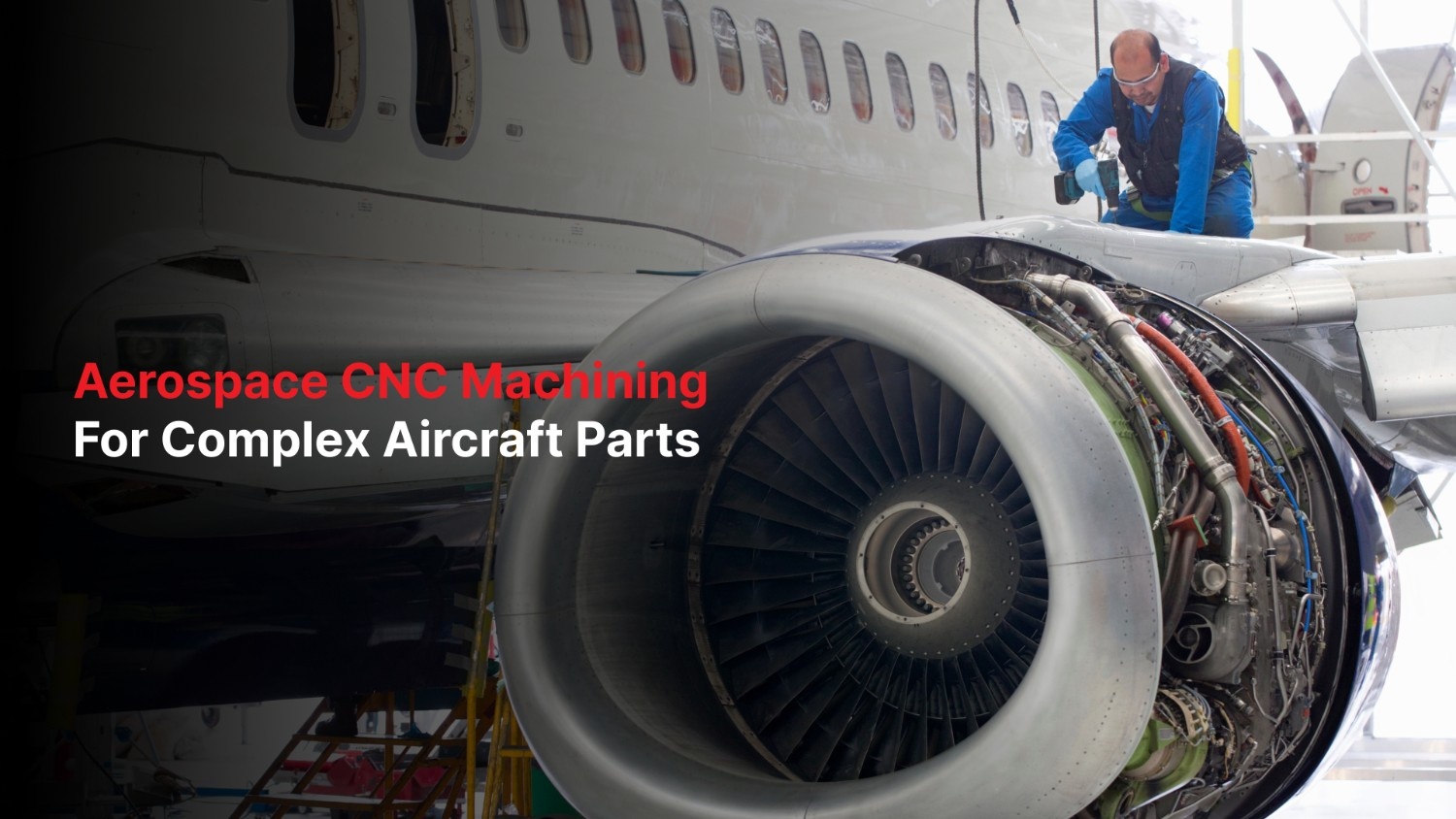
- Engine and exhaust components rely on grades 321, 309, and 310 to sustain structural integrity through thermal cycling and oxidation at temperatures that would degrade aluminum or carbon steel
- Fuel tanks and internal fluid systems use austenitic grades 304, 304L, 316, and 316L — selected based on chloride exposure, with 316L preferred in elevated-chloride environments
- Structural components including fasteners, actuators, control rods, and cockpit hardware increasingly specify PH martensitic grades to gain corrosion resistance without sacrificing tensile strength
The SpaceX Starship program offers a well-documented example of grade-level decision-making at scale. In January 2019, Elon Musk announced a shift from carbon fiber to 301 stainless steel, citing cost ($3/kg versus $135/kg for carbon fiber), a 50% strength gain at cryogenic temperatures, and sufficient heat tolerance to reduce thermal shielding requirements. The cost differential was notable, but the performance case — particularly cryogenic strength — drove the specification.
That performance logic extends across the industry. Grade selection is rarely about a single property; it follows the specific operating environment:
Grade selection logic:
- Mild corrosion environments (cabin, internal tanks): 304, 304L
- Chloride-heavy environments: 316, 316L
- High-temperature oxidation to ~1,150°C: 309, 310
- Ultra-high strength structural applications: 13-8Mo, 15-5 PH, 17-4 PH
What Happens When the Wrong Material Is Specified
Material selection errors in aerospace follow a predictable cascade. A component that cannot sustain its service environment corrodes or degrades, triggering unscheduled maintenance — among the most expensive operational disruptions in aviation. That maintenance event generates airworthiness documentation. If the failure pattern repeats, fleet-wide inspections follow.
The NTSB, FAA, and EASA have documented this pathway repeatedly:
- An NTSB investigation found AISI 1025 carbon steel rudder posts fractured from fatigue, with corrosion and surface roughness acting as stress concentrators — directly linking material and surface condition to flight-control risk
- EASA Airworthiness Directive 2026-0114 cited Airbus A350 main landing gear axle corrosion from incorrect corrosion-protection coating application during production, requiring repetitive inspections and corrective action
- An NTSB investigation into a fatal wing separation found fatigue cracking associated with corrosion in wing spar fitting hole bores, with improper maintenance and failure to detect extensive corrosion cited as contributing factors
Each case shows the same pattern: when the material or protection strategy doesn't match the service environment, a component-level failure escalates into a fleet-level safety and compliance problem. The question is never whether the wrong material will cause issues — only when, and at what cost.
Material selection errors are compounded by machining errors. The correct alloy, machined out of tolerance, introduces stress concentrations, surface finish defects, and dimensional variances that compromise fatigue life. Getting the grade right matters — but so does holding the geometry, surface finish, and dimensional tolerances that determine how long that grade actually performs in service.
How to Get Full Performance from Stainless Steel in Aerospace
Stainless steel performs best when grade selection is matched precisely to the service environment. The right chromium content, the right alloying additions, and the correct heat treatment condition for PH grades are decisions made at the specification stage — and they determine whether a component reaches its rated service life.
Machining aerospace-grade stainless steel requires capabilities and process discipline that not every contract shop can provide. Austenitic grades work-harden during cutting. Without controlled toolpath strategies, proper feeds and speeds, and consistent coolant management, the cutting process itself creates surface stresses that reduce fatigue life. Sandvik Coromant identifies work hardening, built-up edge, high cutting forces, and heat at the cutting zone as the primary machining risks for austenitic stainless — all of which require deliberate process controls, not just capable equipment.
Criterion Precision Machining, based in Brook Park, Ohio, holds tolerances to ±.0002" on stainless steel components using multi-axis Swiss turning centers (5-, 6-, and 8-axis configurations), 5-axis CNC milling, and wire EDM. The machining operation must account for the material's behavior during cutting — not just the target dimensions. Fewer setups reduce repeated engagement with already-stressed material surfaces, directly limiting work-hardening accumulation.
CAM software — Autodesk PartMaker® for Swiss turning and Mastercam® for milling — enables optimized toolpath strategies and cutting parameter control for stainless and other challenging alloys.
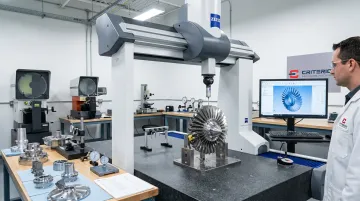
At Criterion, dimensional verification is built into every stage of manufacturing — not just the end of the line. Their inspection infrastructure includes:
- Global Advantage CMM with PC-DMIS software for high-precision dimensional analysis
- OASIS optical inspection system for automated surface and feature verification
- Keyence systems capable of measuring up to 99 dimensions on up to 100 parts simultaneously
Full documentation packages — First Article Inspection Reports, material certifications, and Certificates of Conformance — are standard, managed through their ProShop ERP platform for complete traceability. ISO 9001:2015 and ISO 13485:2016 certifications, ITAR registration, and DFARS compliance cover the documentation and regulatory requirements aerospace programs demand.
Conclusion
Stainless steel's role in aerospace is not the result of tradition or default specification. It comes from a specific combination of corrosion resistance, mechanical strength, thermal stability, and lifecycle durability that no single alternative delivers across all aerospace service environments simultaneously.
These advantages compound over time. A correctly specified and precisely machined stainless steel component reduces maintenance burden, extends service intervals, and maintains structural integrity across the full operational life of the aircraft. The longer the program runs, the more that value accumulates.
Aerospace designs continue pushing toward higher operating temperatures, lighter structures, and more demanding service environments. The stainless steel grade family has expanded to meet those demands directly: PH grades now reach above 1,793 MPa, while high-temperature grades sustain oxidation resistance to 1,150°C. Realizing that performance in service depends as much on how a component is machined as on what it's made from — tolerances, surface finish, and feature integrity all determine whether the material's properties translate to the finished part.
Frequently Asked Questions
What stainless steel is used in aerospace?
Three grade families dominate aerospace use:
- Austenitic (304, 316, 321) — corrosion resistance in tanks and structural parts
- High-temperature austenitic (309, 310) — engine and exhaust components
- Precipitation-hardened martensitic (15-5 PH, 13-8Mo, 17-4 PH) — high-strength structural applications like landing gear
Grade selection depends on the governing requirement: corrosion, temperature, or strength.
What is the best metal for aerospace?
Each metal serves a different requirement. Aluminum is preferred where low weight drives design. Titanium is specified where light weight and high strength are both required. Stainless steel is the right choice when corrosion resistance, thermal performance, or ultra-high strength governs — particularly in landing gear, engine components, and structural joints.
Why is stainless steel preferred over aluminum for certain aerospace components?
Stainless steel has significantly higher tensile strength (505–550 MPa vs. 310 MPa for 6061-T6), shear modulus (77–86 GPa vs. 26 GPa), and melting point (1,370–1,455°C vs. 582–652°C). For high-load, high-temperature, or high-impact applications like landing gear and engine exhaust, aluminum would degrade or fail under service conditions where stainless maintains structural integrity.
What makes stainless steel suitable for high-temperature aerospace environments?
Specific austenitic grades maintain structural integrity and resist oxidation at extreme temperatures — 321 to ~870°C continuous service, 309S to ~1,000°C, and 310H to ~1,150°C. These thresholds are well beyond what standard carbon steel can sustain without degradation.
How does precision machining affect stainless steel aerospace component performance?
Stainless steel work-hardens during machining, and without controlled cutting parameters, the process introduces surface stresses and dimensional inaccuracies that directly reduce fatigue life. Machining partner selection — including verified capability in the material and in-process inspection — is as critical as correct grade specification.
Is stainless steel used in aircraft structures?
Yes. Stainless steel is used in structural roles including fasteners, actuators, flap tracks, engine mounts, and superstructure joints. Precipitation-hardened grades are increasingly replacing conventional alloy steels in these applications to gain corrosion resistance without sacrificing the strength structural requirements demand.