At the center of this ecosystem sit prime contractors — large integrators that hold direct government contracts and deliver complete weapons systems or platforms. Behind them runs a vast supply chain of certified precision manufacturers whose components determine whether those programs succeed or fail.
This guide covers the seven most prominent U.S. aerospace and defense prime contractors, what each specializes in, and what their supplier qualification requirements mean for precision manufacturers operating in this space.
Key Takeaways
- The DoD obligated approximately $445 billion on contracts in FY2024, with seven prime contractors accounting for the majority of that spending
- Prime contractors require Tier 2/3 suppliers to hold AS9100, ITAR registration, and often NADCAP accreditation before qualifying
- Each prime specializes in distinct platform categories — knowing those distinctions helps suppliers identify the right entry points
- Documented quality systems carry more weight than company size in supplier qualification decisions
- First article inspection records, material certifications, and traceability documentation are non-negotiable at the point of entry
Overview of U.S. Aerospace and Defense Contractors
A prime contractor, as defined under the Federal Acquisition Regulation, is a company that has entered into a direct contract with the U.S. government to deliver a complete system, platform, or service. Prime contractors hold the government relationship. Subcontractors and Tier 2/3 precision suppliers produce components under contracts with the prime, not with the DoD or NASA directly.
According to the Congressional Research Service, the DoD obligated roughly $445 billion on contracts in FY2024. Seven contractors alone — Lockheed Martin, RTX, Boeing, General Dynamics, Northrop Grumman, HII, and L3Harris — captured the bulk of those obligations.
What makes this supply chain demanding is the qualification barrier. Primes impose strict supplier requirements across four areas:
- Quality management certifications (AS9100, ISO 9001)
- Export compliance under ITAR
- Demonstrated tolerance and process capability
- Full material traceability
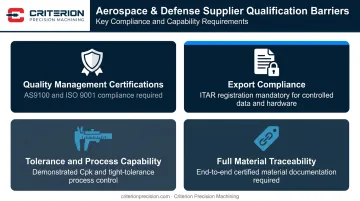
These requirements aren't incidental. The supplier ecosystem is a structural dependency — and its integrity directly determines program performance.
Top U.S. Aerospace and Defense Contractors
These contractors are evaluated on DoD contract volume, program breadth across military branches, manufacturing depth, and long-term strategic importance — listed here in no particular rank order.
Lockheed Martin Corporation
Lockheed Martin is the world's largest defense contractor by revenue, recording $75 billion in net sales in 2025. Formed on March 15, 1995 through the merger of Lockheed Corp. and Martin Marietta, the company has built an unmatched position across aeronautics, missiles, space, and rotary systems.
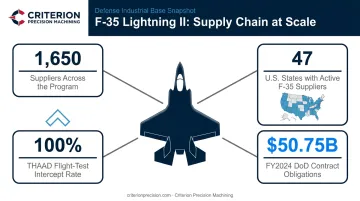
The F-35 Lightning II defines Lockheed's scale. CRS reports the program draws on 1,650 suppliers across 47 U.S. states — one of the most geographically distributed manufacturing networks in U.S. defense history. The THAAD missile defense system has achieved a 100% flight-test intercept success rate, and Lockheed serves as prime contractor for NASA's Orion spacecraft.
| Detail | Information |
|---|---|
| Founded / HQ | March 15, 1995 / Bethesda, Maryland |
| Core Specialization | Aeronautics, Missiles & Fire Control, Rotary & Mission Systems, Space |
| Notable Programs | F-35 Lightning II, THAAD missile defense, Orion spacecraft |
| FY2024 DoD Obligations | $50.75 billion |
RTX (Raytheon Technologies)
RTX was formed on April 3, 2020 through the merger of Raytheon Company and United Technologies Corporation. It operates three major businesses — Collins Aerospace, Pratt & Whitney, and Raytheon — covering nearly the full aircraft system stack from propulsion to avionics to guided munitions.
Pratt & Whitney's F135 engine powers all three F-35 variants, with more than 1,300 engines delivered. The Patriot missile system serves 19 nations. AMRAAM remains the only radar-guided air-to-air missile cleared to fly on the F-35, illustrating how RTX's businesses reinforce each other across programs.
| Detail | Information |
|---|---|
| Founded / HQ | April 3, 2020 (merger) / Arlington, Virginia |
| Core Specialization | Propulsion systems, guided missiles, avionics, cybersecurity |
| Notable Programs | Patriot missile system, F135 engine, AIM-120 AMRAAM |
| FY2024 DoD Obligations | $24.82 billion |
Northrop Grumman Corporation
Northrop Grumman's heritage traces to Northrop Aircraft (founded 1939) and the 1994 merger with Grumman. Headquartered in Falls Church, Virginia, the company recorded $41.95 billion in 2025 sales with dominant positions in stealth aviation, unmanned systems, electronic warfare, and space.
The B-21 Raider, a dual-capable stealth bomber designed to deliver both conventional and nuclear munitions, represents the company's most consequential current program. The RQ-4 Global Hawk provides persistent ISR capability across theaters. Northrop also led the industry team for NASA's James Webb Space Telescope.
| Detail | Information |
|---|---|
| Founded / HQ | 1939 (Northrop heritage) / Falls Church, Virginia |
| Core Specialization | Stealth aircraft, unmanned systems, electronic warfare, space |
| Notable Programs | B-21 Raider, RQ-4 Global Hawk, James Webb Space Telescope |
| FY2024 DoD Obligations | $18.58 billion |
Boeing Defense, Space & Security
Boeing's defense division supplies the U.S. Air Force, Navy, and Army across military aircraft, rotorcraft, and space systems. In 2026, Boeing Defense, Space & Security relocated its headquarters from Arlington, Virginia back to St. Louis — its historical home.
Boeing's defense portfolio benefits directly from its commercial aviation manufacturing infrastructure. The F/A-18 Super Hornet carries a maximum takeoff weight of 66,000 lb. The KC-46 Pegasus tanker holds 212,299 lb of fuel. The AH-64 Apache has accumulated more than 5.3 million flight hours, including 1.3 million in combat.
| Detail | Information |
|---|---|
| Founded / HQ | 1916 (Boeing heritage) / St. Louis, Missouri (as of 2026) |
| Core Specialization | Military aircraft, rotorcraft, space launch systems, satellites |
| Notable Programs | F/A-18 Super Hornet, KC-46 Pegasus tanker, AH-64 Apache |
| FY2024 DoD Obligations | $23.22 billion |
General Dynamics Corporation
General Dynamics was incorporated in 1952 and is headquartered in Reston, Virginia. With $52.6 billion in 2025 revenue, the company spans land systems, naval shipbuilding, business aviation, and IT/C4ISR — a diversification that insulates it against single-program risk.
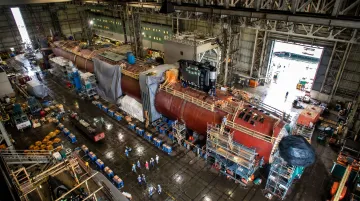
Its Electric Boat subsidiary holds the most technically demanding position in U.S. defense manufacturing: prime contractor for the 12-ship Columbia-class ballistic missile submarine program, performing approximately 78% of construction. Electric Boat and HII Newport News also jointly produce Virginia-class submarines and have delivered 22 boats since 2004.
On the land side, the M1 Abrams main battle tank debuted in 1980, with General Dynamics Land Systems continuing to produce upgraded SEPv3 variants.
| Detail | Information |
|---|---|
| Founded / HQ | 1952 / Reston, Virginia |
| Core Specialization | Nuclear submarines, combat vehicles, business aviation, IT/C4ISR |
| Notable Programs | Columbia-class submarine, Virginia-class submarine, M1 Abrams |
| FY2024 DoD Obligations | $19.20 billion |
L3Harris Technologies
L3Harris was formed from the merger of L3 Technologies and Harris Corporation and is headquartered in Melbourne, Florida. The company reported $21.87 billion in 2025 revenue with a focus on communications, electronic warfare, space sensors, and intelligence systems — the technology layer that connects platforms rather than the platforms themselves.
Its AN/PRC-117G Falcon III multiband networking manpack radio is 30% smaller and 35% lighter than comparable systems. That kind of integration — commercial technology advances applied at defense timelines — runs throughout L3Harris's product portfolio.
| Detail | Information |
|---|---|
| Founded / HQ | 2019 (merger) / Melbourne, Florida |
| Core Specialization | Communications systems, electronic warfare, avionics, space sensors, night vision |
| Notable Programs | AN/PRC-117G multiband radio, tactical communications systems, space domain awareness sensors |
| FY2024 DoD Obligations | $7.97 billion |
Huntington Ingalls Industries (HII)
HII spun off from Northrop Grumman on March 31, 2011, and is headquartered in Newport News, Virginia. America's largest military shipbuilder, HII reported $12.5 billion in 2025 revenue across two core shipbuilding divisions and a growing Mission Technologies segment.
Newport News Shipbuilding is the sole designer and builder of U.S. Navy nuclear-powered aircraft carriers. That monopoly position reflects the technical difficulty of nuclear propulsion and the decades of institutional knowledge required to construct Gerald R. Ford-class carriers. Ingalls Shipbuilding has delivered 36 Arleigh Burke-class destroyers to the Navy.
| Detail | Information |
|---|---|
| Founded / HQ | March 31, 2011 (spin-off) / Newport News, Virginia |
| Core Specialization | Nuclear aircraft carriers, submarines, surface combatants, naval IT |
| Notable Programs | Gerald R. Ford-class carrier, Virginia-class submarine (with GD), Arleigh Burke-class destroyer |
| FY2024 DoD Obligations | $8.02 billion |
How We Chose These Contractors
The contractors on this list were selected based on four criteria:
- Annual DoD prime contract obligations — FY2024 data from Forecast International and Defense News
- Program breadth — involvement across multiple military branches and platform categories
- Manufacturing depth — not just systems integration, but core production capability
- Strategic long-term importance — programs essential to U.S. national security over the next decade
The Supplier Quality Factor
An often-overlooked dimension of contractor performance is the quality of their precision manufacturing supply chain. Every prime on this list imposes supplier qualification requirements that go beyond basic capability. Northrop Grumman's SQAR mandates AS9100 certification for Level 1–3 suppliers and NADCAP accreditation for NDT, heat treating, and welding.
Boeing's D1-4426 governs approved process sources for special processes and raw materials. Lockheed Martin's supplier quality manual references AS9100 and NADCAP-approved sources throughout.
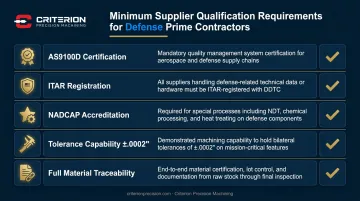
For precision manufacturers entering this supply chain, the minimum requirements are:
- AS9100D certification — the aerospace-specific quality management standard built on ISO 9001:2015
- ITAR registration — required by 22 CFR 122.1 for any company manufacturing components for defense applications
- NADCAP accreditation — for special processes including heat treating, NDT, and welding
- Tolerance capability — typically ±.0002" or tighter for guidance and propulsion components
- Full material traceability — lot-level documentation, certificates of conformance, and FAIRs
Criterion Precision Machining, an ITAR-registered, ISO 9001:2015-certified precision machining company in Brook Park, Ohio, represents the type of Tier 2/3 supplier these primes depend on. The company holds tolerances down to ±.0002" across Swiss turning, CNC turning, and 5-axis milling for aerospace, defense, and weapons applications.
Common Procurement Mistakes
- Over-indexing on brand recognition rather than evaluating program-specific manufacturing capability
- Ignoring ITAR and export compliance status, which is a disqualifying oversight for any defense program component
- Failing to assess quality documentation depth: traceability, FAIRs, and CoCs are program requirements, not optional extras
Conclusion
These seven contractors represent the structural backbone of U.S. defense manufacturing — from stealth bombers and nuclear submarines to guided missiles and carrier battle groups. Each operates in distinct platform categories, and each maintains supplier qualification standards that reflect the criticality of what they build.
No prime contractor operates in isolation. Behind every F-35 or Columbia-class submarine is a network of certified precision manufacturers whose quality and reliability determine whether programs deliver on schedule and within specification. Suppliers who can't demonstrate certification, traceability, and proven tolerance capability don't make it past initial qualification — and for good reason.
Criterion Precision Machining (Brook Park, Ohio) provides precision contract machining for aerospace and defense supply chain programs — with AS9100 and ISO 9001 certifications, ITAR registration, and tolerances down to ±.0002". Contact them at office@criteriontool.com or 216-267-1733 to discuss your program requirements.
Frequently Asked Questions
What is the largest aerospace and defense contractor in the United States?
Lockheed Martin is the largest U.S. defense contractor by revenue, recording $75 billion in net 2025 sales and $50.75 billion in FY2024 DoD obligations — consistently the highest in the industry. Its F-35 program alone involves 1,650 suppliers across 47 states.
What certifications do aerospace and defense prime contractors require from their suppliers?
The baseline is ISO 9001, but primes require AS9100D, the aerospace-specific quality management standard that adds aviation, space, and defense requirements on top of ISO 9001. ITAR registration and NADCAP accreditation for special processes (heat treating, NDT, welding) are also standard requirements for Tier 1–3 suppliers.
What is ITAR and why does it matter for U.S. defense manufacturing?
ITAR (International Traffic in Arms Regulations), administered by the State Department under 22 CFR Parts 120–130, governs the export of defense-related articles, services, and technology. Any U.S. company manufacturing components for defense applications must register under 22 CFR 122.1 before legally producing or supplying those parts. Non-compliance carries criminal penalties and can result in permanent loss of export privileges, making ITAR registration non-negotiable for any defense supplier.
What is the difference between a prime contractor and a subcontractor in aerospace and defense?
A prime contractor holds a direct contract with the U.S. government (DoD or NASA) for a complete system or platform. Subcontractors and Tier 2/3 precision suppliers produce components, sub-assemblies, or machined parts under contracts with the prime — they have no direct contractual relationship with the government.
How do aerospace and defense contractors maintain quality across their supply chains?
Primes enforce supplier qualification programs built around:
- AS9100 certification and documented quality management systems
- First Article Inspection Reports (FAIRs) and full material traceability
- Statistical process control, CMM inspection, and supplier audit rights
What materials are most commonly machined for aerospace and defense components?
Titanium (Ti-6Al-4V), Inconel 718, aerospace-grade aluminum alloys (6061, 7075), 17-4 and 15-5 PH stainless steels, and PEEK are the most common. These materials are selected for their strength-to-weight ratios, corrosion resistance, and performance in high-temperature, high-stress environments typical of airframes, engines, and weapons systems.