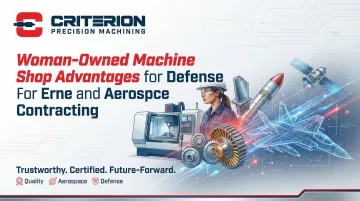
Key Takeaways
- Woman-owned machine shops deliver real advantages: supplier diversity compliance, precision credentials, and documented quality systems
- Key benefits include meeting DoD's 5% supplier diversity goal, access to shops with ISO/AS9100/ITAR credentials, and reduced supply chain concentration risk
- Many demonstrate stronger quality control, faster response times, and better on-time delivery than larger, less agile suppliers
- WBENC and WOSB certifications validate legitimate woman ownership (51%+ owned, controlled, and operated by women)
- Most relevant for defense primes, aerospace OEMs, and procurement teams building more resilient supply chains
What Is a Woman-Owned Machine Shop in Defense and Aerospace Context
A woman-owned business is a company that is at least 51% owned, controlled, managed, and operated by one or more women. Third-party certifications like WBENC (Women's Business Enterprise National Council) or WOSB (Women-Owned Small Business) validate this status through detailed documentation review and site visits.
In defense and aerospace, woman-owned machine shops operate as precision manufacturing suppliers producing mission-critical components. That typically includes:
- Aerospace structures and flight-critical hardware
- Defense assemblies and weapons systems parts
- Tight-tolerance components (often ±0.0002" or tighter)
- Exotic materials such as titanium, Inconel, and specialty alloys
- Quality systems compliance: AS9100, ISO 9001, and ITAR registration
Woman-owned status delivers real strategic outcomes for prime contractors and program managers: it satisfies supplier diversity requirements, opens access to specialized manufacturing capabilities, and reduces supply chain concentration risk. These are procurement advantages with direct impact on cost, quality, and delivery.
Key Advantages of Woman-Owned Machine Shops for Defense and Aerospace Contracting
The advantages below focus on measurable operational and strategic benefits rather than abstract diversity goals. Each advantage directly impacts outcomes that procurement teams track: cost, quality, delivery, compliance, and supply chain risk.
Advantage 1: Supplier Diversity Compliance and Competitive Positioning
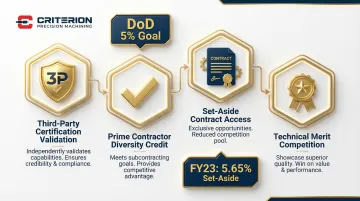
Defense primes and aerospace OEMs face mandated supplier diversity goals. The DoD maintains a prime contracting goal of awarding 5% of total spending to WOSBs for fiscal years 2020 through 2025. In FY23, the Army awarded $4.12 billion (4.67%) to WOSBs, illustrating the ongoing push to meet these statutory targets.
How certification creates advantage:
- WBENC or WOSB certification provides third-party validation of woman ownership
- Prime contractors count these purchases toward diversity goals
- Creates preferential access to set-aside contracts—in FY 2023, set-asides accounted for 5.65% of all WOSB awarded contract dollars
- Woman-owned shops often compete effectively on technical merit, not just diversity status
Why this matters:
Working with certified woman-owned suppliers lets defense contractors meet compliance requirements without sacrificing manufacturing quality. It also reduces the administrative burden of documenting supplier diversity spend.
The consequences of falling short are concrete. Non-compliance can trigger liquidated damages equal to the actual dollar shortfall, plus negative CPARS ratings that can remove a contractor from future competitive ranges entirely.
KPIs impacted:
- Supplier diversity spend percentage
- Number of certified diverse suppliers in supply base
- Subcontracting plan fulfillment rates
- Competitive positioning for government contracts
When this advantage matters most: For defense primes with DoD supplier diversity plans, aerospace OEMs differentiating through supply chain practices, and procurement teams selecting between technically comparable shops.
Advantage 2: Specialized Precision Manufacturing with Quality System Rigor
Woman-owned machine shops serving defense and aerospace often maintain stringent quality certifications—AS9100D, ISO 9001, ISO 13485—and security credentials like ITAR registration and CMMC compliance while delivering precision work at tolerances down to ±0.0002".
How woman-owned shops create this advantage:
- Many woman-owned precision shops concentrate exclusively on "no-failure" industries, aligning quality systems around aerospace, defense, and medical requirements
- Direct owner involvement typically means hands-on oversight of quality processes rather than delegated management
- Investments in 5-axis machining, CMM inspection, and ERP systems support tight-tolerance production
- Northrop Grumman supplier quality guides, for example, specify evaluation of close tolerance dimensions ≤±0.005" and diameter tolerances of 0.001" or less—standards these shops routinely meet
Why quality rigor matters:
- Reduces quality escapes and rework costs on mission-critical programs
- Ensures traceability and documentation required for defense and aerospace applications
- ITAR registration enables handling of controlled technical data
- ISO certifications demonstrate systematic quality management
- Owner accessibility typically speeds issue resolution compared to navigating large supplier hierarchies
KPIs impacted:
- First-pass yield rates and defect rates per million opportunities
- Cost of quality and audit findings
- ITAR compliance scores and certification renewal status
- Customer quality ratings
When this advantage matters most: For mission-critical components with tolerances below ±0.001", programs requiring ITAR compliance, work involving exotic materials (titanium, Inconel, PEEK), and new program launches requiring rapid quality system validation.
Advantage 3: Agility, Responsiveness, and Supply Chain Risk Mitigation
Woman-owned machine shops, often smaller and owner-operated, demonstrate greater flexibility in accommodating engineering changes, expedited deliveries, and custom requirements compared to larger suppliers. This agility reduces supply chain disruption risk.
How woman-owned shops create this advantage:
- Direct owner involvement enables faster decision-making on design changes, capacity allocation, and problem-solving
- Lean operations with less bureaucracy allow quicker response to urgent needs
- Diversifying supply base with woman-owned suppliers reduces concentration risk from relying on few large suppliers
- Strong relationships and communication through owner accessibility
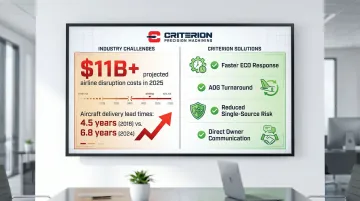
The commercial aerospace supply chain faces severe strain. Supply chain disruptions are projected to cost airlines over $11 billion in 2025 due to delayed fuel efficiencies, maintenance costs, and inventory holding. Aircraft delivery lead times have extended from 4.5 years in 2018 to 6.8 years in 2024.
Why agility is an advantage:
- Reduces lead times when engineering changes occur mid-program
- Enables faster response to AOG (aircraft on ground) situations or critical defense needs
- Improves supply chain resilience by avoiding over-reliance on single sources
- Direct owner communication resolves issues faster than navigating large supplier hierarchies
KPIs impacted:
- Average lead time and on-time delivery percentage
- Engineering change order response time
- Supply chain concentration metrics (spend percentage with top suppliers)
- Supplier responsiveness scores and inventory carrying costs
When this advantage matters most: During prototype and low-rate initial production phases, programs under schedule pressure, aftermarket/MRO applications requiring rapid turnaround, and any situation where primary supplier disruptions require a responsive backup source.
What Happens When You Overlook Woman-Owned Suppliers in Defense and Aerospace
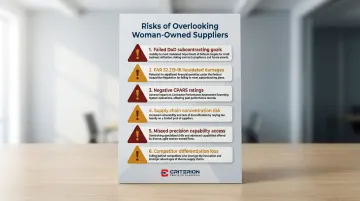
Skipping woman-owned suppliers in your supply chain isn't just a missed checkbox — it carries real compliance, financial, and operational consequences.
- Fails DoD small business subcontracting goals, which directly affects contract award scores and competitive positioning
- Violates FAR 52.219-16 if good faith effort isn't documented — triggering liquidated damages equal to the shortfall; the GAO ruling in Graybar (B-410886) confirmed prime contractors can be excluded from competitive ranges for repeated socioeconomic subcontracting failures
- Negative CPARS ratings from compliance shortfalls follow a contractor into future bids, compounding the damage
- Over-reliance on a narrow supplier base increases concentration risk, leaving programs exposed to single-source failures or delivery delays
- Woman-owned shops often offer precision machining capabilities, quality certifications (ISO 9001, ISO 13485), and responsiveness that larger suppliers don't prioritize for smaller programs
- Competitors who actively source from woman-owned suppliers gain measurable advantages in diversity metrics, supply chain flexibility, and evaluation scores
How to Get the Most Value from Woman-Owned Suppliers
Maximizing value means treating woman-owned suppliers as strategic partners — chosen for what they can deliver, not just what they check off a compliance list. Three practices consistently separate high-performing supplier relationships from transactional ones.
Qualify on Technical Merit First
Evaluate woman-owned machine shops against the same criteria as any supplier. Key qualifications to verify:
- Relevant certifications (ISO 9001, ISO 13485, ITAR registration)
- Equipment capabilities (5-axis milling, Swiss turning, CMM inspection)
- Tolerance capability — typically ±0.0002" for aerospace and defense work
- Material experience with titanium, Inconel, and high-strength alloys
- Financial stability and quality management systems
Woman-owned status adds real strategic value for contract compliance, but technical capability has to come first.
Communicate Requirements Early and Clearly
Provide detailed specifications, quality requirements, and delivery expectations from the start. Where possible, bring suppliers into the design phase early — smaller shops can flag manufacturability issues before they become costly changes.
Keep communication direct through owner or management contacts. Sharing visibility into upcoming program needs lets agile shops plan capacity in advance, which benefits your schedule as much as theirs.
Build for the Long Term
Transactional purchasing leaves value on the table. Woman-owned shops with direct owner involvement get better at serving your program over time — they learn your standards, anticipate needs, and respond faster because the relationship matters to them personally.
Consider multi-year agreements or preferred supplier status. Provide performance feedback. The responsiveness that makes these shops attractive in the short term compounds significantly as the partnership matures.
Conclusion
Woman-owned machine shops offer defense and aerospace contractors measurable advantages that go well beyond diversity compliance. The returns grow when these suppliers are treated as strategic partners rather than checkbox vendors:
- Quality tightens through iterative collaboration on specs and tolerances
- Responsiveness improves as the relationship matures and communication channels sharpen
- Supply chain resilience builds through a more diversified, vetted sourcing base
Supplier selection should lead with technical qualification and strategic fit. Woman-owned certification then adds a concrete second layer of value: compliance credit, competitive differentiation on set-aside contracts, and reduced concentration risk across your supply chain. Shops like Criterion Precision Machining — WBENC-certified, ISO 9001 and ISO 13485 registered, and built around mission-critical tolerances — demonstrate what that combination looks like in practice. The business case stands on its own merits.
Frequently Asked Questions
What does WBENC certified mean?
WBENC (Women's Business Enterprise National Council) certification verifies that a business is at least 51% owned, controlled, managed, and operated by women. This third-party validation is widely recognized by corporations and government agencies for supplier diversity programs and provides documented proof of woman ownership status.
What is the difference between WBE and WBENC?
WBE (Women's Business Enterprise) is the general term for woman-owned businesses, while WBENC is a specific certifying organization that validates WBE status through a rigorous application process. WBENC is also an SBA-approved third-party certifier, so businesses can satisfy both WBE and WOSB federal requirements through a single process.
Is WOSB certification worth it?
For small businesses pursuing federal contracts, WOSB (Women-Owned Small Business) certification opens access to set-aside opportunities—in FY 2023, set-asides accounted for 5.65% of all WOSB awarded contract dollars—along with competitive advantages in federal procurement.
How long does it take to get WBENC certification?
WBENC certification typically takes 90 days from the date the file is deemed complete. The process includes a documentation review and a site visit. Allow extra time if your documentation requires clarification before the file is accepted as complete.
How to get certified as a WOSB?
Register in SAM.gov, ensure your business meets the 51% woman-owned and controlled criteria, then submit documentation through SBA's MySBA Certifications platform or an approved third-party certifier. The SBA aims to make determinations within 90 calendar days of receiving a complete application package.
How much does it cost to get WOSB certification?
WOSB certification through the SBA is free. Using third-party certifiers like WBENC typically costs $350–$1,250 depending on annual gross revenue, scaled to business size.