For buyers sourcing components in aerospace, defense, medical device, or photonics applications, this distinction matters. A non-conforming part in these environments doesn't create a rework line item — it can compromise a surgical outcome, a mission system, or a patient's safety.
This guide covers what ISO 9001 certification actually means in a machining context, what the standard requires at the process level, why it matters for mission-critical applications, and how to evaluate whether a shop's certification reflects genuine operational discipline or just a certificate on the wall.
Key Takeaways
- ISO 9001 certifies the system behind the parts — not the parts themselves — through independent third-party audits
- Certified shops must maintain documented process controls, material traceability, calibrated inspection systems, and formal corrective action processes
- Certification requires ongoing surveillance audits — not a one-time achievement
- ISO 13485 builds on ISO 9001 for medical device applications and adds regulatory alignment with FDA and EU MDR
- Boeing and Lockheed Martin contractually require accredited QMS certification from machining suppliers
What ISO 9001 Certification Actually Means for a Machine Shop
ISO 9001 is a Quality Management System (QMS) standard published by the International Organization for Standardization. The current edition — ISO 9001:2015 — is the fifth revision of the standard and remains active until the expected September 2026 publication of the next edition.
The critical point: ISO 9001 certifies the system behind the parts, not the parts themselves. A third-party auditor has verified that the shop's processes for planning, production, inspection, documentation, and corrective action meet defined international criteria.
The PDCA Framework in Practice
ISO 9001 is built on Plan-Do-Check-Act (PDCA) logic:
- Plan — Define processes before production begins, including setups, inspection criteria, and quality objectives
- Do — Execute those processes consistently across operators and shifts
- Check — Measure outputs against requirements and monitor results
- Act — Respond to gaps with documented corrective action and drive improvement
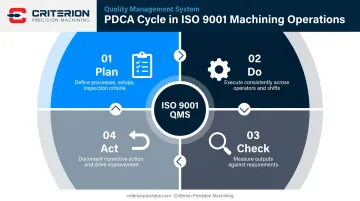
This isn't a philosophy exercise. PDCA structures how a certified shop approaches every production run.
What Third-Party Certification Actually Requires
Certification is not self-declared. An accredited registrar conducts an initial audit across all relevant shop functions, evaluates documented procedures against the standard's requirements, and issues a certificate only when the shop demonstrates full conformance.
Certification doesn't end at issuance. Per BSI and NQA guidance, ISO 9001 certificates are valid for three years, but the structure between initial audit and recertification matters:
- Surveillance audits — Conducted annually to verify ongoing conformance, not just at renewal
- Three-year recertification — A full re-audit of the QMS at the end of each cycle
- Risk-based thinking (Clause 6) — Shops must identify and address risks to quality before defects occur, not after
- Leadership accountability (Clause 5) — Quality performance is a formal leadership obligation, not a shop floor function alone
A certificate date tells buyers when the shop was last verified. Surveillance audit history tells them whether the QMS has stayed current.
What ISO 9001 Requires from a Machining Operation
Certification maps to specific clause requirements that translate directly into machining controls. Here's what the standard actually demands:
Process Documentation and Control
Clauses 4.4, 7.5, 8.1, and 8.5.1 require shops to define and document how parts are planned, set up, machined, and inspected. The intent is repeatability — results should be consistent across different operators and shifts, not dependent on one skilled machinist's memory.
For production buyers, this documented consistency is what separates a reliable supplier from one that gets lucky on the first run.
Material Traceability
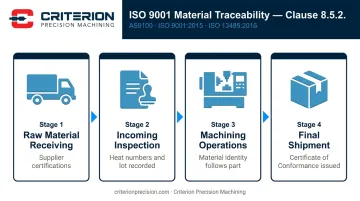
Clause 8.5.2 requires documented identification and traceability of materials from receiving through the finished part. In practice, this means:
- Raw materials arrive with supplier certifications
- Heat numbers and lot information are recorded at incoming inspection
- Material identity follows the part through every machining operation
- The finished part ships with a Certificate of Conformance referencing the original purchase order and material documentation
In regulated industries, this chain of custody is what makes traceability actionable — not a paper exercise, but a documented path back to the source material if a field failure ever demands it.
Calibration and Measurement System Integrity
Clause 7.1.5 requires that gauges, coordinate measuring machines, and other measurement equipment be calibrated on a defined schedule and verified for accuracy before use. Per NQA's guidance on this clause, the standard requires documented evidence that measurement resources are fit for purpose.
Inspection results are only defensible if the instruments generating them are traceable and calibrated. An uncalibrated CMM producing a passing report offers no real assurance — the measurement data is worthless without a verified reference standard behind it.
Nonconformance Handling
When a part or process falls outside specification, Clause 8.7 requires the shop to:
- Identify the nonconforming output
- Segregate it to prevent inadvertent use
- Document the nonconformance
- Initiate corrective action to prevent recurrence
This contrasts sharply with informal "fix and forget" approaches common in uncertified shops, where a verbal conversation replaces a documented investigation and there's no mechanism to confirm the fix actually held.
Continuous Improvement and Customer Feedback
Clauses 9.1.2 and 10.3 require certified shops to actively monitor customer satisfaction and feed that data into process reviews. A compliant QMS functions as a living operational system — complaints, delivery misses, and escape events should generate measurable improvement actions, not just apologies.
Why ISO 9001 Matters When Parts Cannot Fail
In aerospace, defense, medical device, and photonics manufacturing, component failure has consequences that extend well beyond scrap costs.
A surgical instrument that fails during a procedure, or a defense system component that doesn't perform to specification, creates outcomes that cannot be undone.
ISO 9001's controls are specifically designed to reduce the probability of a non-conforming part reaching the customer. The evidence supports this: a Harvard Business School study of nearly 1,000 California firms found ISO 9001 adopters had a 0.5% business failure rate versus 7.1% for matched non-adopters, and 9% higher sales growth — reflecting the operational discipline that certification imposes.
Run-to-Run Consistency for Repeat Production
A certified shop cannot rely on a single machinist's skill to reproduce tight-tolerance parts across a production run. Procedures govern every setup, tooling selection, and in-process checkpoint. When an operator changes shifts, the procedure doesn't change with them.
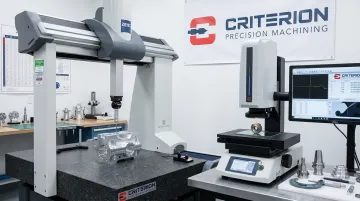
This is where documented process controls translate directly into buyer value. Shops like Criterion Precision Machining back this requirement with real inspection infrastructure — including a Global Advantage CMM with PC-DMIS software, the OASIS optical inspection system capable of measuring multiple dimensions simultaneously, and Keyence IM systems that can inspect up to 99 dimensions on up to 100 parts at once. These systems produce defensible, repeatable inspection records — not incidentally, but because the standard requires them.
Traceability as a Supplier Qualification Requirement
That documented evidence doesn't just satisfy internal audits — it satisfies prime contractors. Boeing contractually flows QMS standards including ISO 9001 and AS9100 to its supply chain. Lockheed Martin Aeronautics requires suppliers to maintain third-party certified AS/EN9100 QMS for covered programs.
Working with a non-certified shop doesn't just create risk for the parts — it creates audit exposure for the buyer's own quality system. If your supplier doesn't hold accredited certification, you cannot demonstrate adequate supplier qualification controls to your own customers or regulators.
ISO 9001 vs. ISO 13485: What the Difference Means for Medical Parts Buyers
ISO 13485:2016 is the medical device-specific QMS standard. It extends ISO 9001's framework with requirements aligned with FDA and EU MDR regulations — including more rigorous design controls, risk management requirements, and specific documentation for post-market surveillance.
| Feature | ISO 9001:2015 | ISO 13485:2016 |
|---|---|---|
| Scope | General QMS across industries | Medical device manufacturing for regulatory purposes |
| FDA recognition | Not a medical device regulatory QMS | FDA QMSR incorporates ISO 13485:2016 by reference |
| Risk management | Risk-based thinking required | Formal risk management per ISO 14971 |
| Design controls | General requirements | Specific medical device design control requirements |
| Global certificates (2023) | 837,978 | 32,963 |
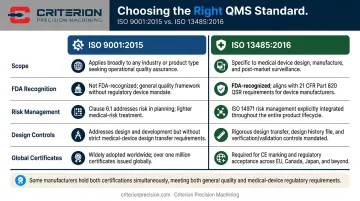
ISO 9001 alone is sufficient for commercial or industrial machined components. Medical device manufacturers sourcing implants, surgical instruments, or diagnostic components should require ISO 13485 — it confirms the QMS has been specifically validated for medical device regulatory requirements.
Criterion Precision Machining holds both ISO 9001:2015 and ISO 13485:2016, positioning the shop to serve buyers whose programs span regulated and non-regulated applications across medical device, aerospace, defense, and photonics manufacturing.
How to Evaluate Whether a Shop's ISO 9001 Certification Is Real
A certificate tells you a shop passed an audit. It doesn't tell you how recently, how rigorously, or whether the QMS is still functioning. Here's how to find out:
Ask About Recent Audit History
Ask when the most recent surveillance audit was conducted and whether any major nonconformances were identified. A shop with nothing to hide will answer directly.
Also ask which accredited registrar issued the certificate. Registrar accreditation is publicly verifiable through ANAB's directory of accredited certification bodies, so you're not taking anyone's word for it.
Ask How the Shop Handles Customer-Reported Nonconformances
The answer reveals whether the QMS is a working operational tool or a compliance document on a shelf. A certified shop should describe:
- Formal root cause analysis (not just "we fixed it")
- Documented corrective action with a defined resolution
- Verification that the fix actually worked
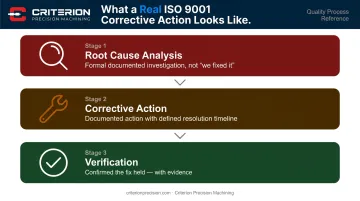
Shops that respond with informal phone calls and verbal assurances aren't operating the standard as intended. ISO 9001 requires documented corrective action — no exceptions.
Request a Sample Document
Ask for a sample inspection report or material certification for a part similar to your application. A genuinely certified shop produces this immediately, because generating it is standard operating procedure.
If a shop needs time to compile documentation for a sample request, consider what that documentation process looks like on an active production job.
Frequently Asked Questions
What does ISO 9001 certified machining mean?
It means the shop has been independently audited and verified to operate a Quality Management System meeting ISO 9001:2015 requirements — covering process documentation, material traceability, inspection controls, nonconformance handling, and continuous improvement. The certification covers the system behind the parts, not the parts themselves.
How much does it cost to get ISO 9001 certified for machining?
Costs depend on company size, registrar selected, and how much process development is needed before the first audit. Typical cost drivers include gap analysis, documentation, training, internal audits, and the two-stage certification audit, plus recurring surveillance audit fees. For specific figures, request quotes directly from accredited registrars.
How long does it take to become ISO 9001 certified for machining?
Timeline depends on the shop's starting point and organizational readiness. The path runs from gap analysis through QMS implementation, internal auditing, and a two-stage certification audit — most shops complete first certification within 6 to 18 months.
Are there changes to ISO 9001 coming in 2026?
Yes. ISO has published ISO/FDIS 9001 as edition 6, with publication expected in September 2026. Shops currently certified to ISO 9001:2015 should monitor ISO/TC 176/SC 2 communications for transition timelines and requirement changes. Until ISO formally publishes the new edition, ISO 9001:2015 remains the active standard.
Is ISO 9001 certification required for aerospace or medical device machining?
ISO 9001 is a common baseline in aerospace and defense, but many programs require AS9100D, which builds on ISO 9001:2015 with additional aviation, space, and defense requirements. Medical device machining typically requires ISO 13485 instead.
What is the difference between ISO 9001 and ISO 13485 in machining?
ISO 9001 is a general-purpose QMS standard applicable across industries. ISO 13485 is specific to medical device manufacturing and adds requirements for design controls, risk management per ISO 14971, and regulatory compliance with FDA and EU MDR. Machine shops serving both medical and non-medical regulated industries may hold both certifications simultaneously.