ISO 9001:2015 is the foundational quality management standard that governs how aerospace manufacturing suppliers document, control, and improve their processes. Understanding its requirements helps buyers identify genuine compliance gaps before they become costly problems — and helps suppliers close those gaps before a customer audit does it for them.
This article covers the core requirements of ISO 9001:2015, how they apply to precision aerospace machining, how the standard relates to AS9100, and what separates a truly capable certified supplier from one that's simply maintaining paperwork.
Key Takeaways
- ISO 9001:2015 is built on seven quality management principles, all directly applicable to aerospace manufacturing
- Mandatory requirements span Clauses 4–10, covering organizational context, leadership, planning, support, operations, performance evaluation, and improvement
- AS9100 Rev D builds on ISO 9001:2015 and adds aerospace-specific requirements: FOD control, counterfeit part management, and configuration management
- ISO 9001:2015 is often the minimum qualification threshold for sub-tier suppliers; direct OEM suppliers typically must hold AS9100
- A valid certificate isn't enough — also verify audit cadence, inspection depth, and ERP-backed traceability before qualifying a supplier
What Is ISO 9001:2015 and Why It Matters in Aerospace Manufacturing
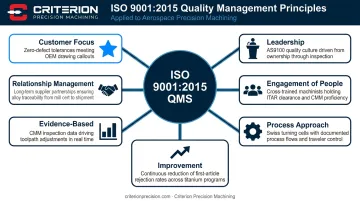
ISO 9001:2015 is the internationally recognized quality management system (QMS) standard published by the International Organization for Standardization. It rests on seven core quality management principles:
- Customer focus
- Leadership
- Engagement of people
- Process approach
- Improvement
- Evidence-based decision making
- Relationship management
These aren't abstract ideals. Each one maps directly to a discipline aerospace machining suppliers must practice daily — from maintaining calibrated measurement equipment (evidence-based decision making) to managing sub-tier supplier quality (relationship management).
Why Aerospace Demands a Formal QMS
Components produced for aviation, defense, and space operate under extreme conditions. A machined titanium fitting that's three thousandths of an inch out of tolerance doesn't just fail inspection — it can fail in service. That reality makes a systematized, auditable approach to quality non-negotiable.
ISO 9001:2015 wasn't written for aerospace alone — it applies across every industry. That breadth is exactly what makes it useful: its framework for process control, risk management, and documented quality evidence transfers directly to precision machining operations producing flight-critical hardware.
The 2015 Revision: What Changed
The 2015 update moved the standard away from prescriptive documentation checklists toward a results-focused, process-oriented approach. Three changes stand out for aerospace suppliers:
- Risk-based thinking replaced the 2008 version's separate preventive action requirement — risk consideration is now built into planning, operations, and improvement cycles
- Organizational context (Clause 4) requires suppliers to formally identify external factors like FAA regulations, ITAR obligations, and customer flow-down requirements
- Leadership accountability (Clause 5) puts QMS ownership on top management directly, not just the quality department
According to the ISO Survey 2024, there are over 1.47 million valid ISO 9001:2015 certificates covering more than 2.3 million certified sites worldwide. At that scale, certification isn't a differentiator — it's the floor. Aerospace customers treat it as the minimum entry point for any supplier conversation.
The Mandatory Requirements of ISO 9001:2015 Explained
ISO 9001:2015 follows a ten-clause structure. Clauses 1–3 cover scope, normative references, and definitions. The mandatory certification requirements live in Clauses 4 through 10.
Clauses 4–6: Context, Leadership, and Planning
Clause 4 (Organizational Context) requires organizations to define internal and external factors affecting quality objectives and identify what interested parties (customers, regulators, end users) expect. For aerospace suppliers, this means formally documenting customer flow-down requirements, applicable regulatory frameworks (FAA, ITAR, DFARS), and supply chain obligations before production begins.
Clause 5 (Leadership) puts QMS accountability on top management directly. Quality can't be fully delegated to a quality manager and ignored by ownership. Leadership must establish the quality policy, set objectives, and ensure the QMS gets the resources it needs.
Clause 6 (Planning) formalizes risk-based thinking. Organizations must identify risks and opportunities across their processes and build responses into planning before problems occur, not in response to them.
Clauses 7–8: Support and Operations
This is the operational core of the standard and where aerospace machining requirements become most specific.
Clause 7 (Support) covers:
- Competent, trained personnel
- Calibrated measurement equipment with documented calibration records
- Controlled infrastructure and production environments
- Documented information (work instructions, records, procedures)
- Customer and internal communication processes
Clause 8 (Operation) governs how products are actually made. For precision machined aerospace parts, this includes:
- Documented work instructions tied to each operation
- In-process inspection checkpoints at defined stages
- Material traceability from raw stock through finished part
- Control of externally provided processes and materials
- Formal disposition of nonconforming outputs (scrap, rework, or customer concession) with documented root cause analysis
In aerospace specifically, that last point carries extra weight: a single failure mode can affect an entire production lot, making documented corrective action essential rather than procedural.
Clauses 9–10: Performance Evaluation and Improvement
Clause 9 (Performance Evaluation) requires organizations to monitor KPIs, conduct internal audits on a defined schedule, and perform management reviews that feed real data (not just assurances) into decision-making.
Clause 10 (Improvement) mandates that nonconformances trigger documented corrective actions and that continual improvement is demonstrated with measurable outcomes — not simply declared in a policy statement.
ISO 9001:2015 vs. AS9100: Key Differences Aerospace Manufacturers Should Understand
The Relationship Between the Two Standards
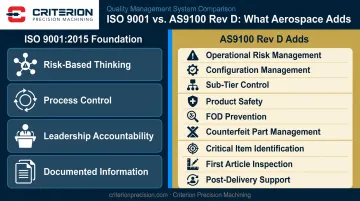
AS9100 Rev D (9100:2016), published by SAE International and developed by the International Aerospace Quality Group (IAQG), fully incorporates all ISO 9001:2015 requirements and layers aviation, space, and defense-specific requirements on top.
ISO 9001 is a prerequisite — not an equivalent. You cannot hold AS9100 without satisfying every ISO 9001:2015 requirement first.
The IAQG identifies several significant additions AS9100 makes over the ISO 9001 baseline:
- Operational risk management — more structured than ISO 9001's risk-based thinking
- Configuration management — controlling product definition and change across the lifecycle
- Control of externally provided processes — stricter requirements for sub-tier suppliers and special processes
- Product safety — explicit requirements for safety-critical characteristics
- Foreign object debris (FOD) prevention and control
- Counterfeit part management
- Critical item and key characteristic identification
- First article inspection (FAI) requirements
- Post-delivery support obligations
When ISO 9001 Is Sufficient vs. When AS9100 Is Required
Understanding which standard applies isn't about tier level alone — it depends on what your customer requires.
| Supplier Type | Typical Requirement |
|---|---|
| Direct OEM supplier | AS9100 required |
| Prime contractor sub-tier (structural, flight-critical) | AS9100 typically required |
| Sub-tier producing standard precision components | ISO 9001:2015 may satisfy requirements |
| COTS hardware or ground support equipment | ISO 9001:2015 may be acceptable |
Lockheed Martin's Appendix QX (Rev 10, 2023) requires third-party AS/EN9100 certification for most product categories, with ISO 9001 acceptable only for specific COTS or ground support equipment suppliers. Your customer's flow-down requirements are the real governing document — always check them rather than assuming tier level automatically determines what's needed.
Verifying AS9100 Certification
Don't accept a certificate at face value. The OASIS database maintained by IAQG is the authoritative tool for verifying an aerospace supplier's AS9100 certification status, suspension history, and audit outcomes.
Boeing specifically requires that AS9100 certifications come from an ANAB-accredited registrar and that the supplier appears in OASIS — a certificate alone is not sufficient.
How ISO 9001:2015 Requirements Play Out on the Aerospace Machine Shop Floor
The Clause 8 requirements for operational planning and control look straightforward in the standard text. In practice, they translate into specific, verifiable shop-floor disciplines.
Traceability in Precision Aerospace Machining
Every dimension, material lot, revision level, and inspection result must be captured and retrievable. That requirement isn't met by paper travelers alone. Modern ERP systems integrated with quality modules fulfill this requirement by creating a digital audit trail from order intake through final delivery.
At Criterion Precision Machining, ProShop ERP serves as the integrated ERP/MES/QMS backbone: it tracks every operation, tool, and measurement across the production lifecycle. The system connects quoting, scheduling, job tracking, and quality documentation under a single platform.
That means material certifications, inspection records, and revision levels are linked to specific production orders — not maintained in disconnected files. ISO 9001:2015 Clause 8 requires documented information sufficient to demonstrate product conformity and enable traceability; a unified architecture makes that requirement auditable, not just achievable.
Inspection Depth Matters
ISO 9001:2015 requires calibrated measurement equipment and documented inspection records. For aerospace-grade precision machining, that requirement has real depth:
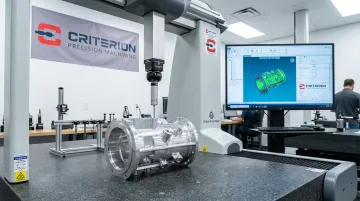
- CMM systems with inspection software (such as PC-DMIS) for dimensional verification of complex geometries
- Optical inspection systems capable of measuring multiple dimensions simultaneously, reducing measurement cycle time without sacrificing accuracy
- SPC software for identifying process drift before parts go out of tolerance
- First article inspection packages documenting full dimensional and material compliance against drawing requirements
Criterion's quality infrastructure — including a Global Advantage CMM with PC-DMIS software and Keyence measuring systems capable of measuring up to 99 dimensions simultaneously — represents the kind of inspection depth that translates ISO 9001:2015's calibration and documented information requirements into practical, verifiable quality evidence.
Nonconforming Output Control
When a machined part falls outside tolerance, ISO 9001:2015 requires a documented disposition path. The three options are scrap, rework, or customer concession (use-as-is authorization). Each requires documentation. Customer concession also requires customer approval before the part ships.
The standard also requires root cause analysis and corrective action to prevent recurrence. In aerospace machining, that means the same failure mode cannot repeat across production runs unchecked. The corrective action record becomes part of the quality evidence that auditors and aerospace buyers review during supplier qualification.
Risk-Based Thinking and Continuous Improvement in Aerospace QMS
From Preventive Action to Risk-Based Thinking
The 2008 version of ISO 9001 required a separate preventive action procedure. The 2015 revision dissolved that into something more systemic: risk-based thinking embedded across every planning and operational decision. As ISO/TC 176 guidance describes it, risk consideration is now inherent in the system rather than bolted on as a standalone requirement.
For aerospace machining operations, risks that must be formally identified and addressed include:
- Material substitutions or supplier changes that could affect mechanical properties
- Process parameter drift from equipment wear or environmental changes
- Equipment maintenance gaps that create calibration or capability uncertainty
- Revision control failures that allow outdated drawings to reach the shop floor
Continual Improvement as a Formal Discipline
Continual improvement under ISO 9001:2015 is not an annual initiative. It's an ongoing cycle fed by multiple data inputs that feed into documented improvement actions with measurable outcomes.
Standard inputs for this cycle include:
- Internal audit findings and nonconformance trends
- Management review data and customer feedback
- Supplier performance and process capability metrics
LNS Research data shows that while 73% of manufacturers had implemented or planned formal process improvement programs, benchmarking activity remains limited. Many organizations run improvement programs without external reference points — so progress is measured against internal baselines only, not industry performance.
Aerospace OEMs consistently favor suppliers who use quality data to drive operational decisions. For contract machinists, that means closing the loop on audit findings and nonconformance trends rather than filing them away — something Criterion Precision Machining builds into its AS9100-aligned quality system as a matter of standard practice.
What to Look for in an ISO 9001-Certified Aerospace Precision Machining Partner
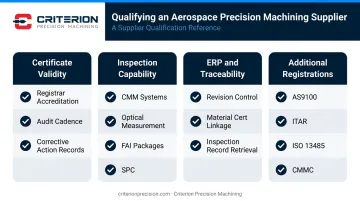
A valid ISO 9001:2015 certificate is the starting point — not the finish line. Here's what to verify beyond the certificate itself.
Certificate Validity and Audit Activity
- Confirm the certificate is current and issued by an accredited registrar
- Ask about the internal audit cadence — active QMS organizations audit regularly, not just before external audits
- Request evidence of documented corrective action records — a supplier with no corrective action history either has perfect processes (unlikely) or isn't tracking problems (a red flag)
Inspection Capability
ISO 9001:2015 requires calibrated measurement equipment and documented inspection records. Aerospace precision machining demands more than a basic inspection bench:
- CMM systems with software capable of measuring complex 3D geometries
- Optical or vision-based measurement for high-throughput dimensional verification
- Documented FAI packages that demonstrate full compliance with drawing requirements before production quantities ship
- SPC capability for monitoring process stability over time
ERP and Traceability Integration
Ask suppliers specifically how their ERP or quality management system handles:
- Drawing revision control and change propagation to open orders
- Material certification capture and linkage to specific job orders
- Inspection record retention and retrieval by part number and lot
Additional Registrations
Suppliers who also hold ITAR registration, FDA registration, or CMMC certification signal experience with the documentation rigor and regulatory accountability that aerospace programs demand. These aren't incidental credentials — they reflect a quality culture built well beyond the ISO 9001:2015 baseline.
Criterion Precision Machining holds ISO 9001:2015 and AS9100 certifications (issued through Smithers Quality Assessments), along with ISO 13485:2016, ITAR registration, and FDA registration. That combination directly mirrors the multi-regulatory environment its aerospace, defense, and medical device customers operate in.
Frequently Asked Questions
What is the aerospace version of ISO 9001?
AS9100 (Rev D / 9100:2016) is the aerospace industry's extension of ISO 9001:2015, developed by the IAQG and published by SAE International. It incorporates all ISO 9001 requirements and adds aviation, space, and defense-specific requirements including critical item management, FOD control, counterfeit part management, and configuration management. AS9100 is maintained by IAQG, not ISO.
What are the mandatory requirements of ISO 9001:2015?
Clauses 4 through 10 contain all mandatory requirements: organizational context, leadership, planning, support, operations, performance evaluation, and improvement. The standard requires documented processes, risk-based thinking, and evidence of continual improvement, not a fixed set of rigid procedures.
What is the difference between ISO 9001 and AS9100?
ISO 9001:2015 is a general quality management standard applicable across all industries. AS9100 builds entirely on ISO 9001 and adds aerospace-specific requirements for product safety, FOD prevention, and configuration management. Both standards share the same clause structure, with AS9100 adding the aerospace layer on top.
Do aerospace suppliers need AS9100, or is ISO 9001 enough?
It depends on the customer and tier level. Direct OEM suppliers and prime contractor-level organizations typically must hold AS9100. Sub-tier precision machining suppliers may satisfy customer requirements with ISO 9001:2015. Customer flow-down documentation is the governing authority — always verify requirements against the specific purchase order or supplier quality requirements document.
How does ISO 9001:2015 support traceability in aerospace machining?
Clause 8 requires documented information to maintain traceability of products throughout production, meaning every part must be linkable to its material lot, revision level, inspection records, and process parameters. ERP systems integrated with quality modules make this practical to maintain at production scale, particularly for shops running small-batch to mid-volume mission-critical work.
How often must an ISO 9001:2015 certification be renewed?
ISO 9001:2015 certification is valid for three years, with surveillance audits conducted annually during that period to verify ongoing compliance. At the end of the three-year cycle, a full recertification audit is required to maintain certified status.